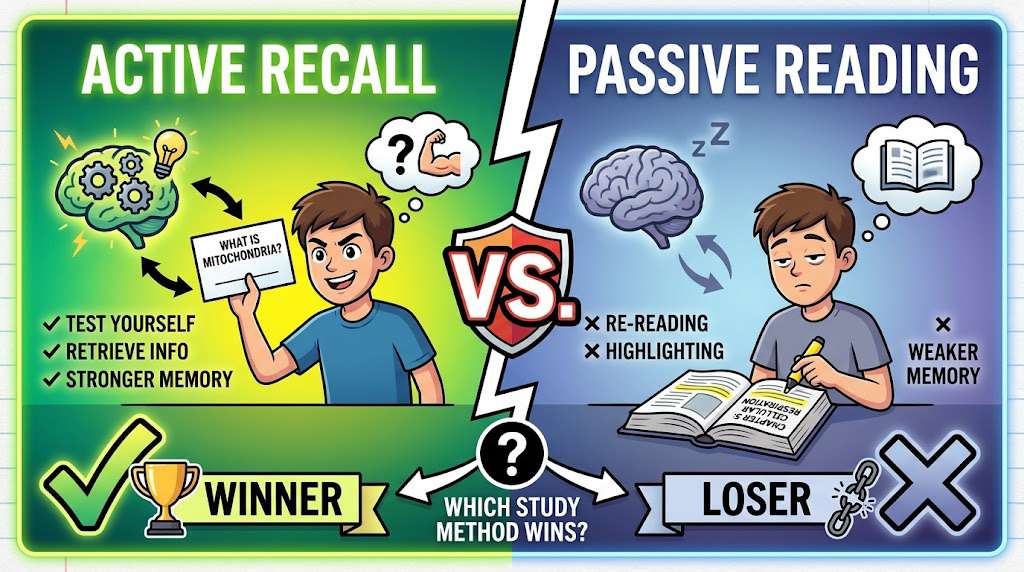
Active Recall vs. Passive Reading: Which Study Method Wins?
Introduction
Picture two students preparing for the same Biology examination. The first spends three hours reading and re-reading her textbook chapter on the nervous system, highlighting sentences in yellow as she goes. The second spends the same three hours closing her textbook after one read-through, then trying to explain the nervous system out loud from memory, checking her notes only when she gets stuck.
Both students feel they have studied for three hours. Both may even feel equally confident afterward. But research on learning and memory consistently shows that the second student will remember far more, for far longer, and will perform noticeably better in the actual examination.
The difference between these two students is the difference between passive reading and active recall — and understanding this difference may be one of the most valuable things you learn before your next set of examinations.
What Is Passive Reading?
Passive reading is the process of reading through notes or a textbook without actively testing whether the information has actually been absorbed. It includes:
- Reading a chapter from start to finish.
- Highlighting or underlining key sentences.
- Re-reading notes the night before a test.
- Copying notes word-for-word without processing them.
Passive reading feels productive. The words are familiar by the third or fourth read-through, and this familiarity creates a comforting illusion: the feeling that you know the material. Psychologists call this the illusion of fluency — mistaking the ease of recognizing information for the ability to actually recall and use it.
What Is Active Recall?
Active recall is the practice of deliberately retrieving information from memory, rather than simply looking at it again. Instead of asking "does this look familiar?", active recall forces you to ask "can I actually produce this information myself, without looking?"
Examples of active recall include:
- Closing your book and writing down everything you remember about a topic.
- Answering flashcard questions without peeking at the answer first.
- Explaining a concept out loud as if teaching someone else.
- Attempting past questions before checking the marking scheme.
- Covering your notes and trying to reconstruct a diagram from memory.
Active recall feels harder than passive reading — and that difficulty is exactly the point. The mental effort of retrieving information is what strengthens memory.
The Science Behind Why Active Recall Works Better
This is not simply a matter of opinion or study habit preference. Decades of research in cognitive psychology support active recall as the more effective method.
The Testing Effect
One of the most well-established findings in learning science is the testing effect: the act of retrieving information from memory — even without any feedback — strengthens that memory more than simply reviewing the same information again.
In classic studies, students who studied material once and then tested themselves repeatedly performed significantly better on delayed exams than students who spent the same total time re-reading the material multiple times, even though the re-reading group often felt more confident beforehand.
Retrieval Strengthens the Memory Pathway
Every time you successfully retrieve a piece of information from memory, the neural pathway to that information is reinforced. Passive reading strengthens recognition — the ability to identify information when you see it again. Active recall strengthens retrieval — the ability to produce information when you need it, with nothing in front of you. Examinations almost always demand retrieval, not recognition.
Desirable Difficulty
Psychologists use the term desirable difficulty to describe learning strategies that feel harder in the moment but produce stronger long-term retention. Active recall is uncomfortable precisely because it exposes gaps in your knowledge immediately — gaps that passive reading conveniently hides until the exam itself reveals them.
Why Passive Reading Feels More Comfortable
If active recall is so much more effective, why do so many students still prefer passive reading? The answer lies in how each method feels while you are doing it.
- Passive reading produces no immediate failure — you never discover what you don't know until later.
- It requires less mental effort in the moment, making it feel less exhausting.
- It creates a false sense of progress through familiarity with the words on the page.
- It is easier to do while distracted or tired, since it demands less active engagement.
Active recall, by contrast, immediately confronts you with what you cannot yet remember. This can feel discouraging in the short term — but that discouragement is actually useful information, showing you exactly where more work is needed before the real exam does.
How to Practice Active Recall: Practical Techniques
1. The Blank Page Method
After studying a topic, close your book and take a blank sheet of paper. Write down everything you can remember about the topic — definitions, diagrams, examples, formulas. Only after you have exhausted your memory should you check your notes to see what you missed.
2. Flashcards Done Properly
Flashcards are only effective as active recall if used correctly. Read the question side, attempt a full answer in your mind or out loud, and only then flip the card to check. Flipping immediately without attempting an answer turns flashcards into passive reading in disguise.
3. The "Teach It" Technique
Explain a topic out loud as though you were teaching it to a younger student who has never encountered it before. If you find yourself pausing, stumbling, or unable to explain a step clearly, that is exactly the part of the topic you need to revisit.
4. Practice Questions Before Notes
Rather than reviewing your notes and then attempting past questions, try reversing the order occasionally: attempt the past question first, using only what you already remember, and check your notes afterward to fill in the gaps. This reveals your true starting knowledge far more honestly.
5. The Cover-and-Recall Method for Diagrams
For subjects like Biology, Chemistry, and Geography that rely heavily on diagrams, look carefully at a labelled diagram, then cover it completely and try to redraw and label it from memory. Compare your version to the original and note exactly where you went wrong.
6. Spaced Retrieval
Combine active recall with spacing: test yourself on a topic, then test yourself again after a day, then after three days, then after a week. Each successful retrieval after a longer gap strengthens the memory more powerfully than retrieving it again immediately.
Does This Mean Reading Is Useless?
Not at all. Reading remains essential — you cannot actively recall information you have never encountered in the first place. The key is understanding the role each method should play:
- Reading is best used for the first encounter with new material — to build initial understanding.
- Active recall should follow shortly after — to lock that understanding into memory and reveal any gaps.
A useful ratio to aim for is spending roughly a third of your study time on initial reading or learning, and two-thirds on actively testing yourself on what you just learned. Most students do the exact opposite, spending the vast majority of their time reading and almost none testing themselves.
A Simple Study Session Using Both Methods
Here is what an effective session might look like in practice:
- Read through one topic in your textbook or notes (10–15 minutes).
- Close the material and write down everything you remember (10 minutes).
- Check your notes and highlight only what you missed or got wrong (5 minutes).
- Attempt two or three past questions on that topic without referring back (15 minutes).
- Mark your answers and note any recurring gaps for future review (5 minutes).
This structure ensures that most of your session is spent retrieving information, not simply re-encountering it.
Common Mistakes When Trying Active Recall
- Checking the answer too quickly. Give yourself a genuine attempt before looking, even if it feels uncomfortable.
- Only recalling easy topics. It is tempting to keep testing yourself on what you already know well. Prioritize the topics you find difficult.
- Confusing recognition with recall. Multiple-choice self-testing can sometimes measure recognition rather than true recall. Where possible, test yourself with open-ended questions instead.
- Giving up after one failed attempt. Struggling to recall something and then finding the correct answer is itself a powerful learning event — do not skip past it too quickly.
- Doing it only once. A single round of active recall helps, but spaced repetition across several days produces far stronger long-term retention.
Why This Matters for WAEC, JAMB, and NECO
These examinations are, fundamentally, retrieval tasks. In the examination hall, there is no textbook to glance at, no highlighted notes to skim. You must produce answers entirely from memory, often under significant time pressure.
A student who has only ever practiced recognizing information in a textbook is being asked, on examination day, to perform a skill they have never actually trained. A student who has practiced active recall throughout their revision has been rehearsing the exact skill the examination demands, over and over, long before the exam ever begins.
Conclusion
Passive reading feels comfortable, familiar, and productive — but comfort is not the same as learning. Active recall feels harder, sometimes frustrating, and occasionally humbling as it reveals exactly what you do not yet know. That discomfort is not a sign that something is wrong; it is the sign that real learning is taking place.
The next time you sit down to study, resist the urge to simply read your notes one more time. Close the book. Test yourself. Struggle a little. Check what you missed. That single change in approach — retrieving instead of merely reviewing — is one of the most powerful, evidence-backed study upgrades available to any student preparing for WAEC, JAMB, or NECO.