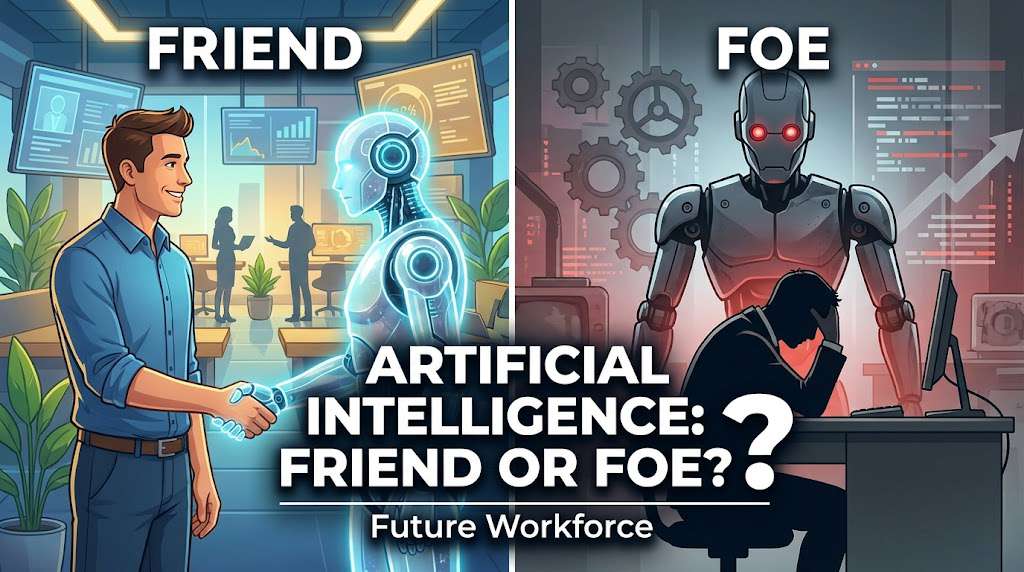
Artificial Intelligence: Friend or Foe for the Future Workforce?
Introduction
Not long ago, artificial intelligence existed primarily in the realm of science fiction — the domain of robots, space exploration films, and futuristic novels. Today, AI is woven into the fabric of everyday life. It recommends the next video you watch, filters your email inbox, powers the voice assistants on your smartphone, and helps doctors detect diseases with remarkable accuracy.
But as artificial intelligence becomes increasingly sophisticated, a pressing and uncomfortable question has moved to the centre of public debate: what does AI mean for the future of human work? Will it create exciting new opportunities, or will it render millions of jobs obsolete? Is artificial intelligence humanity's greatest ally — or its most formidable competitor?
For young people preparing to enter the workforce, these are not abstract questions. They are urgent and deeply personal. This article explores what artificial intelligence is, how it is already changing the world of work, and what today's students can do to thrive in an AI-powered future.
What Is Artificial Intelligence?
Artificial intelligence refers to the ability of computer systems to perform tasks that would normally require human intelligence. These tasks include:
- Understanding and generating language.
- Recognising images, faces, and patterns.
- Making decisions based on data.
- Learning from experience and improving over time.
- Solving complex problems and performing calculations at extraordinary speed.
Modern AI systems are powered by a technology called machine learning, in which computers are trained on vast quantities of data and learn to identify patterns and make predictions without being explicitly programmed for every scenario.
Recent advances — particularly in a field known as generative AI — have produced tools capable of writing essays, generating images, composing music, writing computer code, and holding convincing conversations with human beings. Tools such as ChatGPT, Google Gemini, and image generators like DALL-E have demonstrated capabilities that would have seemed extraordinary just a decade ago.
How AI Is Already Changing the Workplace
Artificial intelligence is not a future threat — it is already transforming industries around the world. Its impact is being felt across a remarkably wide range of sectors.
Manufacturing and logistics. Automated systems and robots powered by AI are performing tasks in factories and warehouses that were previously carried out by human workers — assembling products, sorting packages, and managing inventory with speed and precision that far exceeds human capability.
Healthcare. AI systems are being used to analyse medical scans, identify early signs of cancer, assist in surgical procedures, and predict patient outcomes. In some areas, AI diagnostic tools have been shown to match or even surpass the accuracy of experienced human doctors.
Finance. Banks and financial institutions use AI to detect fraudulent transactions, assess credit risk, manage investment portfolios, and provide customer service through automated chatbots — tasks that once required large teams of human employees.
Creative industries. Perhaps most surprisingly, AI is making significant inroads into fields once considered uniquely human. AI tools can now generate written content, design graphics, compose music, and produce realistic images — raising profound questions about the future of creative professions.
Education. AI-powered platforms are providing personalised learning experiences, automating the marking of certain types of assessments, and supporting teachers with administrative tasks — freeing up more time for meaningful human interaction in the classroom.
The Case for AI as Friend
Optimists argue that fears about AI and unemployment are overstated, and that history supports their confidence. Previous waves of technological change — from the Industrial Revolution to the rise of computers and the internet — displaced certain types of work while creating new industries, new roles, and new opportunities that could not have been anticipated beforehand.
They point to several reasons for optimism about AI's impact on the workforce:
AI creates new jobs. The development, maintenance, and regulation of AI systems requires large numbers of skilled workers — data scientists, AI engineers, ethicists, cybersecurity specialists, and many others. Entirely new industries and job categories are emerging around AI technology.
AI augments human capability. Rather than replacing human workers entirely, AI often works alongside them — handling repetitive or data-intensive tasks while freeing human workers to focus on the aspects of their roles that require creativity, empathy, judgement, and interpersonal skill. A doctor assisted by an AI diagnostic tool can see more patients and make better-informed decisions. A journalist with access to AI research tools can produce more thoroughly researched articles.
AI can eliminate dangerous and unpleasant work. Many of the jobs most susceptible to automation are those that are physically dangerous, repetitive, or deeply unpleasant. If AI and robots can take on these roles, human workers may be freed to pursue more fulfilling and meaningful careers.
The Case for AI as Foe
Critics of unchecked AI development, however, raise serious and legitimate concerns that deserve careful consideration.
Job displacement is real and significant. While AI may create new jobs in the long term, the transition could be deeply painful for workers whose roles are automated. Unlike previous technological revolutions, AI's impact may be faster and broader, affecting not just manual labour but highly skilled professional roles in law, medicine, finance, and the creative industries.
The benefits of AI may not be equally shared. The economic gains from AI are likely to flow primarily to the technology companies and investors who own and develop these systems, potentially widening the gap between the wealthy and the rest of society. Workers in lower-income countries, who often perform the types of routine tasks most susceptible to automation, may be disproportionately affected.
AI raises profound ethical questions. Who is responsible when an AI system makes a harmful decision? How do we prevent AI from perpetuating the biases present in the data it is trained on? How do we ensure that AI is developed and deployed in ways that serve humanity as a whole, rather than a privileged few? These are questions that societies and governments are only beginning to grapple with.
What Skills Will Young People Need?
Whatever the future holds, it is clear that the skills required to thrive in an AI-powered workforce will differ significantly from those valued in previous generations. Experts consistently highlight several key areas:
- Critical thinking and problem-solving. The ability to analyse complex situations, evaluate evidence, and devise creative solutions is something AI cannot yet replicate effectively.
- Emotional intelligence and interpersonal skills. Empathy, communication, leadership, and the ability to collaborate with others remain distinctly human strengths that AI cannot replace.
- Digital literacy. Understanding how AI and digital systems work — even at a basic level — will be essential for navigating the modern workplace.
- Adaptability and lifelong learning. In a rapidly changing world, the willingness and ability to continuously learn new skills will be more valuable than any single qualification.
- Creativity. Original thinking, artistic expression, and the ability to generate genuinely novel ideas remain areas where human beings hold a significant advantage over machines.
Conclusion
Artificial intelligence is neither a simple friend nor a straightforward foe. It is a powerful and complex technology that carries enormous potential for good alongside genuine risks that must be carefully managed. The future it creates will depend not on the technology itself, but on the choices made by governments, businesses, educators, and individuals about how it is developed, regulated, and deployed.
For young people, the most important response to the rise of AI is not fear — it is preparation. By cultivating the skills, values, and adaptability that machines cannot replicate, today's students can position themselves not merely to survive in an AI-powered world, but to shape it.
The future of work belongs to those who are willing to learn, to adapt, and to bring their full humanity to whatever challenges lie ahead. Artificial intelligence may be extraordinarily capable — but it is human beings who will decide what kind of future we build with it.