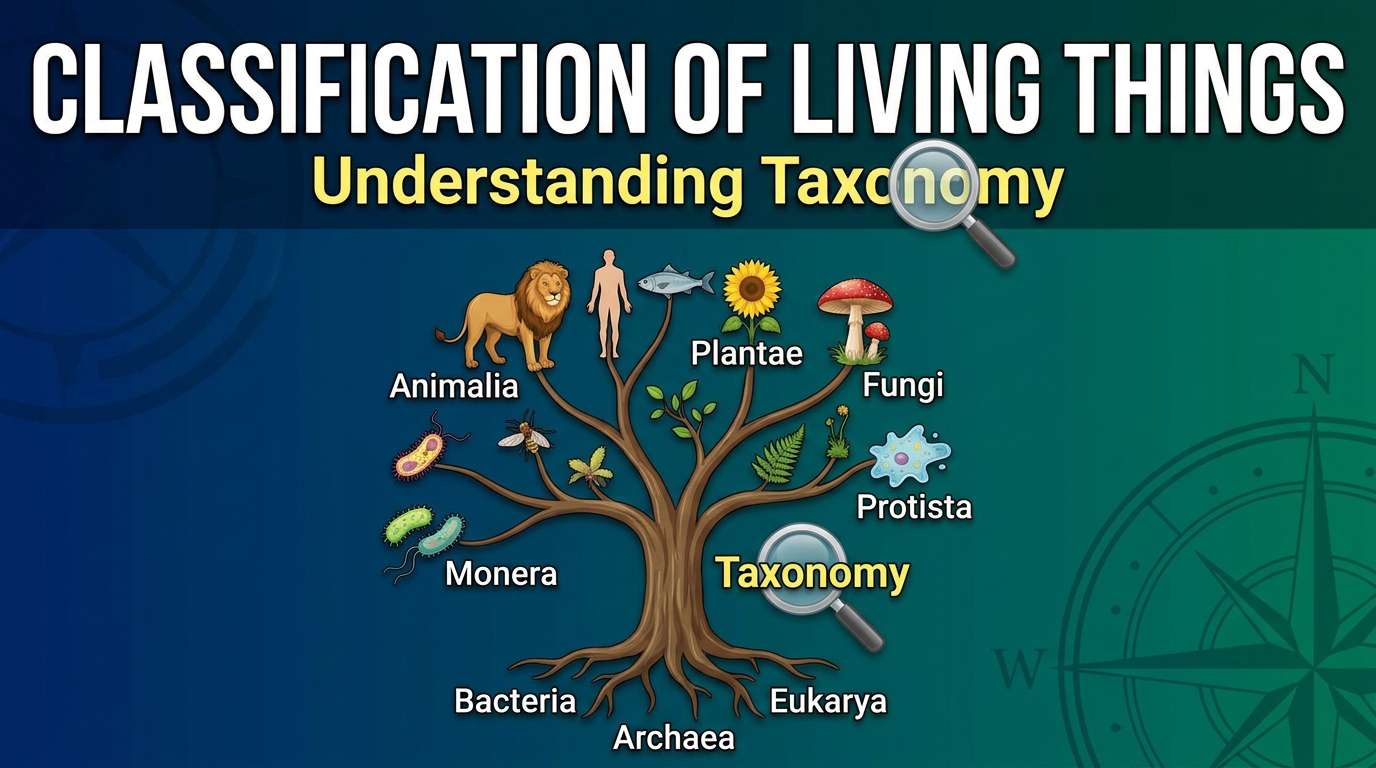
Classification of Living Things: Understanding Taxonomy
Introduction
Scientists estimate that there are somewhere between eight and ten million distinct species of living organisms on Earth, and that figure only accounts for species that have already been identified and studied — countless more likely remain undiscovered, particularly among insects, fungi, and microorganisms. Faced with this staggering diversity, biologists long ago recognized the need for a systematic way to organize, name, and study living things — a science known as taxonomy, or biological classification.
Without classification, biology would be an unmanageable list of unrelated facts about millions of unconnected species. With it, biologists can identify patterns, trace evolutionary relationships, predict characteristics of newly discovered organisms based on their relatives, and communicate about specific species with total precision, regardless of language or location. This article explores how living things are classified, the major groups of life, and why this system matters far beyond simply memorizing a hierarchy.
Why Classification Matters
Biological classification serves several important purposes:
- It organizes the enormous diversity of living things into a manageable, logical system.
- It reflects evolutionary relationships, grouping together organisms that share a common ancestor.
- It allows scientists worldwide to refer to the same organism using a single, universally understood name, avoiding confusion caused by different common names in different languages or regions.
- It helps predict characteristics of a newly studied organism based on its similarity to already well-understood relatives.
The Taxonomic Hierarchy
Modern biological classification arranges living things into a nested hierarchy of groups, from the broadest, most inclusive category down to the most specific. Each level of this hierarchy is called a taxonomic rank, and moving down the hierarchy, each rank contains organisms that are progressively more similar to one another.
The standard taxonomic ranks, from broadest to most specific, are:
- Kingdom
- Phylum
- Class
- Order
- Family
- Genus
- Species
Many students find it helpful to remember this sequence using a mnemonic sentence such as "King Phillip Came Over For Good Soup," where the first letter of each word matches the first letter of each taxonomic rank in order.
Worked Example: Classifying Humans
The full classification of modern humans illustrates how this hierarchy works in practice:
- Kingdom: Animalia (animals)
- Phylum: Chordata (organisms with a nerve cord along their back)
- Class: Mammalia (mammals)
- Order: Primates
- Family: Hominidae
- Genus: Homo
- Species: Homo sapiens
Notice how each level narrows the group further: many different kinds of organisms belong to the Animal Kingdom, fewer belong to the Chordata phylum within it, fewer still to the Mammalia class, and so on, until finally arriving at Homo sapiens — a single, specific species.
The Species: The Basic Unit of Classification
A species is generally defined as a group of organisms that share similar characteristics and are capable of interbreeding with one another to produce fertile offspring. This ability to interbreed and produce fertile offspring is often used as the key test distinguishing separate species — for example, a horse and a donkey can interbreed to produce a mule, but mules are typically infertile, which is one reason horses and donkeys are still classified as separate species rather than the same one.
Binomial Nomenclature: The Two-Name System
To avoid the confusion of relying on common names — which vary between languages, regions, and even different local communities within the same country — biologists use a standardized naming system developed by the Swedish botanist Carl Linnaeus in the eighteenth century, called binomial nomenclature.
Under this system, every species is given a scientific name consisting of exactly two parts:
- The genus name, written first, with a capital letter.
- The species name, written second, in lowercase.
Both parts of the name are conventionally written in italics (or underlined if handwritten) — for example, Homo sapiens for modern humans, or Mangifera indica for the mango tree. This two-part naming system allows any scientist anywhere in the world, regardless of their native language, to know with certainty exactly which organism is being discussed.
The Major Kingdoms of Life
While classification systems have evolved and become more detailed as scientific understanding has advanced, a widely taught framework divides living organisms into five major kingdoms.
Kingdom Animalia (Animals)
Multicellular organisms that cannot make their own food and must obtain energy by consuming other organisms. Animal cells lack cell walls and chloroplasts. This kingdom includes an enormous range of organisms, from simple sponges to complex vertebrates such as humans.
Kingdom Plantae (Plants)
Multicellular organisms capable of photosynthesis, containing chloroplasts and surrounded by a rigid cell wall made of cellulose, as discussed in the article on cell structure. This kingdom includes mosses, ferns, flowering plants, and trees.
Kingdom Fungi
Organisms including moulds, yeasts, and mushrooms, which obtain nutrients by absorbing organic material from their surroundings, often by decomposing dead organic matter. Fungal cells have cell walls, but made of a substance called chitin rather than the cellulose found in plant cell walls, and fungi lack chloroplasts entirely.
Kingdom Protista
A diverse kingdom of mostly single-celled eukaryotic organisms that do not fit neatly into the animal, plant, or fungi kingdoms. Examples include amoeba and the malaria-causing organism Plasmodium.
Kingdom Monera (Bacteria)
Single-celled prokaryotic organisms, lacking a true nucleus and most membrane-bound organelles, as discussed in the article on cell structure. Despite their simplicity, bacteria are found in nearly every environment on Earth and play essential roles, including as decomposers within ecosystems.
Some more modern classification systems separate bacteria further into two distinct kingdoms or domains (Bacteria and Archaea), and viruses are generally considered separately still, since they display some but not all of the characteristics typically used to define living organisms.
Characteristics Used to Classify Organisms
Biologists use a range of observable and measurable characteristics to determine how organisms should be classified and grouped, including:
- Cell structure, such as the presence or absence of a nucleus, cell wall, or chloroplasts.
- Mode of nutrition, such as whether an organism photosynthesizes, absorbs nutrients, or actively consumes other organisms.
- Body structure and symmetry, including the presence of a backbone, limbs, or specific body segments.
- Method of reproduction.
- Genetic and molecular similarities, increasingly used in modern classification alongside physical characteristics, comparing DNA sequences directly between organisms.
Classifying Animals Further: Vertebrates and Invertebrates
Within the animal kingdom, one particularly important distinction, frequently examined, separates animals into two broad groups:
- Vertebrates: Animals with a backbone (vertebral column), including fish, amphibians, reptiles, birds, and mammals.
- Invertebrates: Animals without a backbone, including insects, worms, molluscs, and a wide range of other organisms — in fact, the vast majority of all known animal species are invertebrates.
The Five Classes of Vertebrates
- Fish: Aquatic vertebrates, typically breathing through gills and covered in scales.
- Amphibians: Vertebrates capable of living both in water and on land, typically with moist, permeable skin (e.g. frogs).
- Reptiles: Vertebrates with dry, scaly skin, typically laying eggs on land (e.g. lizards, snakes, crocodiles).
- Birds: Vertebrates covered in feathers, most capable of flight, and laying hard-shelled eggs.
- Mammals: Vertebrates typically covered in hair or fur, usually giving birth to live young, and feeding their young with milk produced by mammary glands.
Dichotomous Keys
A dichotomous key is a practical tool used to identify an unknown organism by working through a series of paired statements, each offering two contrasting options based on observable characteristics. At each step, choosing the option that matches the organism being examined leads either to its correct identification or to a further pair of options, gradually narrowing down the possibilities until the specific organism is identified.
Classification and WAEC/NECO/JAMB Biology
Key examinable areas of this topic include:
- The taxonomic hierarchy, in correct order, from kingdom down to species.
- Binomial nomenclature and its purpose, including correct formatting of scientific names.
- Characteristics of the five kingdoms of life, and how organisms are assigned to each.
- Differences between vertebrates and invertebrates, and the five classes of vertebrates.
- Using and interpreting dichotomous keys to identify unfamiliar organisms.
- The biological definition of a species, particularly the concept of interbreeding to produce fertile offspring.
Common Mistakes Students Make
- Writing scientific names incorrectly, such as forgetting to capitalize the genus name, capitalizing the species name, or failing to italicize or underline the full name.
- Reversing the order of the taxonomic hierarchy, particularly confusing which rank is broader (kingdom) and which is narrowest (species).
- Assuming all single-celled organisms belong to the same kingdom. Both Protista and Monera contain single-celled organisms, but they differ fundamentally in cell structure (eukaryotic versus prokaryotic).
- Confusing fungi with plants, since both may appear stationary and plant-like — but fungi lack chloroplasts entirely and cannot photosynthesize, unlike true plants.
- Assuming the ability to produce any offspring together means two organisms belong to the same species. The offspring must also be fertile for this to generally apply, as illustrated by the horse-and-donkey example.
Conclusion
Biological classification transforms an overwhelming, seemingly chaotic diversity of life into an organized, logical system — one that reflects not just convenient groupings, but genuine evolutionary relationships between organisms. From the broadest kingdom down to a single, precisely named species, this hierarchy allows biologists across the world to study, discuss, and understand living things with remarkable clarity and precision.
Understanding taxonomy is not simply an exercise in memorizing a list of ranks — it is a window into how biologists make sense of the extraordinary variety of life on Earth, and a foundation that supports nearly every other area of biological study, from ecology to genetics to evolution.