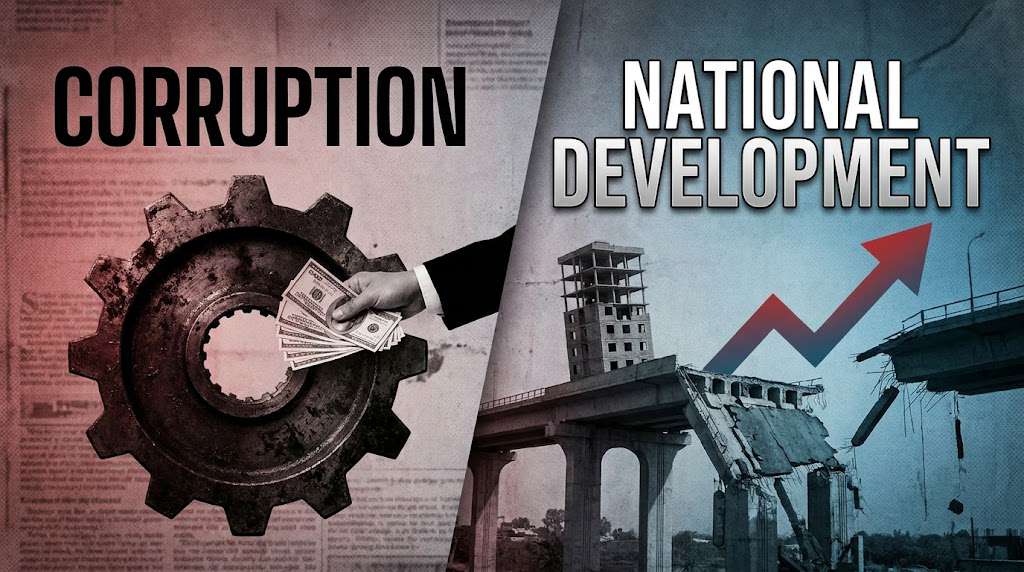
Corruption and Its Effects on National Development
Introduction
A hospital that lacks essential medicine because funds meant to purchase it were diverted elsewhere. A road project abandoned halfway because contract funds were never fully spent as intended. A qualified young graduate turned away from a job opportunity because someone with less merit but the right personal connections was hired instead. These are not simply isolated incidents of bad luck — they are among the many real, tangible consequences of corruption, a problem widely recognized as one of the most significant obstacles to Nigeria's national development.
This article explores corruption in depth — what it is, its various forms, the factors that contribute to it, its wide-ranging effects on national development, and the institutions and strategies established in Nigeria specifically to combat it.
What Is Corruption?
Corruption refers to the abuse of entrusted power or position for private gain, typically involving dishonest or unethical conduct by those holding public office, business responsibility, or other positions of trust. Corruption can occur at every level of society, from a low-level official demanding a small bribe to process routine paperwork, to large-scale embezzlement of public funds by senior government officials.
Common Forms of Corruption
Bribery
Bribery involves offering, giving, or accepting money, gifts, or other favours in exchange for improperly influencing the actions or decisions of an official or other person in a position of trust.
Embezzlement
Embezzlement involves the theft or misappropriation of funds or property that has been entrusted to an individual's care, typically committed by someone in a position of financial responsibility, such as a government official managing public funds.
Nepotism and Favouritism
Nepotism involves granting jobs, contracts, or other benefits to family members or close associates based on personal relationships rather than merit, while favouritism more broadly involves granting unfair preferential treatment to particular individuals or groups for reasons unrelated to genuine merit or qualification.
Extortion
Extortion involves an official or other person in a position of power improperly demanding money, favours, or other benefits from someone, often under threat of denying them a service or benefit they are legitimately entitled to, or of causing them some form of harm.
Fraud
Fraud involves intentional deception carried out for personal or financial gain, such as falsifying records, inflating contract costs, or creating fictitious projects or beneficiaries in order to divert public funds.
Electoral Corruption
Electoral corruption includes practices such as vote buying, ballot manipulation, and other forms of electoral malpractice intended to unfairly influence the outcome of elections, undermining the genuine democratic legitimacy of the results.
Causes of Corruption
Weak Institutional Oversight
Where systems for monitoring, auditing, and holding officials accountable for their use of public resources are weak or poorly enforced, opportunities for corrupt conduct to go undetected and unpunished tend to increase significantly.
Poverty and Economic Hardship
Widespread poverty can create both greater temptation for individuals to engage in corrupt practices for personal survival, and greater public tolerance of minor corrupt practices, particularly among poorly compensated public officials.
Weak Rule of Law and Slow Justice System
Where legal consequences for corrupt conduct are inconsistent, significantly delayed, or rarely enforced against those with sufficient wealth or political influence, the practical deterrent effect of anti-corruption laws is significantly weakened.
Cultural and Social Attitudes
In some contexts, certain corrupt practices, such as small "facilitation" payments to speed up routine government services, may become so normalized within everyday social practice that they are no longer widely perceived as seriously wrong, further entrenching the broader problem.
Greed and Weak Personal Ethics
At an individual level, corruption is also driven simply by personal greed and a willingness to prioritize private gain over public duty and ethical responsibility, regardless of broader systemic or economic pressures.
The Effects of Corruption on National Development
Diversion of Public Resources
Funds intended for essential public services — including healthcare, education, and infrastructure — are diverted for private benefit, directly reducing the quality and availability of services citizens depend on.
Poor Quality Infrastructure and Abandoned Projects
Corruption in the awarding and execution of government contracts often results in substandard construction, inflated project costs, or projects abandoned entirely partway through, wasting significant public resources without delivering the intended public benefit.
Discouragement of Foreign and Domestic Investment
Investors, both foreign and domestic, are generally reluctant to commit capital to environments where corrupt practices create unpredictable additional costs, unfair competitive disadvantages, or significant legal and reputational risks, ultimately reducing economic growth and job creation.
Erosion of Public Trust in Government
Widespread corruption significantly undermines citizens' trust in government institutions, weakening the broader social contract between citizens and the state, and potentially reducing citizens' willingness to pay taxes, obey laws, or otherwise cooperate with government initiatives.
Undermining Merit and Talent
Where positions, contracts, or opportunities are awarded based on corrupt influence rather than genuine merit, qualified and talented individuals are often unfairly excluded, weakening the overall competence and effectiveness of both government institutions and the broader economy.
Widening Inequality
Corruption often disproportionately benefits those who are already wealthy or well-connected, further widening the gap between rich and poor, and reducing resources available for programmes intended to support the most vulnerable members of society.
Undermining Democratic Legitimacy
Electoral corruption, in particular, directly undermines the legitimacy of elected government, since leaders who attain office through vote buying or electoral manipulation cannot be said to genuinely represent the free choice of the electorate.
Nigeria's Anti-Corruption Institutions
Economic and Financial Crimes Commission (EFCC)
The EFCC is a major Nigerian law enforcement agency specifically established to investigate and prosecute financial crimes, including corruption, fraud, and money laundering.
Independent Corrupt Practices and Other Related Offences Commission (ICPC)
The ICPC is another key anti-corruption agency, focused particularly on investigating and prosecuting corrupt practices involving public officials, and on promoting broader public education and reform aimed at preventing corruption.
The Code of Conduct Bureau and Tribunal
The Code of Conduct Bureau monitors compliance by public officials with an established code of conduct, including requirements to declare their assets, while the associated Code of Conduct Tribunal hears cases involving alleged violations of this code by public officials.
The Auditor-General
The Auditor-General is responsible for auditing government accounts and public expenditure, helping identify financial irregularities and promoting greater transparency and accountability in the management of public funds.
Strategies for Combating Corruption
- Strengthening institutional oversight, including more effective auditing, monitoring, and enforcement mechanisms across government agencies.
- Ensuring swift and consistent legal consequences for corrupt conduct, regardless of an offender's wealth, status, or political connections.
- Promoting transparency, including public access to information about government contracts, budgets, and expenditure.
- Civic education and public awareness, helping citizens understand the damaging effects of corruption and encouraging active public rejection of corrupt practices, including refusing to offer or accept bribes.
- Whistleblower protection, encouraging individuals with knowledge of corrupt practices to report them, without fear of retaliation.
- Improving public sector remuneration and working conditions, reducing some of the economic pressures that can contribute to corrupt conduct among officials.
The Role of Individual Citizens in Combating Corruption
While institutional reform is essential, individual citizens also play a meaningful role in reducing corruption through everyday choices — declining to offer or accept bribes, reporting corrupt practices they witness, supporting transparency and accountability initiatives, and holding elected officials accountable through informed voting and active civic engagement.
Corruption and WAEC/NECO Civic Education
Key examinable areas of this topic include:
- The definition and common forms of corruption, including bribery, embezzlement, nepotism, and electoral corruption.
- Causes of corruption, including weak institutions, poverty, and cultural attitudes.
- Effects of corruption on national development, including its impact on public services, investment, and public trust.
- Nigeria's key anti-corruption institutions, including the EFCC, ICPC, and Code of Conduct Bureau.
- Strategies for combating corruption, at both institutional and individual citizen levels.
Common Mistakes Students Make
- Confusing the EFCC and ICPC. While both combat corruption, the EFCC focuses broadly on economic and financial crimes, including money laundering, while the ICPC focuses specifically on corrupt practices involving public officials.
- Assuming corruption only involves large sums of money. Corruption includes small-scale practices, such as minor bribes for routine services, as well as large-scale embezzlement.
- Overlooking the role of ordinary citizens in either enabling or resisting corruption, focusing solely on the responsibility of government officials.
- Describing corruption's effects only in economic terms, without recognizing its broader effects on public trust, democratic legitimacy, and social equality.
- Assuming anti-corruption institutions alone can fully solve the problem, without recognizing the importance of broader cultural, institutional, and individual factors.
Conclusion
Corruption represents one of the most significant and persistent obstacles to Nigeria's national development, quietly diverting resources meant for schools, hospitals, roads, and countless other public goods into private hands, while eroding public trust and undermining the fair, merit-based functioning of both government and the broader economy.
Understanding corruption's many forms, its underlying causes, and its far-reaching effects — alongside the institutions and strategies established to combat it — equips students not just with examination knowledge, but with a genuine civic understanding of a problem that continues to shape Nigeria's development, and one that every citizen, in their own everyday choices, has some role in either perpetuating or resisting.