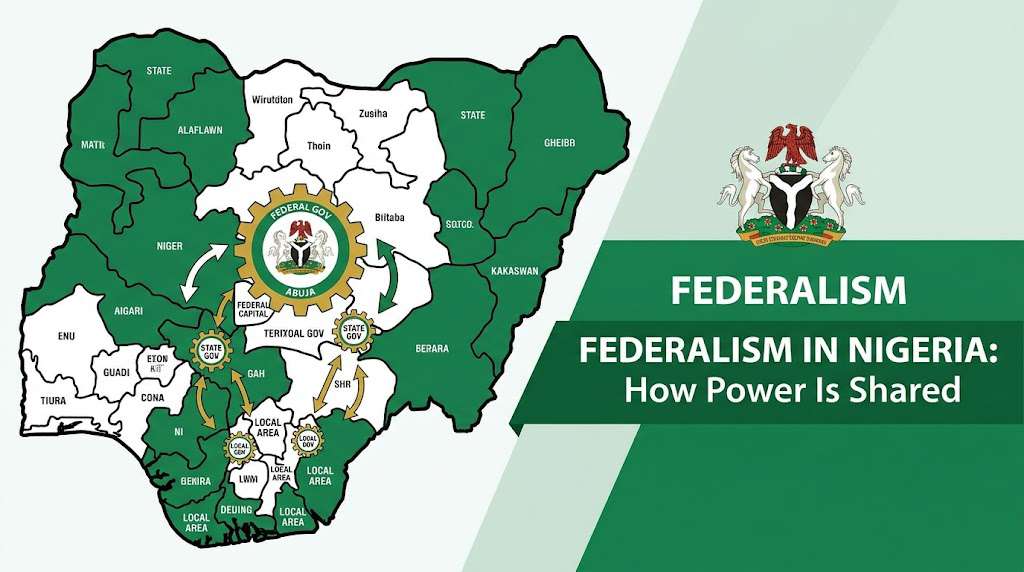
Federalism in Nigeria: How Power Is Shared
Introduction
With over 200 million people, more than 250 distinct ethnic groups, and enormous variation in language, religion, and local tradition across its territory, Nigeria faces a governance challenge shared by very few countries in the world: how to hold together a nation of such extraordinary diversity under a single system of government, without either fracturing under the weight of that diversity or imposing unwanted uniformity on communities that value their distinct identities.
Nigeria's answer to this challenge is federalism — a system of government in which political power is constitutionally divided between a central, national government and a number of constituent regional governments, each possessing genuine authority over specific matters. This article explores how federalism operates in Nigeria in detail, the constitutional division of responsibilities it establishes, and the ongoing debates surrounding its practical operation.
What Is Federalism?
Federalism is a system of government in which power is constitutionally divided between a central (federal) government and a number of regional (state or provincial) governments, with each level possessing its own defined areas of authority that the other cannot simply override. This distinguishes federalism from a unitary system, in which all significant governmental power is concentrated at the centre, with regional or local authorities merely implementing decisions made by the central government and possessing no genuinely independent authority of their own.
Why Nigeria Adopted a Federal System
Nigeria's federal structure developed gradually during the late colonial period, formally introduced with the Lyttleton Constitution of 1954, which divided the country into three regions — Northern, Western, and Eastern — each granted significant self-governing authority. This structure was retained and further developed at independence in 1960, and several key factors have consistently supported Nigeria's continued commitment to a federal, rather than unitary, system:
- Ethnic and cultural diversity: Nigeria's vast number of distinct ethnic groups, each with its own language, customs, and traditions, makes a degree of regional self-governance an important tool for accommodating this diversity.
- Geographic size: Nigeria's large territory makes fully centralized governance from a single seat of power practically difficult, favouring the distribution of certain responsibilities to more local levels of government.
- Historical regional identities: Nigeria's pre-colonial and colonial history left strong regional political identities in place, which a federal structure was seen as better able to accommodate than a fully unitary one.
- Preventing the domination of one group over others: A federal structure, distributing power across multiple states, can help prevent any single ethnic or regional group from gaining excessive control over the entire national government.
The Three Tiers of Government in Nigeria
Nigeria's federal system operates across three distinct tiers of government:
- Federal government: The central national government, headed by the President, responsible for matters of national concern.
- State governments: Currently 36 states plus the Federal Capital Territory, each headed by a Governor, responsible for matters within their own defined jurisdiction.
- Local governments: The most localized tier, responsible for matters of direct, immediate concern to specific communities, such as local markets, primary healthcare, and certain local infrastructure.
The Legislative Lists: Dividing Lawmaking Powers
To clarify precisely which level of government has authority over which matters, the Nigerian Constitution divides legislative subjects into distinct lists, set out in its Second Schedule.
The Exclusive Legislative List
The Exclusive Legislative List contains matters over which only the federal government (through the National Assembly) has the constitutional authority to make laws. State governments have no power to legislate on these matters at all. This list includes subjects such as:
- Defence and the armed forces
- Foreign affairs and international relations
- Currency, banking, and monetary policy
- Immigration and citizenship
- Mines and minerals, including oil and gas
- Aviation and civil aviation
- The Nigerian Police Force
The Concurrent Legislative List
The Concurrent Legislative List contains matters over which both the federal government and state governments may legislate. However, where a valid federal law and a state law on the same concurrent matter genuinely conflict, the federal law generally takes precedence, and the conflicting provision of the state law is considered void to the extent of that conflict. This list includes subjects such as:
- Education
- Health and hospitals
- Electricity generation and distribution
- Agriculture
- Roads and certain aspects of transportation
- Statistics and census-related matters
Residual Matters
Matters not explicitly listed in either the Exclusive or Concurrent Legislative Lists are generally understood to fall within the exclusive authority of state governments, since the Constitution reserves to the states whatever legislative authority it has not specifically assigned to the federal government. These are often referred to as residual matters, and may include areas such as certain aspects of local land use, chieftaincy affairs, and other matters of primarily local concern within a particular state.
Fiscal Federalism: Revenue Allocation
Federalism is not only about dividing lawmaking power — it also concerns how revenue, particularly from Nigeria's substantial oil and gas resources, is distributed among the three tiers of government, a subject often referred to as fiscal federalism. Nigeria uses a Federation Account, into which most centrally collected national revenue is paid, before being distributed among the federal, state, and local governments according to a formula determined periodically by relevant government bodies. This revenue-sharing arrangement has long been one of the most politically sensitive aspects of Nigerian federalism, particularly for oil-producing states seeking a greater share of revenue derived from resources located within their own territory — a principle often referred to as derivation.
The Role of the Supreme Court in Federal Disputes
Disputes between the federal government and individual states, or between states themselves, regarding the proper division of powers or revenue under the federal system are ultimately resolved by the judiciary, particularly the Supreme Court, which has original jurisdiction over disputes directly between the federal government and a state, or between states. This judicial role is essential to maintaining a genuinely federal system, since it provides an independent, authoritative mechanism for resolving disagreements about where the constitutional boundaries between federal and state authority actually lie.
Advantages of Nigeria's Federal System
- Accommodates diversity, allowing different states to reflect local preferences and priorities on matters within their authority.
- Brings government closer to the people, since many decisions affecting daily life are made at the state or local level, closer to those affected by them.
- Encourages healthy competition and policy experimentation, as different states may adopt different approaches to shared challenges, allowing successful policies to be observed and potentially adopted elsewhere.
- Distributes power, reducing the risk that any single group or region could dominate the entire country's government.
Challenges Facing Nigerian Federalism
Despite its constitutional foundation, the practical operation of federalism in Nigeria faces several significant, ongoing challenges:
- Over-centralization: Critics argue that the Exclusive Legislative List grants the federal government excessive authority relative to the states, limiting genuine state autonomy in practice.
- Revenue allocation disputes: Ongoing disagreements persist regarding the fairness of the formula used to distribute revenue among the federal, state, and local governments, particularly concerning derivation for oil-producing states.
- Calls for restructuring: Various political and civil society voices have periodically called for a fundamental restructuring of Nigeria's federal arrangement, sometimes advocating a return to a system with fewer, more powerful regions, similar to Nigeria's earlier post-independence structure.
- Resource control debates: Particularly in the oil-producing Niger Delta region, disputes over control of natural resource revenue have remained a persistent and politically significant issue.
Federalism and WAEC/NECO Government
Key examinable areas of this topic include:
- The definition of federalism and how it differs from a unitary system of government.
- The three tiers of government in Nigeria and their respective areas of responsibility.
- The Exclusive and Concurrent Legislative Lists, including specific examples of matters found on each.
- The concept of residual matters reserved to state governments.
- Fiscal federalism and revenue allocation, including the concept of derivation.
- Advantages and challenges associated with Nigeria's federal system.
Common Mistakes Students Make
- Confusing the Exclusive and Concurrent Legislative Lists. Only the federal government may legislate on Exclusive List matters; both federal and state governments may legislate on Concurrent List matters.
- Assuming states can freely legislate on any matter not specifically prohibited. States are generally limited to residual matters and Concurrent List matters, while Exclusive List matters remain entirely beyond their legislative authority.
- Confusing federalism with separation of powers. Federalism concerns the division of authority between federal and state governments; separation of powers concerns the division of authority among the executive, legislature, and judiciary at a given level of government.
- Describing Nigeria's federal system as identical to that of other federations, such as the United States, without recognizing Nigeria's own distinct historical development and specific constitutional arrangements.
- Overlooking local government as a distinct tier, focusing only on federal and state government when discussing Nigeria's federal structure.
Conclusion
Federalism represents Nigeria's constitutional answer to one of its most fundamental governance challenges: how to unite an extraordinarily diverse population, spread across a vast territory, under a single national government, while still allowing meaningful room for regional and local self-governance. Through its carefully defined Exclusive and Concurrent Legislative Lists, its three-tier structure of federal, state, and local government, and its ongoing, evolving arrangements for sharing national revenue, Nigeria continues to work out, in practice, exactly how power and resources should be shared across this federal structure.
Understanding federalism is essential not just for examination success, but for understanding many of the most significant and recurring political debates in Nigeria today — from calls for restructuring, to disputes over resource control, to ongoing questions about the appropriate balance of power between Abuja and the states.