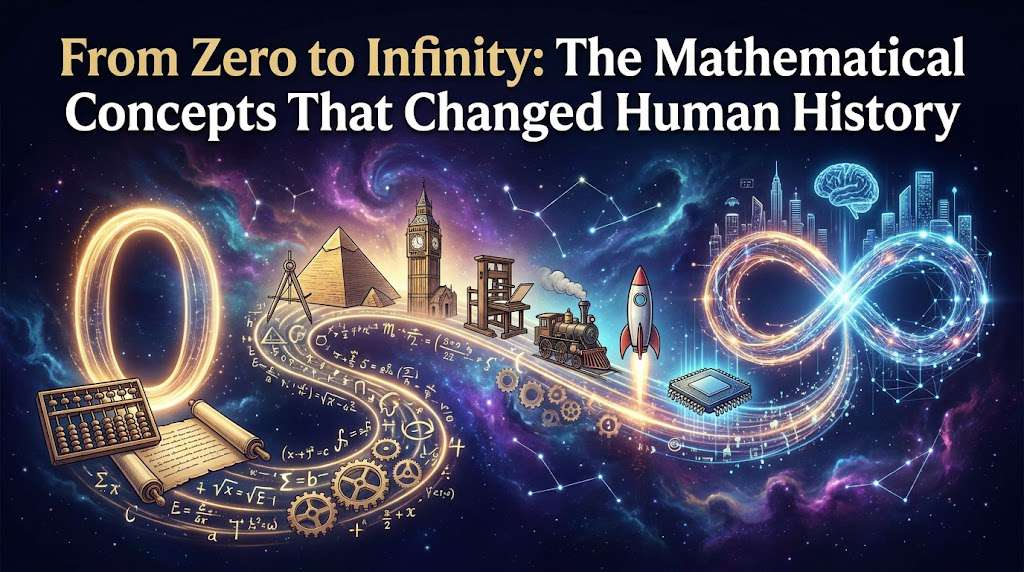
From Zero to Infinity: The Mathematical Concepts That Changed Human History
Introduction
Imagine trying to do mathematics without the number zero. No calculators, no computers, no bank accounts, no engineering. For most of human history, zero did not exist as a number — and its absence held civilisation back in ways we rarely appreciate today.
Now imagine trying to measure the area under a curved line, calculate the orbit of a planet, or describe the motion of a falling object — without calculus. For centuries, these problems were unsolvable. Then two men, working independently and ocean apart, invented the same revolutionary tool within years of each other.
Mathematics is not just a school subject. It is the language in which human beings have written their greatest achievements. Every time civilisation hit a wall — a problem too large, too complex, or too abstract to solve — a mathematical breakthrough tore that wall down. This is the story of those breakthroughs: the ideas that did not just change mathematics, but changed history itself.
1. The Invention of Numbers and Counting Systems
Before anything else, humanity needed a way to count. The earliest evidence of counting dates back over 40,000 years to tally marks scratched into bones — the Lebombo Bone found in southern Africa and the Ishango Bone found in what is now the Democratic Republic of Congo. These are among the oldest mathematical objects ever discovered.
But tally marks have serious limitations. As societies grew more complex — tracking harvests, trading goods, measuring land — they needed more powerful systems. Several great civilisations independently developed structured number systems:
- The Babylonians (around 2000 BCE) developed a base-60 number system, which is why we still divide hours into 60 minutes and circles into 360 degrees today.
- The Egyptians developed a system of hieroglyphic numerals that allowed them to manage the enormous logistics of pyramid construction.
- The Romans developed the Roman numeral system — familiar, but deeply limited. Try multiplying XLVII by CXIX using only Roman numerals, and you will quickly see why this system held mathematics back.
- The Hindu-Arabic system — the 0–9 digits we use today — emerged in India and was transmitted to Europe through Arabic scholars. It is arguably the most important numerical innovation in history.
The genius of the Hindu-Arabic system is positional notation: the value of a digit depends on its position. The "3" in 300 is worth ten times the "3" in 30. This simple idea makes arithmetic vastly more powerful and efficient than any system before it.
2. The Birth of Zero
Of all the numbers, zero is the strangest and the most revolutionary. It took humanity thousands of years to accept it — and some of the greatest mathematical minds in history resisted it fiercely.
Zero as a Placeholder
The first use of zero was not as a number but as a placeholder — a way of distinguishing 300 from 30. The Babylonians used a space, and later a special symbol, to indicate an empty position. But this was still not zero as a true number that could be added, subtracted, or multiplied.
India Gives Zero Its Full Power
The true mathematical zero — a number in its own right, with its own arithmetic rules — was developed in India. The mathematician and astronomer Brahmagupta, writing in 628 CE, was the first to clearly define zero and describe the rules for arithmetic with it:
- Any number plus zero equals that number.
- Any number minus itself equals zero.
- Any number multiplied by zero equals zero.
Brahmagupta even attempted to define division by zero — a problem that still has no complete solution in standard mathematics today.
Why Zero Changed Everything
Zero made the entire Hindu-Arabic positional number system work. Without it, you cannot write 101 — you cannot distinguish it from 11. Zero enabled:
- Efficient written arithmetic.
- Algebra and the concept of solving for an unknown.
- Negative numbers (zero became the dividing point between positive and negative).
- Calculus (which is fundamentally about what happens as quantities approach zero).
- Computer science (all digital information is ultimately expressed in binary — zeros and ones).
Without zero, the modern world simply does not exist.
3. The Development of Algebra
Arithmetic answers the question: what is the answer? Algebra asks a deeper question: what is the unknown? This shift — from calculating known quantities to solving for unknown ones — was one of the most powerful conceptual leaps in mathematical history.
Al-Khwarizmi and the Birth of Algebra
The word "algebra" comes from the Arabic al-jabr, from the title of a book written around 830 CE by the Persian mathematician Muhammad ibn Musa al-Khwarizmi. His book systematically described methods for solving linear and quadratic equations. Al-Khwarizmi is considered the father of algebra — and the word "algorithm" is derived from the Latin version of his own name.
What Algebra Made Possible
Algebra gave mathematicians a general language for describing relationships between quantities. Instead of solving one specific problem at a time, algebra allowed them to describe entire classes of problems with a single equation and solve them all at once. This made possible:
- Engineering calculations for construction and machinery.
- Navigation and astronomy.
- Physics — almost every law of physics is expressed as an algebraic equation.
- Economics and financial modelling.
- Computer programming — every variable in every program is an algebraic concept.
4. The Pythagorean Theorem
Few mathematical results are as old, as famous, or as endlessly useful as the Pythagorean Theorem: in a right-angled triangle, the square of the hypotenuse equals the sum of the squares of the other two sides.
a² + b² = c²
Although named after the Greek philosopher Pythagoras (around 570–495 BCE), the relationship was known to Babylonian and Indian mathematicians centuries earlier. What the Greeks contributed was the concept of a rigorous proof — a logical argument showing why the theorem must be true, not just that it appears to work in examples.
Why It Changed History
The Pythagorean Theorem is the foundation of an enormous amount of mathematics and practical knowledge:
- Surveying and construction: It allows builders to create perfect right angles — essential for every building, road, and bridge.
- Navigation: Sailors used it to calculate distances and plot courses.
- Trigonometry: The entire field of trigonometry — which powers GPS, engineering, and physics — grows directly from this theorem.
- Distance in any dimension: The formula for calculating distance between two points in space, used in everything from computer graphics to machine learning, is a direct extension of the Pythagorean Theorem.
5. The Birth of Proof and Logical Reasoning
Around 300 BCE, the Greek mathematician Euclid wrote a book called the Elements — thirteen volumes that systematically built all of known geometry from a small set of self-evident starting points called axioms, using only logical deduction. It became the most influential mathematics textbook in history, used in schools and universities for over 2,000 years.
What Euclid established was the concept of mathematical proof: the idea that mathematical truth must be demonstrated through logical argument, not just observed in examples. This was revolutionary. It meant that mathematical results, once proved, are true with absolute certainty — not approximately, not usually, but always and forever.
The culture of proof that Euclid established became the foundation of all rigorous science and reasoning. The scientific method, logical philosophy, computer science, and the entire structure of modern mathematics all rest on this Greek idea that truth must be demonstrated, not merely asserted.
6. The Discovery of Irrational Numbers
The ancient Greeks believed that all numbers could be expressed as fractions — ratios of whole numbers. This belief was so fundamental that when a student of Pythagoras named Hippasus discovered that the square root of 2 could not be written as any fraction, it was treated as a scandal. According to legend, Hippasus was drowned at sea by fellow Pythagoreans for revealing this truth.
The square root of 2 is an irrational number: its decimal expansion goes on forever without repeating. So do π (pi) and e (Euler's number). The discovery of irrational numbers shattered the Greek worldview and forced mathematicians to develop a far richer understanding of what numbers actually are.
This matters practically because many of the most important constants in nature and mathematics are irrational. Pi appears in every calculation involving circles. Euler's number e appears in every calculation involving growth and decay. Without irrational numbers, we cannot accurately describe the physical world.
7. The Invention of Calculus
By the 17th century, scientists faced a set of problems they simply could not solve with existing mathematics. How does the speed of a falling object change from moment to moment? What is the area enclosed by a curved shape? How do you calculate the exact orbit of a planet? Algebra and geometry were not enough. A new tool was needed.
In the 1660s and 1670s, two mathematical giants independently invented that tool: Isaac Newton in England and Gottfried Wilhelm Leibniz in Germany. Their creation — calculus — is arguably the single most powerful mathematical tool ever devised.
What Calculus Does
Calculus has two main branches:
- Differential calculus deals with rates of change — how fast something is moving, growing, or changing at any given instant.
- Integral calculus deals with accumulation — finding areas, volumes, and total quantities from information about rates of change.
These two branches are linked by the Fundamental Theorem of Calculus, one of the most beautiful results in all of mathematics: differentiation and integration are inverse operations, two sides of the same coin.
What Calculus Made Possible
Calculus unlocked an era of scientific and technological progress that continues to this day:
- Classical physics: Newton used calculus to derive his laws of motion and universal gravitation, explaining everything from falling apples to planetary orbits.
- Engineering: Every structure, engine, and electrical circuit is designed using calculus.
- Medicine: Drug dosage calculations, medical imaging, and the modelling of disease spread all rely on calculus.
- Economics: Marginal analysis — the foundation of modern economics — is pure calculus.
- Artificial intelligence: The training of every machine learning model, including the AI systems that power modern technology, uses a calculus technique called gradient descent.
8. The Concept of Infinity
Infinity is not a number. It is a concept — the idea of something without end. And for most of mathematical history, mathematicians treated it with extreme caution, regarding it as a dangerous notion that led to paradoxes and contradictions.
Zeno's Paradoxes
Around 450 BCE, the Greek philosopher Zeno of Elea posed a series of paradoxes about infinity and motion. The most famous: to walk from one side of a room to the other, you must first walk halfway. Then halfway of the remaining distance. Then halfway again. Since you can always halve the remaining distance, you must complete infinitely many steps — so how do you ever arrive?
Of course, we do arrive. But the mathematical resolution of this paradox — that an infinite series of numbers can sum to a finite total — had to wait nearly two thousand years.
Cantor and the Mathematics of Infinity
In the 1870s and 1880s, German mathematician Georg Cantor did something extraordinary: he developed a rigorous mathematical theory of infinity and discovered that some infinities are larger than others.
Cantor proved that the set of all whole numbers and the set of all even numbers are the same size of infinity — even though even numbers seem to be only half of all whole numbers. He then proved that the set of all real numbers (including decimals and irrationals) is a strictly larger infinity than the set of whole numbers. There are different sizes of infinity, arranged in an infinite hierarchy.
This idea was so radical that many of Cantor's contemporaries rejected it furiously. The great mathematician Henri Poincaré called it a "disease" infecting mathematics. But Cantor was right, and his work became the foundation of modern mathematical logic and set theory.
9. The Development of Statistics and Probability
For most of history, mathematics dealt with certainty. Geometry proved theorems that were absolutely true. Algebra solved equations with definite answers. But the world is full of uncertainty — and in the 17th century, mathematicians began to develop tools for reasoning about it.
Probability theory began, rather unglamorously, with questions about gambling. French mathematicians Blaise Pascal and Pierre de Fermat corresponded in 1654 about how to fairly divide the winnings of an interrupted game of chance. Their letters founded the mathematical theory of probability.
Statistics developed as a tool for governments and scientists to make sense of large amounts of data. Today, statistics and probability underpin:
- Medical research and clinical trials.
- Weather forecasting.
- Insurance and financial risk assessment.
- Opinion polling and election forecasting.
- Quality control in manufacturing.
- Machine learning and artificial intelligence.
10. The Digital Revolution: Boolean Algebra and Binary Mathematics
In 1854, English mathematician George Boole published a book describing a new kind of algebra — one in which variables had only two possible values: true or false, 1 or 0. Boolean algebra seemed like pure abstract mathematics with no obvious application.
Nearly a century later, American engineer Claude Shannon realised that Boolean algebra perfectly described the behaviour of electrical circuits that were either on or off. This insight became the theoretical foundation of all digital computing. Every smartphone, laptop, server, and supercomputer in the world operates on Boolean logic applied to binary numbers — zeros and ones.
The entire digital world — the internet, social media, streaming video, digital banking, GPS navigation — is built on a mathematical idea developed by a 19th-century English mathematician who had no computer and no way of knowing what his abstract algebra would one day make possible.
Connections to WAEC and JAMB Mathematics
Every concept discussed in this article connects to topics in your mathematics curriculum:
- Number systems: The history of counting systems connects to your study of number bases, indices, and the real number line.
- Algebra: Al-Khwarizmi's work is the direct ancestor of every equation you solve in school.
- Pythagoras: The theorem appears directly in WAEC and JAMB geometry and trigonometry questions.
- Calculus: Differentiation and integration are core topics in Further Mathematics at both WAEC and JAMB level.
- Probability and statistics: These appear in every WAEC and JAMB mathematics paper.
- Surds and irrational numbers: Expressions involving √2 and similar irrational numbers are a standard examination topic.
Common Misconceptions About Mathematical History
- "Mathematics was invented by the Greeks." Greece made enormous contributions, but significant mathematics was developed in Africa, India, Mesopotamia, China, and the Arab world — often centuries before Greek scholars encountered these ideas.
- "Mathematical concepts were discovered by one person." Most major ideas were developed gradually by many people across many generations. Newton and Leibniz both invented calculus. Many people contributed to algebra before al-Khwarizmi.
- "Ancient mathematics was primitive." The Babylonians could solve quadratic equations. Ancient Egyptians used sophisticated arithmetic to manage construction projects of staggering scale. Ancient African mathematicians were recording mathematical patterns tens of thousands of years ago.
- "Mathematics is finished." Thousands of unsolved problems remain in mathematics today. New branches of mathematics continue to be created. The story is far from over.
Conclusion
From the first tally marks scratched into an African bone to the Boolean algebra powering your smartphone, mathematics has been the engine of human progress. Every time the world presented a problem that existing tools could not solve, a mathematical breakthrough changed what was possible.
Zero made arithmetic universal. Algebra made the unknown solvable. Proof made truth certain. Calculus unlocked the laws of nature. Statistics made uncertainty manageable. Binary mathematics made the digital world possible. And the concept of infinity taught us that the universe is stranger and richer than we ever imagined.
When you sit down to solve a mathematics problem — whether in a classroom in Lagos or Abuja or anywhere in the world — you are not just doing schoolwork. You are participating in a conversation that humanity has been having for over 40,000 years. You are using tools that took generations of brilliant minds to build. And somewhere ahead of you, there are problems that have not yet been solved — waiting for the next generation of mathematical thinkers to break through.
That next generation could include you.