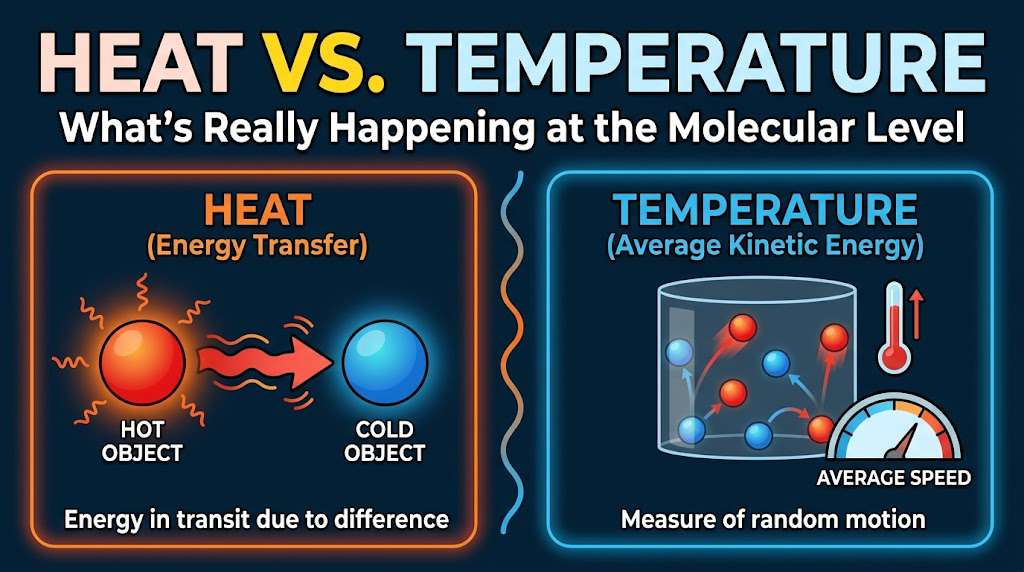
Heat vs. Temperature: What's Really Happening at the Molecular Level
Introduction
A spark from a sparkler can reach temperatures of over a thousand degrees Celsius — hot enough to melt certain metals. Yet touching a sparkler's spark for a brief instant causes no real harm, while stepping into a swimming pool heated to a mere thirty degrees Celsius can feel pleasantly warm, with no danger at all. How can something at a thousand degrees be safe to touch, while something at thirty degrees clearly contains far more total energy?
The answer lies in one of the most commonly confused pairs of concepts in physics: heat and temperature. In everyday language, these words are often used interchangeably — we might say something is "hot" because it has "a lot of heat," or that the "temperature" of a room has risen because it has gotten "hotter." But in physics, heat and temperature describe two distinctly different things, and understanding the difference between them reveals a great deal about how energy moves through the world at the molecular level.
What Is Temperature?
All matter is composed of tiny particles — atoms and molecules — that are constantly in motion, vibrating, rotating, or moving from place to place, depending on whether the substance is a solid, liquid, or gas. This motion is never actually visible to the naked eye, but it is happening constantly, even in objects that appear completely still.
Temperature is a measure of the average kinetic energy of these particles — essentially, how fast they are moving or vibrating, on average. A substance with a high temperature has particles that, on average, are moving quickly and energetically. A substance with a low temperature has particles that are moving more slowly and sluggishly. At the theoretical limit known as absolute zero — approximately minus two hundred and seventy-three degrees Celsius — particle motion would, in principle, come to a complete stop, although this point can never actually be reached in practice.
Crucially, temperature is an average measurement. It describes the typical energy of the particles within a substance, regardless of how many particles are present. A single cup of boiling water and an enormous vat of boiling water both have the same temperature, even though the vat contains vastly more total energy, simply because it contains far more particles.
What Is Heat?
Heat, by contrast, refers to the total amount of thermal energy that is transferred from one object or substance to another, due to a difference in temperature between them. Heat is not a property that an object "contains" in the way that mass or volume are properties an object possesses — rather, heat describes energy in the process of moving from a warmer region to a cooler one.
This is the key distinction: temperature is a measure of the average energy of individual particles, while heat is a measure of the total energy being transferred between objects, which depends not only on temperature but also on the total quantity, or mass, of the substance involved.
This explains the sparkler paradox introduced earlier. A spark from a sparkler may reach an extremely high temperature, meaning its individual particles are moving with enormous average energy. However, because a spark consists of an extraordinarily tiny quantity of matter, the total amount of thermal energy it contains — and can therefore transfer to your skin — is very small, and is dispersed almost instantly. A swimming pool, by contrast, has a much lower temperature, meaning its particles move with far less average energy, but because it contains an enormous mass of water, it holds a vastly greater total quantity of thermal energy.
How Heat Moves: Conduction, Convection, and Radiation
Heat always flows from a hotter object or region to a cooler one, never the other way around, in accordance with the second law of thermodynamics. This transfer of thermal energy occurs through three main mechanisms.
Conduction occurs when heat is transferred through direct contact between particles. In a solid object, such as a metal spoon left in a hot pan, rapidly vibrating particles at the hot end collide with their neighbours, transferring some of their energy and causing those neighbouring particles to vibrate more vigorously as well. This process continues along the material, gradually spreading heat from the hot end to the cooler end. Metals are particularly good conductors of heat, which is why a metal spoon left in a hot drink quickly becomes too hot to touch.
Convection occurs in liquids and gases, where heated particles themselves physically move from one place to another, carrying their thermal energy with them. When water is heated in a pan, the warmer water near the heat source becomes less dense and rises, while cooler, denser water sinks to take its place, creating a continuous circulating current that distributes heat throughout the liquid. This same principle drives weather patterns in the atmosphere and ocean currents across the globe.
Radiation is the transfer of heat through electromagnetic waves, particularly infrared radiation, and is the only method of heat transfer that can occur through the vacuum of space, requiring no physical medium at all. This is how heat from the Sun reaches the Earth across ninety-three million miles of empty space, and how you can feel warmth radiating from a fire even without touching it directly.
Measuring Temperature and Heat
Temperature is commonly measured using scales such as Celsius, Fahrenheit, and Kelvin, typically using a thermometer that detects changes in a physical property — such as the expansion of a liquid or the electrical resistance of a material — that varies predictably with temperature.
Heat, being a measure of energy, is measured in joules, the same unit used to measure all other forms of energy. The amount of heat required to raise the temperature of a substance depends on its mass and on a property called specific heat capacity — the amount of energy needed to raise the temperature of one kilogram of the substance by one degree Celsius. Water has an unusually high specific heat capacity, meaning it takes a relatively large amount of energy to heat it up, which is part of the reason large bodies of water help moderate the climate of nearby coastal regions.
Why the Distinction Matters
Understanding the difference between heat and temperature has important practical consequences. It explains why a small amount of steam can cause a far more severe burn than the same mass of boiling water, despite both being at the same temperature — steam carries additional latent heat energy released during condensation, on top of its thermal energy due to temperature. It explains why metal objects in a cold room feel colder to the touch than wooden objects at the exact same temperature — metal conducts heat away from your skin much more rapidly, transferring heat energy away from your body faster, even though both objects share an identical temperature.
Engineers rely on this distinction constantly, whether designing efficient insulation for buildings, calculating the cooling requirements for industrial machinery, or determining how much energy is required to heat a particular volume of water in an industrial process.
Conclusion
Although heat and temperature are often used interchangeably in casual conversation, they describe two genuinely different physical concepts. Temperature reflects the average energy of individual particles within a substance, while heat describes the total thermal energy transferred between objects of different temperatures. Recognising this distinction not only resolves apparent paradoxes, such as a tiny spark reaching far higher temperatures than a warm swimming pool while carrying far less total energy, but also reveals the hidden molecular world of motion and energy transfer happening constantly, silently, all around us.