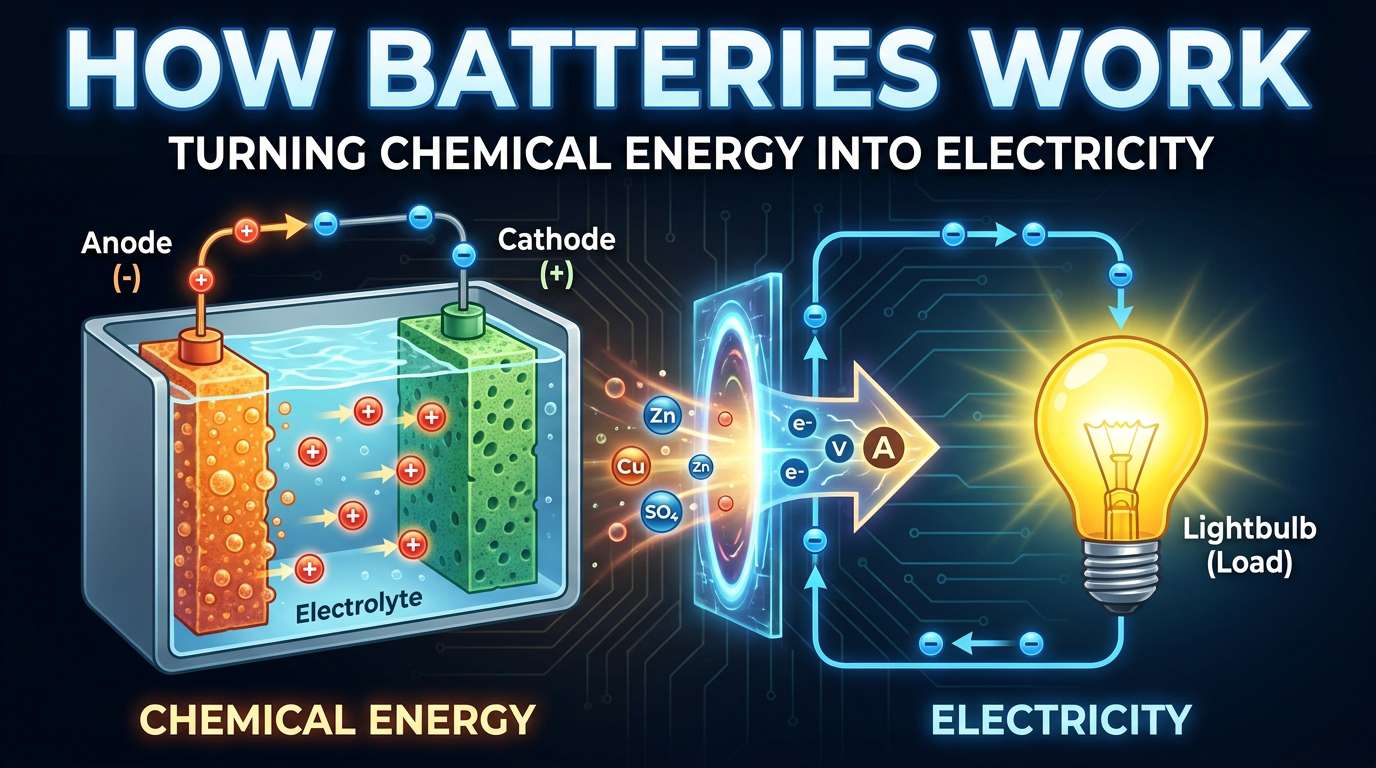
How Batteries Work: Turning Chemical Energy into Electricity
Introduction
Slide two AA batteries into a remote control, and it works instantly — no wires running to a power station, no visible spark, nothing that looks even remotely like a chemistry experiment. But that is exactly what is happening inside every battery, every second it powers a device: a carefully engineered chemical reaction, quietly converting stored chemical energy directly into electrical energy.
A battery is, at its core, a device that converts the chemical energy contained in its materials directly into electrical energy through an electrochemical oxidation-reduction (redox) reaction.1 Understanding how that conversion works reveals one of the most elegant applications of chemistry in everyday technology.
The Three Essential Components of a Battery Cell
While the term "battery" is used loosely, the basic electrochemical unit inside it is technically called a cell; a battery is simply one or more of these cells connected together.1 Every cell is built from three essential components:
The Anode (Negative Electrode)
The anode is the electrode where oxidation takes place — meaning it gives up electrons to the external circuit.1 Because the anode is the source of the electrons that flow through the circuit, it acts as the negative terminal of the battery.2
The Cathode (Positive Electrode)
The cathode is the electrode where reduction takes place — meaning it accepts electrons from the external circuit.1 A useful memory aid used by chemists is "Red Cat An Ox" — REDuction occurs at the CAThode, and ANodes undergo OXidation.2
The Electrolyte
The electrolyte is the ionic conductor that fills the space between the anode and cathode, providing the medium through which charge can move inside the cell.1 Electrolytes are often liquids — typically water or another solvent with dissolved salts, acids, or alkalis to give them ionic conductivity — though some modern batteries use solid electrolytes instead.1
How Electricity Actually Flows Inside a Battery
At the anode, a chemical reaction takes place between the electrode material and the electrolyte, producing electrons that accumulate at that electrode.3 These electrons cannot simply flow through the electrolyte to reach the cathode — instead, they are forced to travel through the external circuit (the wire, device, or component the battery is powering) on their way from the anode to the cathode.3 It is this flow of electrons through the external circuit that we experience as electric current, lighting a bulb, spinning a motor, or powering a chip.
What Happens Inside the Electrolyte
Electrons themselves never travel back through the electrolyte from the cathode to the anode.4 Instead, electrical neutrality inside the cell is maintained by the movement of ions through the electrolyte — positive ions (cations) migrate toward the cathode, while negative ions (anions) migrate toward the anode.5 This ionic movement inside the cell, combined with electron flow through the external circuit, completes the full circuit and keeps the reaction running.
A Concrete Example: The Zinc-Air Cell
In a zinc-air battery, the reaction at the cathode during discharge can be written as:6
½O₂ + H₂O + 2e⁻ → 2OH⁻
with the overall cell reaction being:
2Zn + O₂ → 2ZnO
This reaction produces a theoretical voltage of 1.65 volts, though real-world cells typically deliver closer to 1.35–1.4 volts once practical losses are accounted for.6 Every type of battery — alkaline, lithium-ion, lead-acid, or zinc-air — follows this same fundamental pattern: a specific redox reaction at each electrode, connected through an electrolyte, producing a particular voltage determined by the chemistry involved.
Why Batteries Eventually "Die"
A battery does not run out of electricity in the way a bucket runs out of water — it runs out of usable chemical reactants. Once all of the active material at the cathode has been fully reduced, and all of the active material at the anode has been fully oxidised, the electrode materials are effectively used up and can no longer sustain the reaction.7 At that point, the battery can either be disposed of (or ideally recycled, in the case of primary/disposable batteries), or recharged, in the case of rechargeable secondary batteries.7
Primary vs. Secondary (Rechargeable) Batteries
Batteries fall into two broad categories based on whether their chemical reaction can be reversed:
Primary (Disposable) Batteries
In a primary battery, the redox reaction is essentially one-directional. Once the reactants are consumed, the reaction cannot easily be reversed, and the battery must be discarded or recycled.2 Ordinary alkaline AA and AAA batteries are common examples.
Secondary (Rechargeable) Batteries
In a rechargeable battery, applying an external electric current in the reverse direction can drive the chemical reaction backward, restoring the original reactants at each electrode.7 During charging, electrons are effectively forced back onto the anode material and removed from the cathode material — the reverse of what happens during discharge6 — and remarkably, during this process the identities of the anode and cathode as "positive" and "negative" can actually swap.7 While rechargeable batteries are often more expensive upfront, their ability to be reused many times over often makes them more efficient and economical in the long run.2
Voltage: Why Different Batteries Have Different Strengths
The voltage a battery produces — known more precisely as its electromotive force (emf) — is the electrical potential difference between its cathode and anode, and it is this potential difference that actually drives the electrons around the external circuit.7 Different combinations of electrode materials produce different voltages, which is why a single alkaline cell produces roughly 1.5 volts, while a lithium-ion cell produces a notably higher voltage using an entirely different chemistry.
To achieve a desired voltage or capacity, multiple individual cells can be connected together within a single battery — either in series, which increases the overall voltage, or in parallel, which increases the overall current capacity without changing the voltage.4
Batteries and WAEC/JAMB Chemistry
- Redox reactions: Identifying oxidation (electron loss) at the anode and reduction (electron gain) at the cathode within a working electrochemical cell.
- Electrolysis vs. electrochemical cells: Distinguishing between cells that generate electricity from spontaneous chemical reactions and electrolytic cells that use electricity to drive non-spontaneous reactions.
- Electrode terminology: Correctly identifying the anode and cathode as the negative and positive electrodes respectively in a discharging cell.
- Electrolytes: Understanding the role of the electrolyte in conducting ions between electrodes to complete the internal circuit.
- Everyday applications: Connecting battery chemistry to familiar real-world devices, a common way examiners frame applied electrochemistry questions.
Common Mistakes Students Make
- Assuming electrons flow through the electrolyte. Electrons flow through the external circuit only; charge balance inside the cell is maintained by the movement of ions through the electrolyte.4
- Mixing up oxidation and reduction locations. Oxidation always occurs at the anode; reduction always occurs at the cathode — in every electrochemical cell, without exception.2
- Forgetting that terminal polarity can change during charging. While the anode is negative during discharge, the labels and polarity of the electrodes reverse when a rechargeable battery is being charged.7
- Confusing "cell" and "battery." Strictly speaking, a battery is made up of one or more individual electrochemical cells connected together.1
Conclusion
A battery is, in essence, a small and carefully contained chemical reaction, wired precisely so that its electrons are forced to travel through a circuit — a light bulb, a phone, a car — on their way from one electrode to the other. Every device you have ever powered with a battery was really powered by chemistry: electrons released by oxidation at an anode, accepted by reduction at a cathode, and an electrolyte quietly balancing the charge in between.
The next time your phone battery dies, remember: it hasn't run out of some abstract "electric fluid." It has simply run out of the specific chemical reactants needed to keep its redox reaction going — a reminder that even the most modern technology in your pocket runs on chemistry as old as the periodic table itself.