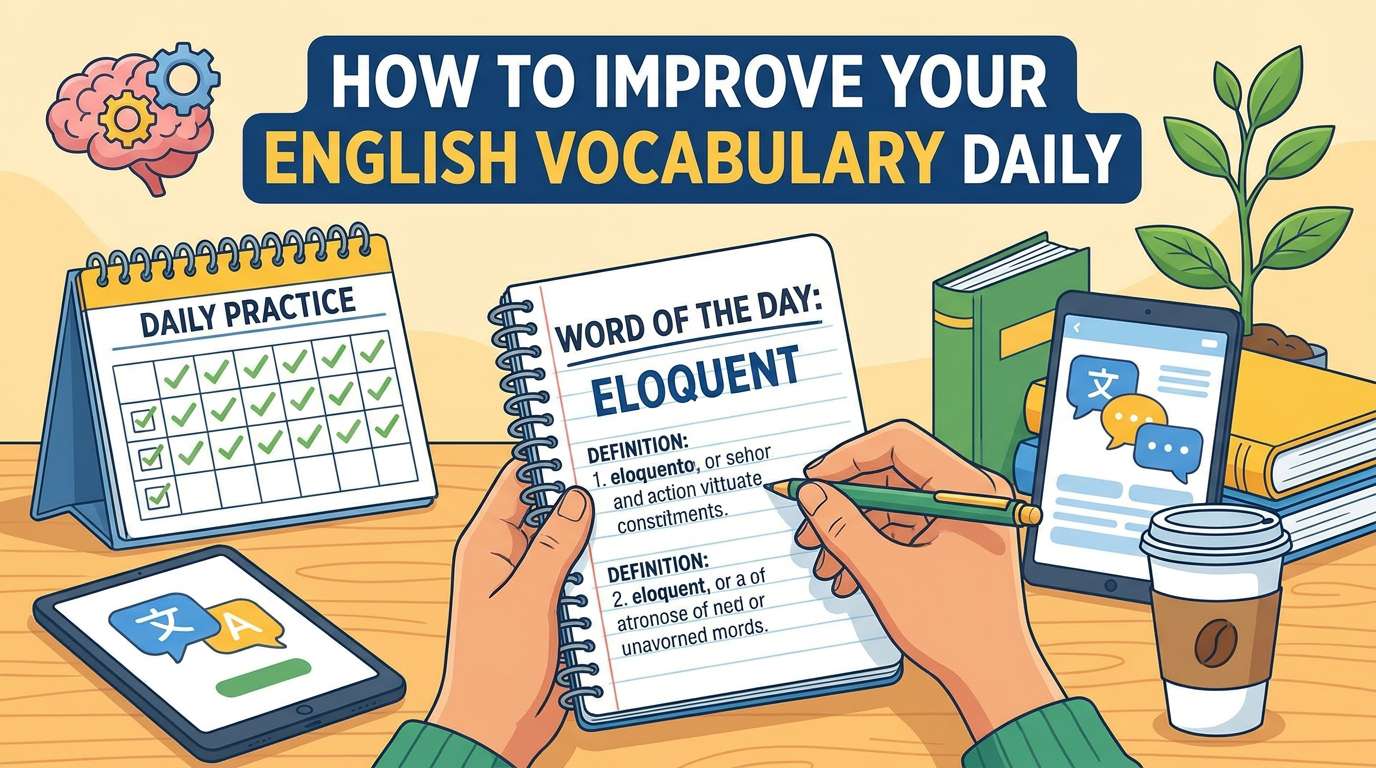
How to Improve Your English Vocabulary Daily
Introduction
A strong vocabulary is one of the most valuable tools for effective communication. Whether you are writing an essay, speaking in class, reading a textbook, or preparing for examinations, knowing the right words helps you express your ideas clearly and confidently.
Many students believe that improving their vocabulary requires memorizing long lists of difficult words. In reality, the best way to build your vocabulary is through small, consistent daily habits. Learning just a few new words every day can lead to significant improvement over time.
This article explores practical strategies students can use to improve their English vocabulary every day.
Why Is Vocabulary Important?
Vocabulary is the collection of words you understand and use in speaking and writing.
A strong vocabulary helps you:
- Communicate ideas more clearly.
- Understand books, articles, and examination questions more easily.
- Improve your writing and speaking skills.
- Perform better in English Language and other subjects.
- Build confidence during conversations and presentations.
The more words you know, the easier it becomes to learn and communicate.
Step 1: Learn New Words Every Day
Make it a habit to learn a small number of new words daily.
For example:
- Learn three to five new words each day.
- Find out their meanings.
- Learn how to pronounce them correctly.
- Use them in sentences.
Small daily improvements add up over weeks and months.
Step 2: Read Regularly
Reading is one of the most effective ways to expand your vocabulary.
Read materials such as:
- Storybooks
- Newspapers
- Educational articles
- Magazines
- School textbooks
Whenever you come across an unfamiliar word, look up its meaning instead of skipping it.
Step 3: Keep a Vocabulary Notebook
Write down every new word you learn.
For each word, include:
- The word itself
- Its meaning
- Its pronunciation (if needed)
- An example sentence
Review your notebook regularly to reinforce your memory.
Step 4: Use New Words in Daily Conversations
Learning a word is only the first step. To remember it, you need to use it.
Try to include newly learned words when:
- Speaking with friends
- Participating in class discussions
- Answering questions
- Writing assignments
Using words in real situations helps them become part of your everyday vocabulary.
Step 5: Practice Writing
Writing encourages you to use a wider range of words.
You can practice by:
- Keeping a daily journal
- Writing short stories
- Summarizing articles
- Composing essays
Challenge yourself to include some of the new words you have learned.
Step 6: Learn Words in Context
Instead of memorizing isolated words, learn them in sentences.
For example:
Instead of learning:
Generous – willing to give.
Learn:
"The generous woman donated books to the school library."
Learning words in context makes them easier to understand and remember.
Step 7: Use a Dictionary Regularly
A good dictionary provides more than just definitions.
It also shows:
- Correct pronunciation
- Different meanings
- Example sentences
- Synonyms and antonyms
- Word forms
Develop the habit of checking unfamiliar words whenever you encounter them.
Step 8: Learn Synonyms and Antonyms
Expanding your vocabulary includes learning words with similar and opposite meanings.
Example:
Happy
- Synonyms: joyful, cheerful, delighted
- Antonyms: sad, unhappy, miserable
This broadens your understanding and improves your writing.
Step 9: Watch and Listen to English Content
Listening helps you hear how words are naturally used.
You can improve your vocabulary by watching or listening to:
- Educational videos
- English news
- Podcasts
- Documentaries
- Audiobooks
Pay attention to new words and expressions you hear.
Step 10: Revise Frequently
Without revision, new words are easily forgotten.
Set aside time each week to:
- Review your vocabulary notebook.
- Test yourself on meanings.
- Use previously learned words in new sentences.
- Practice with quizzes or flashcards.
Regular revision helps move words into your long-term memory.
Common Mistakes to Avoid
- Trying to memorize too many words at once.
- Learning meanings without using the words.
- Ignoring pronunciation.
- Giving up after forgetting a few words.
- Reading very little.
Avoid these habits and focus on steady progress.
Building a Daily Vocabulary Routine
A simple daily routine might look like this:
- Read for 20–30 minutes.
- Learn three new words.
- Write each word in your notebook.
- Use each word in a sentence.
- Review words learned during the previous week.
This routine takes only a short time but produces lasting results.
Conclusion
Improving your English vocabulary is a gradual process that requires consistency rather than speed. By reading regularly, learning new words every day, practicing writing and speaking, and reviewing what you learn, you can steadily build a rich vocabulary.
Remember, every new word you learn increases your ability to understand, communicate, and succeed academically. Start with a few words today, stay consistent, and watch your confidence and language skills grow over time.