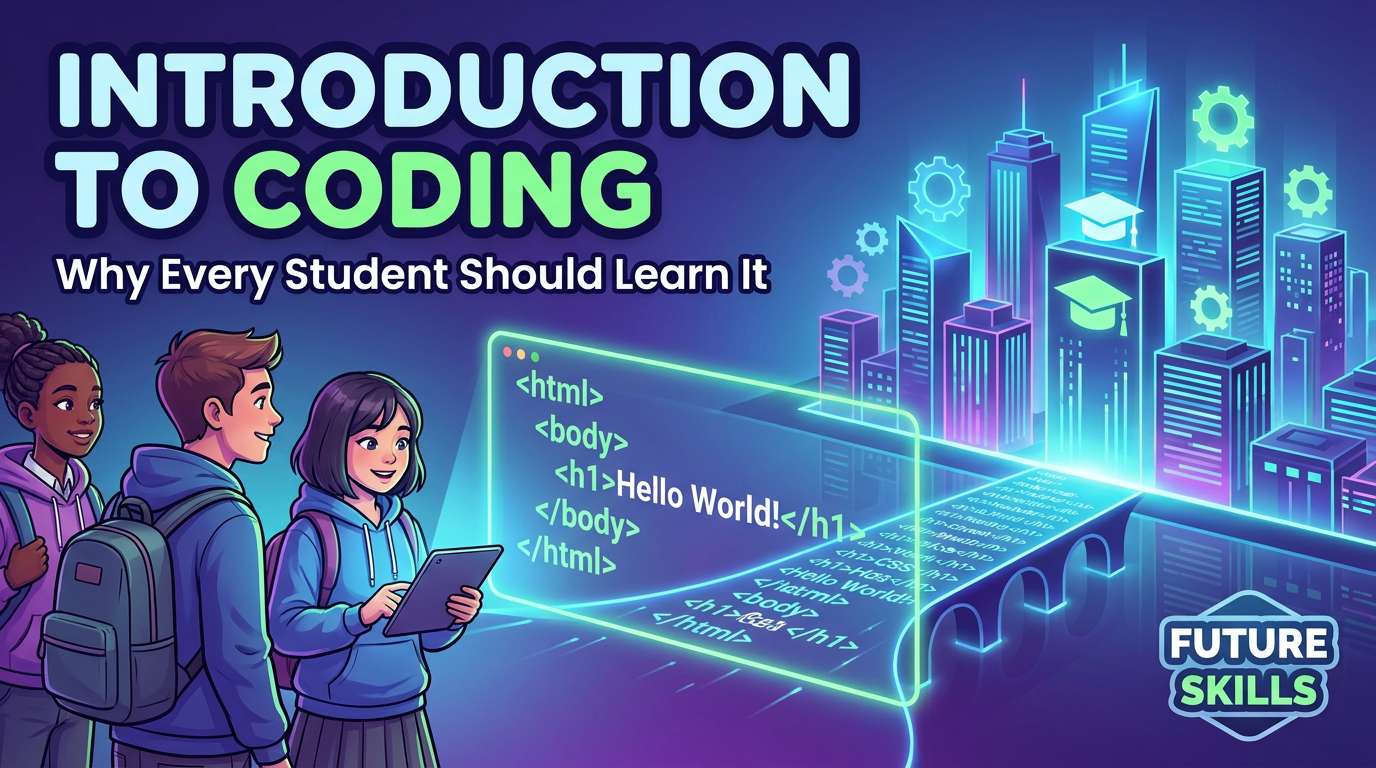
Introduction to Coding: Why Every Student Should Learn It
Introduction
Every app on your phone, every website you visit, every ATM transaction, and every automated message you receive exists because someone, at some point, wrote precise instructions telling a computer exactly what to do. This process — coding, also called programming — has quietly become one of the most valuable and versatile skills a young person can develop, regardless of whether they eventually pursue a career directly in technology.
This article introduces coding in accessible terms — what it actually is, how programming languages work, the different types of coding, and why learning even the basics offers genuine, practical value to Nigerian students across a wide range of future career paths.
What Is Coding?
Coding (or programming) is the process of writing instructions that a computer can understand and execute, in order to perform a specific task or solve a particular problem. These instructions are written using a programming language — a formal set of rules and vocabulary that translates human logic into a form computers can process.
Why Computers Need Programming Languages
At the most fundamental level, computers only truly understand binary code — sequences of 0s and 1s representing electrical signals being either off or on. Writing every instruction directly in binary would be extraordinarily impractical for humans. Programming languages exist specifically to bridge this gap, allowing humans to write instructions using more understandable words, symbols, and logical structures, which are then translated (through a process called compiling or interpreting) into the binary instructions a computer's processor can actually execute.
How Programming Languages Have Evolved
Early programming languages were very close to raw machine instructions, requiring extensive technical knowledge and offering little resemblance to natural human language. Over subsequent decades, programming languages have evolved to become increasingly readable and accessible, using structures and vocabulary that more closely resemble everyday logical reasoning, making coding progressively more approachable for a much broader range of people, including students learning it for the very first time.
Common Programming Languages and Their Uses
HTML and CSS
HTML (HyperText Markup Language) and CSS (Cascading Style Sheets) are the foundational technologies used to structure and style webpages. HTML defines a webpage's basic content and structure, while CSS controls its visual appearance, including colours, fonts, and layout.
JavaScript
JavaScript is a widely used programming language that adds interactivity to websites, allowing features such as dynamic content updates, interactive forms, and responsive user interfaces, without requiring a full page reload.
Python
Python is a highly popular, beginner-friendly programming language known for its clear, readable syntax, widely used across data analysis, artificial intelligence, automation, and general-purpose software development, making it a common recommended starting point for new programmers.
Java and C++
Java and C++ are widely used, more structurally complex languages, commonly used in large-scale software applications, certain mobile app development, and performance-intensive systems such as games and specialized software.
SQL
SQL (Structured Query Language) is specifically used for managing and retrieving information stored in databases, an essential skill for working with the large volumes of structured data that underpin most modern applications and websites.
Core Programming Concepts Every Beginner Encounters
Variables
A variable is a named container used to store a piece of information, such as a number, a word, or a true/false value, which a program can later reference, use, or change as needed.
Conditional Statements
Conditional statements (often written using "if" and "else") allow a program to make decisions, executing different instructions depending on whether a particular condition is true or false — for example, checking whether a student's score meets a specific passing threshold.
Loops
Loops allow a program to repeat a set of instructions multiple times, without requiring the programmer to write out the same instructions repeatedly — extremely useful for tasks such as processing every item in a large list of data.
Functions
A function is a reusable, named block of code designed to perform a specific task, which can be called upon repeatedly throughout a program whenever that particular task needs to be carried out, avoiding unnecessary repetition of the same instructions.
Algorithms
An algorithm is a clear, step-by-step sequence of instructions designed to solve a specific problem or complete a specific task. Learning to code fundamentally involves learning to think algorithmically — breaking a problem down into precise, logical, sequential steps a computer can follow exactly.
Why Coding Skills Offer Value Beyond a Technology Career
Developing Strong Logical and Analytical Thinking
Learning to code strengthens general problem-solving skills, requiring practitioners to break complex problems into smaller, manageable steps and think through the precise logical sequence needed to reach a solution — a transferable skill valuable across virtually any field of study or career.
Improving Attention to Detail
Coding demands careful, precise attention to detail, since even a small error in syntax or logic can prevent a program from working correctly, helping cultivate a disciplined, methodical approach to identifying and correcting mistakes.
Automating Repetitive Tasks
Even basic coding knowledge can allow individuals across many fields — from business and research to journalism and healthcare — to automate repetitive tasks, such as processing large amounts of data or generating routine reports, saving significant time and effort.
Expanding Career Opportunities
As digital technology becomes increasingly embedded across nearly every industry, coding skills are increasingly valuable well beyond traditional technology roles, including in finance, healthcare, agriculture, media, and entrepreneurship, particularly within Nigeria's rapidly growing technology and digital economy sector.
Enabling Creative and Entrepreneurial Projects
Basic coding knowledge empowers individuals to independently build websites, simple apps, or automated tools, supporting personal creative projects or even early-stage entrepreneurial ventures without necessarily needing to hire external technical expertise from the very outset.
Getting Started With Coding as a Beginner
Students interested in exploring coding can generally begin with several accessible approaches:
- Starting with a beginner-friendly language, such as Python or introductory HTML and CSS, given their relatively accessible, readable syntax.
- Using free online learning resources, including numerous beginner-focused coding tutorials and interactive coding platforms available online.
- Practicing with small, manageable projects, such as building a very simple webpage or a basic calculator programme, to apply new concepts practically rather than only studying them theoretically.
- Joining coding clubs or communities, where available, which can provide valuable peer support, motivation, and shared learning opportunities.
Coding and WAEC/JAMB Technology
Key examinable areas of this topic include:
- The definition of coding and the purpose of programming languages.
- Basic programming concepts, including variables, conditional statements, loops, and functions.
- Common programming languages and their typical uses.
- The concept of an algorithm and algorithmic thinking.
- The broader value of coding skills across various career paths.
Common Mistakes Students Make
- Assuming coding is only relevant to those pursuing a career specifically in software development. Coding skills offer genuine value across a wide range of fields and career paths.
- Confusing HTML/CSS with full programming languages like JavaScript or Python. HTML and CSS primarily structure and style content, while languages like JavaScript and Python are used to implement logic, interactivity, and broader computational tasks.
- Believing coding requires advanced mathematical ability from the outset. While some areas of programming involve mathematics, many foundational coding concepts rely primarily on clear logical reasoning rather than advanced math skills.
- Assuming a single programming language is sufficient for every possible task. Different languages are generally better suited to different types of tasks, as outlined earlier in this article.
- Overlooking algorithms as a foundational concept, focusing only on syntax of a specific language without understanding the underlying logical problem-solving process coding is meant to express.
Conclusion
Coding has evolved from a highly specialized technical skill into one of the most broadly valuable capabilities a student can develop today — not only opening doors to careers directly within technology, but strengthening logical thinking, problem-solving, and practical technical capability applicable across an enormous range of fields and future pursuits.
For Nigerian students in particular, coding offers a genuinely accessible entry point into the country's rapidly growing digital economy, requiring primarily a device, an internet connection, and consistent practice rather than expensive specialized equipment. Even a basic understanding of how code works — the variables, conditions, loops, and algorithms explored in this article — provides a valuable foundation for navigating an increasingly digital world, regardless of the specific career path a student ultimately chooses to pursue.