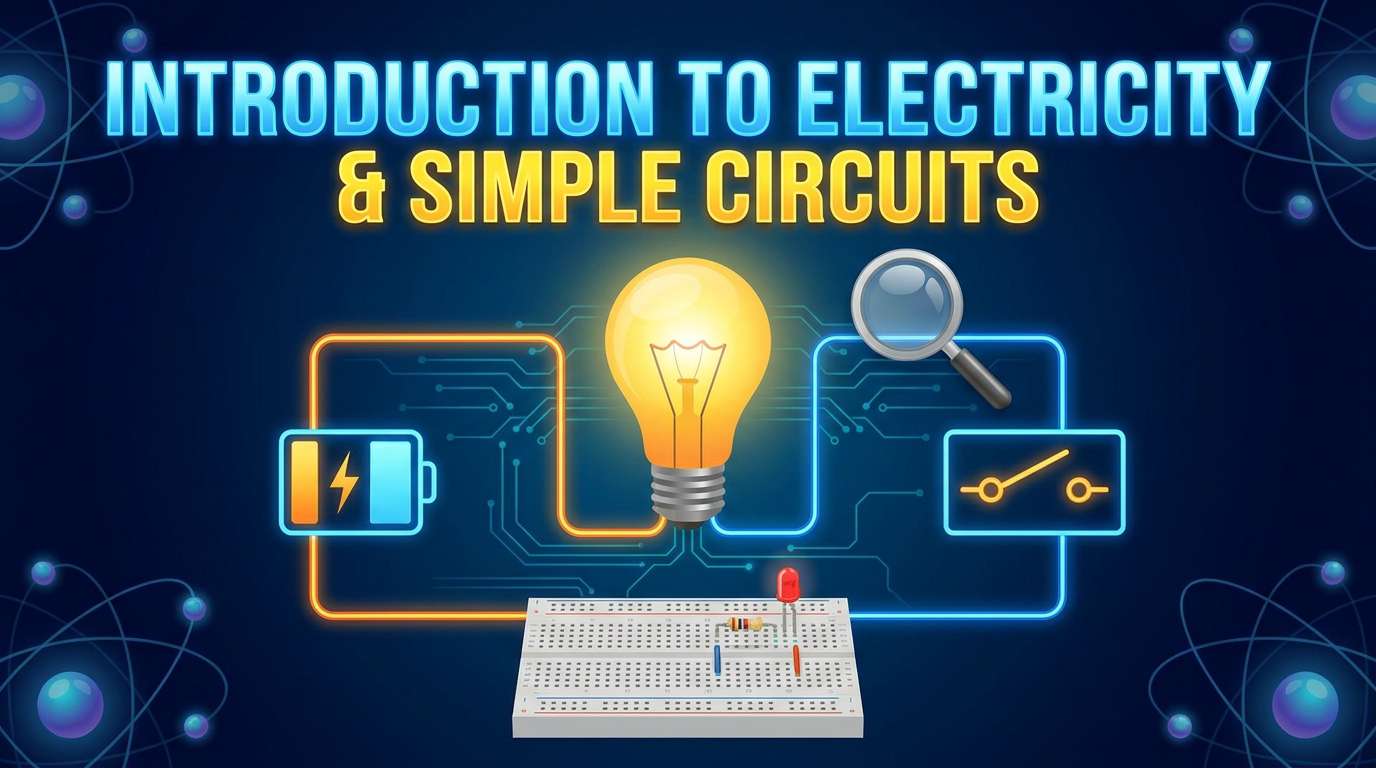
Introduction to Electricity and Simple Circuits
Introduction
Electricity is one of the most important forms of energy in the modern world. It powers our homes, schools, hospitals, industries, and communication systems. From charging a mobile phone to operating a refrigerator, electricity plays a vital role in daily life.
Despite its widespread use, many students have only a basic understanding of how electricity works. Learning the fundamentals of electricity and electrical circuits helps students appreciate the science behind many of the devices they use every day.
This article introduces the basic concepts of electricity, electric current, voltage, resistance, and simple circuits.
What Is Electricity?
Electricity is the flow of electric charges, usually in the form of electrons, through a conductor.
These moving charges carry energy from one place to another, making it possible for electrical devices to function.
Electricity can be generated from various sources including:
- Hydroelectric power stations.
- Solar energy.
- Wind energy.
- Thermal power plants.
- Batteries.
Understanding Electric Charge
Matter is made up of tiny particles called atoms. Within atoms are particles known as electrons and protons.
- Electrons carry negative charges.
- Protons carry positive charges.
Electricity results from the movement of electrons from one place to another.
Types of Electricity
1. Static Electricity
Static electricity occurs when electric charges accumulate on the surface of an object.
Examples include:
- A balloon sticking to a wall after being rubbed on hair.
- A small electric shock when touching a metal object.
- Lightning during thunderstorms.
2. Current Electricity
Current electricity occurs when electric charges flow continuously through a conductor.
This is the type of electricity used in homes, schools, and industries.
What Is Electric Current?
Electric current is the rate of flow of electric charge through a conductor.
It is measured in amperes (A).
The greater the flow of charges, the higher the current.
Examples of devices that use electric current include:
- Light bulbs.
- Fans.
- Televisions.
- Computers.
- Mobile phones.
What Is Voltage?
Voltage is the electrical force that pushes charges through a circuit.
It is sometimes referred to as potential difference.
Voltage is measured in volts (V).
Batteries provide voltage that drives current through electrical devices.
What Is Resistance?
Resistance is the opposition to the flow of electric current.
Every conductor offers some resistance to moving electrons.
Resistance is measured in ohms (Ω).
Materials with high resistance reduce current flow, while materials with low resistance allow current to pass more easily.
Conductors and Insulators
Conductors
Conductors are materials that allow electric current to pass through them easily.
Examples:
- Copper.
- Aluminium.
- Silver.
- Gold.
Insulators
Insulators are materials that resist the flow of electricity.
Examples:
- Rubber.
- Plastic.
- Glass.
- Wood.
What Is an Electric Circuit?
An electric circuit is a complete path through which electric current flows.
For a circuit to work properly, it must form a closed loop.
If the loop is broken, current cannot flow and the circuit stops working.
Components of a Simple Circuit
A simple electrical circuit consists of several basic components.
1. Power Source
The power source provides electrical energy.
Examples:
- Battery.
- Generator.
- Solar cell.
2. Conducting Wires
Wires connect the various parts of the circuit and allow current to flow.
3. Load
The load is the device that uses electrical energy.
Examples:
- Light bulb.
- Fan.
- Motor.
- Radio.
4. Switch
A switch controls the flow of current by opening or closing the circuit.
Open and Closed Circuits
Open Circuit
An open circuit has a break in the path.
Since current cannot flow, connected devices do not operate.
Closed Circuit
A closed circuit provides a complete path for current flow.
Devices connected to the circuit can function normally.
Series Circuits
In a series circuit, components are connected one after another in a single path.
Characteristics include:
- Only one path for current flow.
- Current is the same throughout the circuit.
- If one component fails, the entire circuit stops working.
Example: Traditional Christmas light strings.
Parallel Circuits
In a parallel circuit, components are connected on separate branches.
Characteristics include:
- Multiple paths for current flow.
- Devices operate independently.
- If one branch fails, others continue working.
Most household wiring systems use parallel circuits.
Ohm's Law
Ohm's Law explains the relationship between voltage, current, and resistance.
Formula:
Voltage = Current × Resistance
V = I × R
This formula helps electricians and engineers calculate electrical quantities in circuits.
Electrical Safety
Electricity is useful but can be dangerous if handled improperly.
Important safety rules include:
- Do not touch exposed wires.
- Keep electrical devices away from water.
- Do not overload sockets.
- Switch off appliances when not in use.
- Use properly insulated cables.
Applications of Electricity
Electricity is used in nearly every aspect of modern life.
- Lighting homes and streets.
- Communication systems.
- Transportation systems.
- Healthcare equipment.
- Industrial production.
- Education and technology.
Common Mistakes Students Make
- Confusing voltage with current.
- Misunderstanding the role of resistance.
- Forgetting that circuits must be closed.
- Mixing up conductors and insulators.
- Applying electrical formulas incorrectly.
Tips for Studying Electricity
- Understand the basic concepts before memorizing formulas.
- Practice drawing circuit diagrams.
- Solve numerical problems regularly.
- Learn standard electrical symbols.
- Perform simple circuit experiments when possible.
Conclusion
Electricity is a fundamental form of energy that powers the modern world. Understanding electric current, voltage, resistance, conductors, insulators, and circuits provides a solid foundation for studying physics and electrical technology.
By mastering these basic concepts, students can better appreciate how electrical devices work and prepare themselves for more advanced studies in science, engineering, and technology.