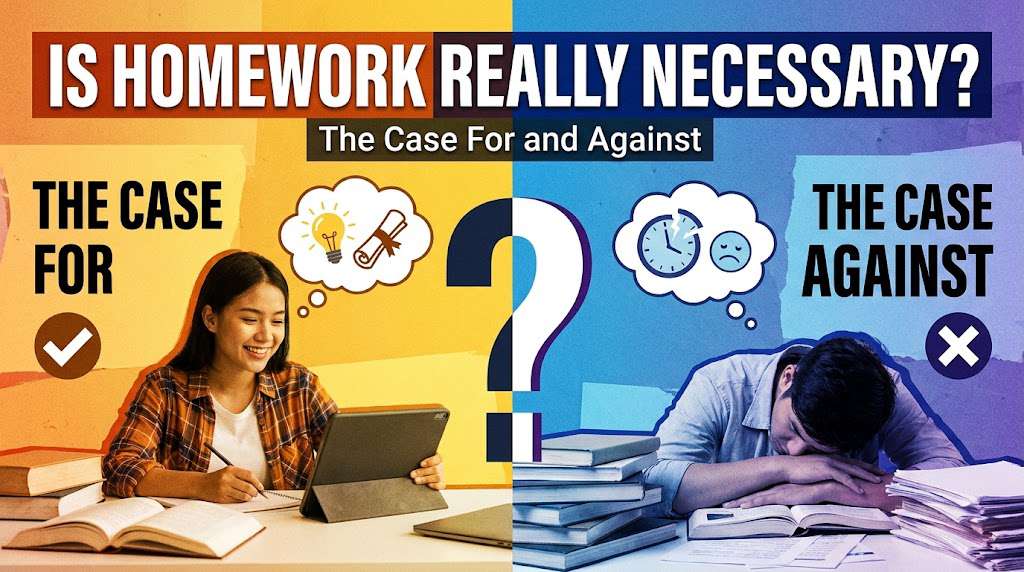
Is Homework Really Necessary? The Case For and Against
Introduction
It is a scene familiar to students everywhere. The school bell rings, bags are packed, and just as the prospect of freedom beckons, a teacher delivers the familiar instruction: "Don't forget your homework." For most students, homework is an unavoidable feature of school life — as routine as morning assembly or end-of-term examinations.
But is homework actually necessary? Does it genuinely improve learning, or is it simply a tradition that schools continue out of habit? Parents, teachers, students, and researchers have debated this question for decades, and opinions remain sharply divided.
This article examines both sides of the argument to explore whether homework is a valuable learning tool or an unnecessary burden on young people.
What Is the Purpose of Homework?
Before examining the arguments for and against homework, it is worth considering what homework is intended to achieve. Educators who support the practice typically argue that homework serves several important functions:
- Reinforcing and consolidating what has been taught in class.
- Encouraging students to work independently and take responsibility for their learning.
- Developing discipline, time management, and organisational skills.
- Preparing students for examinations and assessments.
- Keeping parents informed about what their children are studying at school.
These are reasonable goals. The question is whether homework actually achieves them — and at what cost.
The Case For Homework
Supporters of homework put forward several well-established arguments in its favour.
Homework reinforces classroom learning. The process of revisiting material outside the classroom helps students consolidate what they have learned and move information from short-term to long-term memory. Psychologists refer to this as the "spacing effect" — the finding that learning is more effective when it is spread out over time rather than concentrated in a single session.
Homework builds independent learning skills. Working through a problem or completing a task without the immediate support of a teacher requires students to think for themselves, manage their time, and develop resilience. These are skills that will serve them throughout their academic and professional lives.
Homework prepares students for examinations. Regular practice through homework assignments helps students become familiar with the type of questions they will face in formal assessments. Students who consistently complete homework tend to perform better in examinations because they have had more opportunity to practise and identify gaps in their understanding.
Research supports homework — in moderation. A widely cited analysis by educational researcher Harris Cooper found a positive correlation between homework and academic achievement, particularly for secondary school students. However, the research also suggested that this benefit has limits — more homework is not always better, and excessive amounts can be counterproductive.
The Case Against Homework
Critics of homework raise equally compelling objections, many of which resonate strongly with the lived experiences of students and families.
Homework causes stress and reduces wellbeing. Numerous studies have found that heavy homework loads contribute significantly to stress, anxiety, and sleep deprivation among students. Young people need time to rest, play, socialise, and pursue interests outside of school. When homework consumes their evenings and weekends, it leaves little room for the activities that are essential for healthy development.
Homework widens the inequality gap. Not all students have access to the same resources at home. Some have quiet study spaces, fast internet connections, and parents who can provide academic support. Others share cramped living spaces, lack internet access, or have parents who are working multiple jobs and unable to help. Homework can therefore disadvantage students who are already struggling, reinforcing existing inequalities rather than reducing them.
The evidence for homework is weaker than many assume. While some research supports the benefits of homework for older students, the evidence for younger students is far less convincing. Several studies have found little or no correlation between homework and academic achievement at primary school level, raising questions about whether the practice is genuinely effective or simply habitual.
Homework can undermine a love of learning. When students are overwhelmed with assignments, learning can begin to feel like a chore rather than a source of curiosity and pleasure. The pressure to complete homework quickly and correctly — often late at night after a long school day — is unlikely to foster a genuine love of the subject being studied.
What Do Students Think?
It will come as little surprise that many students are not enthusiastic supporters of homework. Surveys consistently show that students feel they are given too much homework and that it interferes with their personal time, sleep, and extracurricular activities.
However, student opinions are more nuanced than a simple dislike of homework. Many students acknowledge that certain types of homework — particularly revision for upcoming examinations or practice of skills such as mathematics or language learning — are genuinely useful. What they object to is homework that feels pointless, repetitive, or disconnected from what they are learning in class.
Finding the Right Balance
The debate over homework is unlikely to be resolved by abolishing it entirely or by defending it uncritically. The evidence suggests that the quality, purpose, and quantity of homework matter enormously.
Many education experts now advocate for a more thoughtful approach to homework — one that prioritises meaningful tasks over volume, takes into account students' wellbeing and home circumstances, and ensures that homework is clearly connected to what is being taught in class.
Some schools have experimented with reducing or eliminating homework altogether, replacing it with encouraging students to read for pleasure, pursue creative interests, or spend time with their families. Early results from such experiments have been broadly positive, with students reporting lower stress levels and no significant decline in academic performance.
Conclusion
The question of whether homework is truly necessary does not have a simple answer. Used thoughtfully and in moderation, homework can reinforce learning, build important skills, and help students prepare for examinations. Used excessively or without clear purpose, it can cause stress, widen inequalities, and erode a student's love of learning.
What is clear is that homework should never be assigned simply out of habit or tradition. Every task set outside the classroom should have a clear purpose, be appropriate to the student's age and circumstances, and contribute meaningfully to their learning and development.
Ultimately, the goal of education is not to produce students who are expert at completing homework — it is to nurture curious, capable, and confident individuals who are equipped for the challenges of adult life. Homework, when used wisely, can contribute to that goal. When used poorly, it can undermine it.