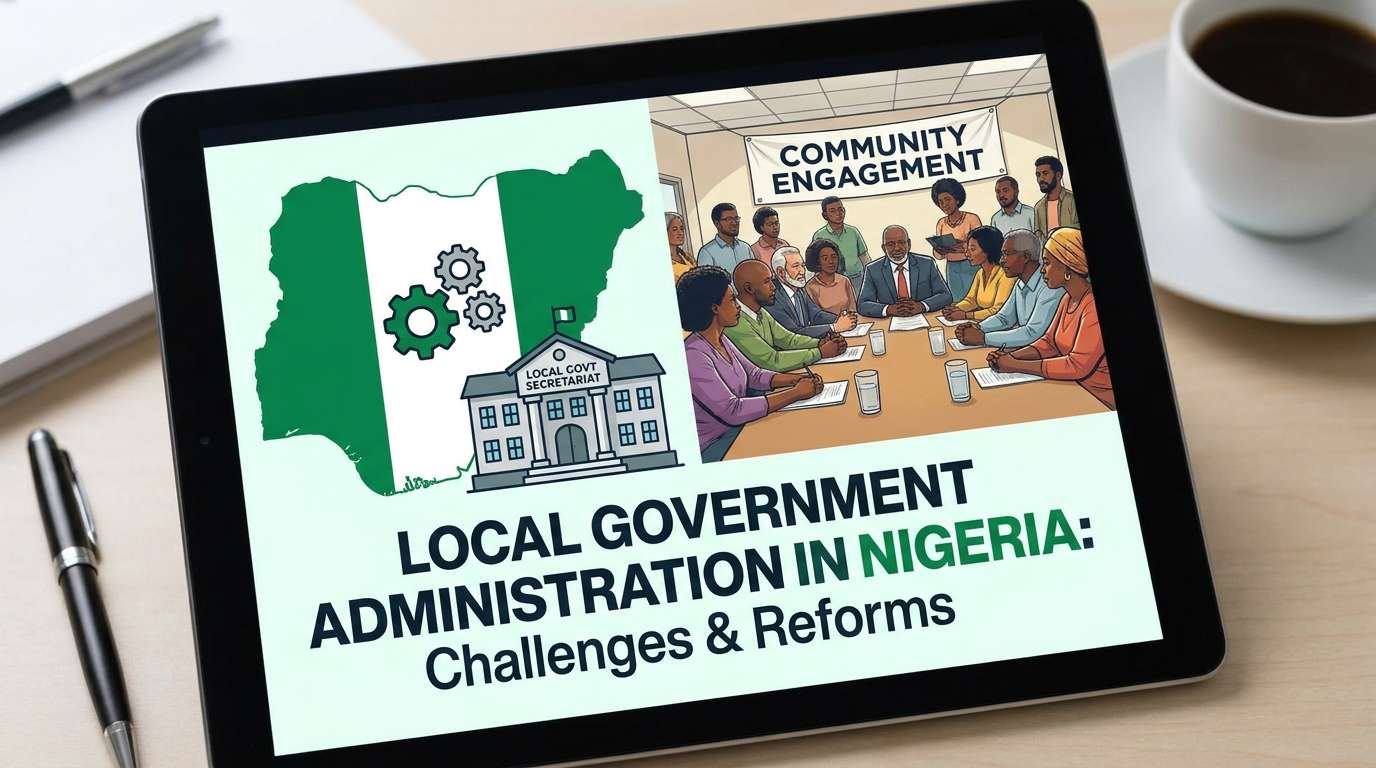
Local Government Administration in Nigeria
Introduction
Local government is the third and closest tier of government to the people, after the federal and state governments. It is responsible for administering affairs at the grassroots level, bringing governance closer to the ordinary citizen.
In Nigeria, local governments play a crucial role in providing basic services, promoting community development, and serving as a training ground for future political leaders.
Understanding local government administration helps students appreciate how governance is structured at the grassroots and why this level of government matters for everyday life.
Meaning of Local Government
Local government refers to a system of administration in which a defined community or area manages its own affairs through elected representatives, under the general supervision of state and federal governments.
It is the government closest to the people, dealing with matters that directly affect their daily lives, such as sanitation, primary healthcare, and local infrastructure.
Structure of Local Government in Nigeria
Nigeria currently has 774 local government areas (LGAs) spread across the 36 states and the Federal Capital Territory. Each local government is structured as follows:
1. The Executive Arm
- Headed by an elected Chairman.
- Assisted by a Vice Chairman.
- Supported by supervisory councillors who oversee specific departments.
2. The Legislative Arm
- Made up of elected councillors representing different wards within the local government.
- Responsible for making bye-laws for the local government area.
- Headed by the Leader of the Legislative Council.
3. Traditional Institutions
Traditional rulers, though not part of the formal governmental structure, often play advisory roles and assist local governments in maintaining peace and mobilizing communities.
Functions of Local Government
1. Provision of Basic Amenities
Local governments construct and maintain local roads, markets, motor parks, and public conveniences within their areas.
2. Primary Healthcare Services
They establish and manage primary healthcare centers, providing basic medical services to rural and urban communities.
3. Primary Education
Local governments, in collaboration with state governments, are responsible for the management of primary schools within their areas.
4. Registration of Births and Deaths
They maintain records of vital events such as births, deaths, and marriages within their jurisdiction.
5. Sanitation and Environmental Management
Local governments oversee waste disposal, drainage maintenance, and general environmental sanitation within their areas.
6. Collection of Rates and Taxes
They collect local taxes, tenement rates, and market or shop fees, which contribute to internally generated revenue.
7. Maintenance of Law and Order
Local governments assist in maintaining peace at the community level, often working with traditional rulers and community leaders.
8. Agricultural Development
They support farmers through extension services, provision of farming inputs, and development of local agricultural markets.
Sources of Revenue for Local Government
- Statutory allocation from the Federation Account.
- Grants from state and federal governments.
- Internally generated revenue, such as tenement rates and market fees.
- Fines and fees from local courts and licenses.
- Loans and external assistance for specific development projects.
Importance of Local Government
- Brings governance closer to the people at the grassroots level.
- Provides essential services that directly affect citizens' daily lives.
- Serves as a training ground for future political leaders.
- Encourages grassroots participation in governance and development.
- Helps in the equitable distribution of resources and development across regions.
- Facilitates the implementation of federal and state policies at the community level.
Relationship Between Local Government and State Government
Local governments in Nigeria operate under the supervision of state governments, which are constitutionally empowered to create laws guiding local government administration. This relationship has often generated debate, particularly regarding the autonomy and control of local government funds, which are sometimes managed through State Joint Local Government Accounts.
Challenges Facing Local Government Administration in Nigeria
- Excessive control and interference by state governments, limiting autonomy.
- Inadequate and irregular funding, especially due to diversion of allocated funds.
- Corruption and mismanagement of local government resources.
- Weak internally generated revenue due to poor tax collection systems.
- Political instability, including prolonged use of caretaker committees instead of elected officials.
- Inadequate infrastructure and manpower for effective service delivery.
Ways to Strengthen Local Government Administration
- Granting genuine financial and administrative autonomy to local governments.
- Ensuring regular and transparent local government elections.
- Strengthening internally generated revenue through efficient tax systems.
- Improving accountability and transparency in the use of local government funds.
- Building the capacity of local government staff for effective service delivery.
Conclusion
Local government administration is vital to Nigeria's federal structure, serving as the closest point of contact between citizens and government. Strengthening local governments through genuine autonomy, adequate funding, and accountable leadership is essential for grassroots development and effective governance across the country.