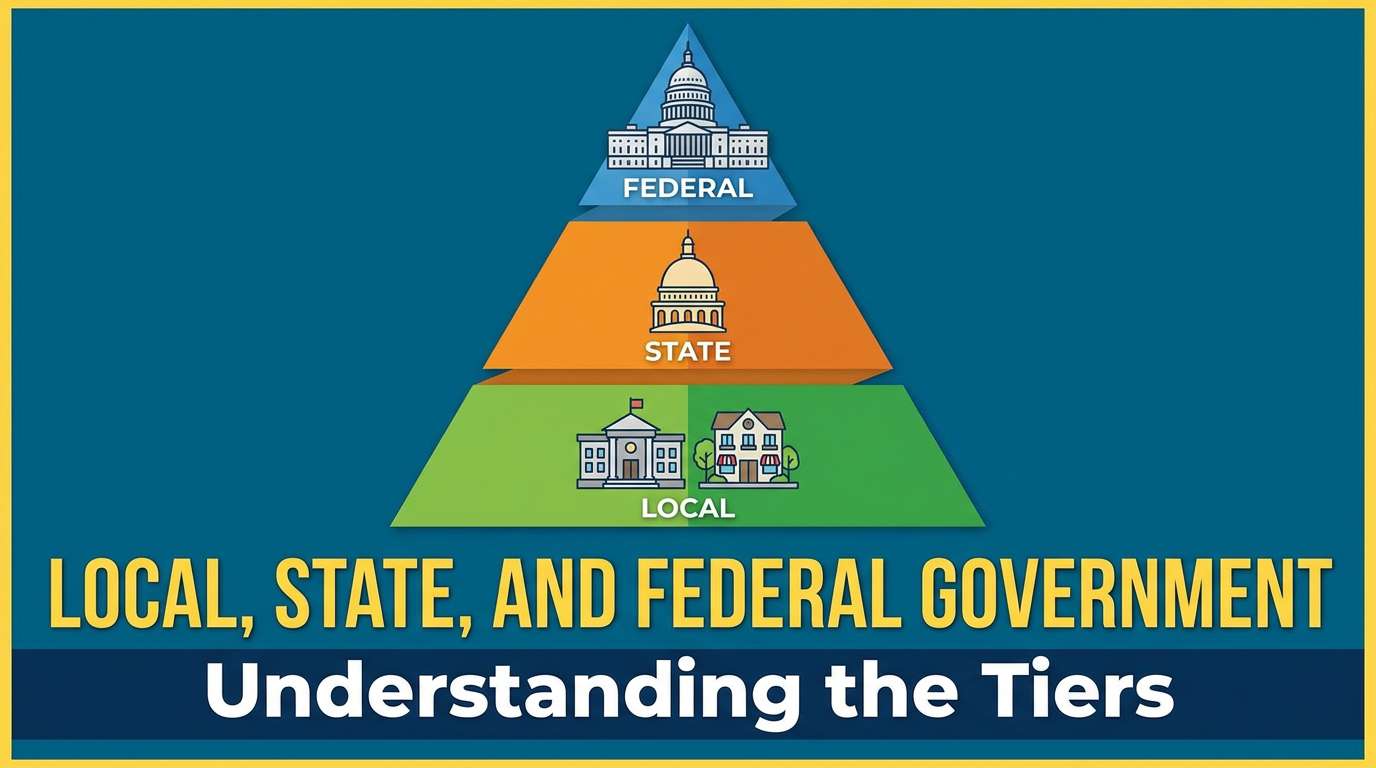
Local, State, and Federal Government: Understanding the Tiers
Introduction
When a pothole appears on a street in a small town, it is unlikely that the President of Nigeria will personally oversee its repair. When a dispute arises over international trade agreements, it is equally unlikely that a local government council will be the body responsible for resolving it. Different kinds of governmental responsibility naturally suit different levels of government — some matters are best handled close to the communities they affect, while others require coordination at a much broader, national scale.
Nigeria's Constitution formally recognizes this reality by establishing three distinct tiers of government — federal, state, and local — each with its own defined structure, responsibilities, and sources of funding. This article explores each of these tiers in depth, how they relate to one another, and how they function together within Nigeria's broader federal system, building on the foundational discussion of federalism covered elsewhere in this syllabus.
Why Nigeria Has Three Tiers of Government
Given Nigeria's enormous population, geographic size, and diversity, a single, centralized government attempting to directly manage every level of public administration — from national defence down to local market regulation — would be impractical and poorly suited to the specific needs of individual communities. By establishing three distinct tiers, each responsible for different categories of governmental function, Nigeria's constitutional structure aims to bring certain decisions closer to the people most directly affected by them, while reserving matters of truly national concern for coordinated action at the federal level.
The Federal Government
The federal government, headquartered in the Federal Capital Territory, Abuja, is Nigeria's central, national government, headed by the President. It is responsible for matters of national concern, as defined primarily by the Exclusive Legislative List discussed in the article on Nigerian federalism.
Structure of the Federal Government
- Executive: Headed by the President, supported by the Vice President, ministers, and federal government agencies and parastatals.
- Legislature: The National Assembly, consisting of the Senate and House of Representatives.
- Judiciary: Headed by the Supreme Court, alongside other federal courts such as the Federal High Court.
Key Responsibilities of the Federal Government
- National defence and the armed forces
- Foreign affairs and diplomatic relations
- Currency, monetary policy, and national economic planning
- Immigration, citizenship, and passport issuance
- Regulation of mines and mineral resources, including oil and gas
- National infrastructure projects of broad significance, such as major federal highways and international airports
State Governments
Nigeria currently consists of 36 states, along with the Federal Capital Territory, each headed by a Governor, elected directly by the residents of that state. State governments operate largely within the areas defined by the Concurrent Legislative List and matters considered residual to state authority, as discussed in the article on Nigerian federalism.
Structure of State Government
- Executive: Headed by the Governor, supported by a Deputy Governor and state commissioners.
- Legislature: The State House of Assembly, a unicameral (single-chamber) legislature.
- Judiciary: Headed by the State High Court, alongside other state-level courts.
Key Responsibilities of State Governments
- State-level education, including secondary schools and, in many cases, state universities and colleges
- State hospitals and aspects of healthcare provision
- State roads and certain aspects of transportation infrastructure
- Agricultural development within the state
- State civil service administration and internal state security coordination, working alongside federal security agencies
Local Government
Local government represents the tier of government closest to individual communities, intended to address matters of direct, everyday concern to residents at a highly localized level. Nigeria's local government areas (LGAs), numbering 774 in total, are typically headed by an elected Chairman, supported by elected Councillors representing individual wards within the local government area.
Key Responsibilities of Local Governments
- Registration of births, deaths, and marriages
- Maintenance of local markets, motor parks, and parks and gardens
- Provision and maintenance of primary healthcare centres
- Refuse disposal and sanitation within the local area
- Assessment of properties for the purpose of levying certain local rates and taxes
- Construction and maintenance of local roads, streets, and drains not classified as state or federal roads
State Independent Electoral Commissions (SIECs)
Unlike federal and state elections, which are organized by INEC, elections for local government chairpersons and councillors are organized by each state's own State Independent Electoral Commission (SIEC), a body established separately within each state specifically for this purpose.
How Government Is Funded Across the Three Tiers
Each tier of government relies on a combination of internally generated revenue and allocations received from the Federation Account, into which nationally collected revenue — particularly from oil and gas — is paid before being distributed among the three tiers according to a revenue allocation formula, as discussed in greater detail in the article on Nigerian federalism.
- Federal government revenue includes customs duties, company income tax, and its allocated share of the Federation Account.
- State government revenue includes personal income tax collected within the state, certain state-level fees and levies, and its allocated share of the Federation Account.
- Local government revenue includes market fees, local rates, and its allocated share of the Federation Account, often distributed through the state government via a State Joint Local Government Account.
How the Three Tiers Interact
Although each tier possesses its own defined constitutional responsibilities, the three tiers of government do not operate in complete isolation from one another. In practice, considerable cooperation, coordination, and occasional tension exists between them, particularly regarding:
- Concurrent List matters, such as education and health, where both federal and state governments legislate and implement policy, sometimes requiring coordination to avoid conflicting approaches.
- Revenue allocation, a frequent source of disagreement, particularly regarding the fairness of the formula distributing funds among the three tiers.
- Local government autonomy, an ongoing and significant debate in Nigeria concerning the degree of genuine independence local governments hold in practice, given that many rely heavily on state governments for the disbursement of their allocated federal funding.
The Debate Over Local Government Autonomy
One of the most persistent and significant debates concerning Nigeria's three-tier system involves the practical independence of local governments. While the Constitution recognizes local government as a distinct tier, critics have long argued that in practice, many state governments exercise substantial influence over local government finances and administration — for example, through joint state-local government accounts — limiting the genuine autonomy the Constitution appears to envisage for this tier. This debate has periodically prompted legal challenges and calls for constitutional reform aimed at strengthening local government independence, including notable rulings from the Supreme Court addressing the direct allocation of local government funds.
Local, State, and Federal Government and WAEC/NECO Government
Key examinable areas of this topic include:
- The structure of each tier of government, including its executive, legislative, and (where applicable) judicial components.
- Specific responsibilities assigned to the federal, state, and local tiers of government.
- How each tier of government is funded, including internally generated revenue and Federation Account allocations.
- The distinction between INEC and State Independent Electoral Commissions (SIECs).
- Ongoing debates surrounding local government autonomy within Nigeria's federal system.
Common Mistakes Students Make
- Confusing the responsibilities of state and local government, particularly regarding education and healthcare, where both may have some role, but at different levels (e.g. state secondary schools versus local primary healthcare centres).
- Assuming INEC organizes local government elections. These are organized by each state's own State Independent Electoral Commission (SIEC), not INEC.
- Describing the State House of Assembly as bicameral. Unlike the National Assembly, State Houses of Assembly are unicameral, consisting of a single chamber.
- Overlooking local government revenue sources, focusing only on federal allocations without recognizing locally generated revenue such as market fees and local rates.
- Assuming all three tiers of government operate with complete independence from one another, without acknowledging the genuine interdependence and, at times, tension between them, particularly regarding local government autonomy.
Conclusion
Nigeria's three-tier system of government — federal, state, and local — reflects a deliberate constitutional effort to match different categories of governmental responsibility to the level of government best suited to handle them, from matters of broad national significance managed by the federal government, to the more immediate, everyday concerns addressed by local government closest to individual communities.
Understanding how these three tiers are structured, funded, and interconnected — along with the genuine, ongoing debates surrounding the practical autonomy of local government in particular — gives students a much fuller picture of how governance in Nigeria actually operates, well beyond the simple textbook division of federal, state, and local responsibilities.