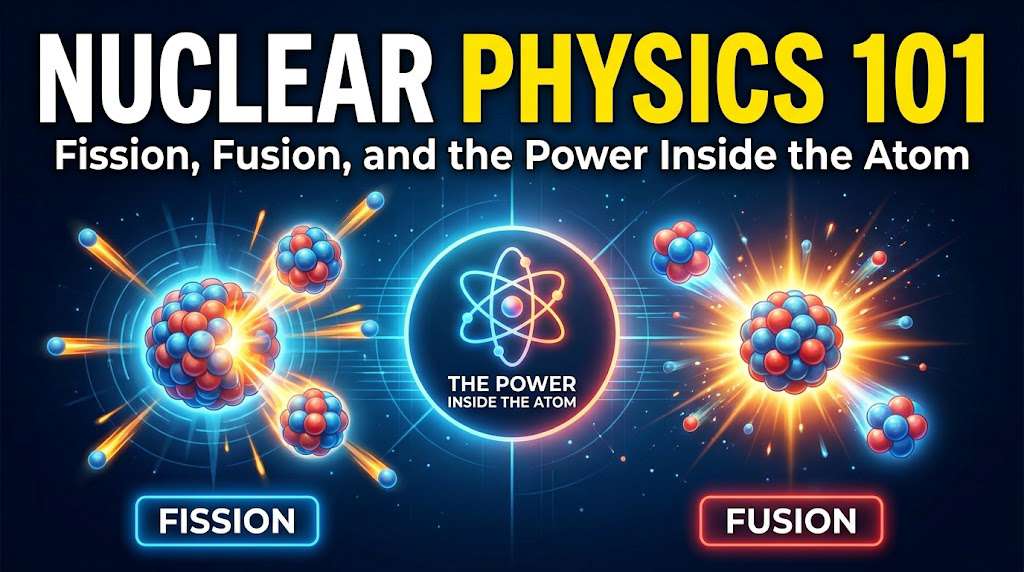
Nuclear Physics 101: Fission, Fusion, and the Power Inside the Atom
Introduction
Deep within every atom lies an extraordinary source of energy, locked away in a space far smaller than the atom itself. This tiny region, called the nucleus, contains forces so powerful that splitting or combining nuclei can release energy on a scale millions of times greater than any ordinary chemical reaction, such as burning fuel. These same nuclear processes power nuclear reactors that generate electricity for millions of homes, fuel the devastating force of nuclear weapons, and provide the energy that causes every star in the night sky, including our own Sun, to shine.
Two nuclear processes in particular — fission and fusion — lie at the heart of nuclear physics. Though they involve opposite actions, splitting apart versus combining together, both processes release enormous amounts of energy by tapping into the powerful forces that hold the nucleus of an atom together.
Inside the Atomic Nucleus
Every atom consists of a tiny, dense nucleus at its centre, surrounded by a cloud of much lighter electrons. The nucleus itself is made up of two types of particles: positively charged protons and neutrally charged neutrons, collectively known as nucleons.
Holding the nucleus together is one of the four fundamental forces of nature, known as the strong nuclear force. This force is necessary because, without it, the positively charged protons packed closely together within the nucleus would repel one another due to electromagnetic repulsion and fly apart. The strong nuclear force is, true to its name, extraordinarily powerful at very short distances — far stronger than the electromagnetic repulsion between protons — but it acts only across the tiny distances found within the nucleus itself.
The immense energy associated with nuclear processes comes from a famous relationship discovered by Albert Einstein, expressed in his equation:
E = mc²
This equation reveals that mass and energy are, in a sense, interchangeable, and that even a tiny amount of mass can be converted into an enormous quantity of energy, since the equation involves multiplying mass by the speed of light squared — an extraordinarily large number. Nuclear reactions involve very slight changes in the total mass of the particles involved, and according to Einstein's equation, even these slight changes in mass correspond to enormous releases of energy.
Nuclear Fission: Splitting Atoms
Nuclear fission occurs when the nucleus of a heavy, unstable atom — typically uranium-235 or plutonium-239 — is split apart into two smaller nuclei, usually after being struck by a neutron. This splitting process releases a substantial amount of energy, along with additional neutrons, which can go on to strike other nearby unstable nuclei, causing them to split as well.
If enough fissionable material is present, this process can become self-sustaining, with each split triggering further splits in a continuous process known as a chain reaction. In a nuclear power station, this chain reaction is carefully controlled, using materials that absorb excess neutrons to regulate the rate of fission, ensuring that energy is released steadily and safely. The heat generated by this controlled fission process is used to boil water, producing steam that drives turbines and generates electricity, in much the same way that a coal or gas power station generates electricity, except using nuclear fission as the heat source rather than combustion.
In an uncontrolled chain reaction, where fission is allowed to accelerate rapidly and without restraint, an enormous amount of energy can be released in an extremely short period of time — this is the destructive principle behind nuclear weapons.
Nuclear Fusion: Combining Atoms
Nuclear fusion is, in many respects, the opposite of fission. Rather than splitting a heavy nucleus apart, fusion involves forcing two light nuclei — typically isotopes of hydrogen — to combine together, forming a single, heavier nucleus, and releasing a substantial amount of energy in the process.
Fusion is the process that powers the Sun and every other star in the universe. Within the Sun's extraordinarily hot and dense core, where temperatures reach approximately fifteen million degrees Celsius, hydrogen nuclei are forced together with such force that they overcome their natural electromagnetic repulsion and fuse to form helium, releasing the immense energy that ultimately reaches Earth as sunlight and warmth.
Fusion releases significantly more energy per unit of mass than fission and produces far less long-lived radioactive waste, making it an extremely attractive potential energy source. However, achieving and sustaining the extreme temperatures and pressures required to trigger fusion here on Earth has proven enormously challenging, and although experimental fusion reactors have made significant progress in recent years, a commercially viable fusion power station capable of reliably generating more energy than it consumes remains, for now, a goal still being actively pursued by scientists around the world.
Comparing Fission and Fusion
Although both processes release energy by altering atomic nuclei, fission and fusion differ in several important ways. Fission splits heavy elements, such as uranium, while fusion combines light elements, such as hydrogen. Fission is already used commercially in nuclear power stations around the world, while fusion remains largely confined to research reactors and experimental facilities. Fission produces radioactive waste that can remain hazardous for thousands of years, while the radioactive by-products of fusion are generally far less long-lived. For these reasons, many scientists view fusion as a particularly promising long-term solution for generating large amounts of clean energy, should the considerable remaining technical challenges eventually be overcome.
Risks and Safety
Nuclear power carries unique risks alongside its considerable benefits. Nuclear reactors must be very carefully designed and operated to prevent accidents, and historical incidents such as the Chernobyl disaster in 1986 and the Fukushima disaster in 2011 demonstrate the serious consequences that can result when safety systems fail. Modern reactor designs incorporate multiple layers of safety systems specifically intended to prevent such incidents from recurring, and nuclear power remains, statistically, one of the safest large-scale sources of electricity generation when measured by deaths per unit of energy produced, despite the public attention such rare incidents tend to attract.
Radioactive waste produced by nuclear fission also presents a long-term challenge, since certain by-products of the fission process remain hazardous for extremely long periods of time, requiring careful, secure storage to protect both people and the environment for many generations to come.
Conclusion
Nuclear physics reveals an extraordinary source of power hidden within the very building blocks of matter itself. Fission, achieved by splitting heavy atomic nuclei, already powers reactors generating electricity for millions of people worldwide, while fusion, the process of combining light nuclei together, powers every star in the universe and may one day offer humanity an abundant, cleaner source of energy here on Earth.
Understanding these processes not only illuminates how nuclear power stations and nuclear weapons work, but also reveals the very same physics responsible for the light and warmth of the Sun — a powerful reminder that the same fundamental laws of physics govern phenomena across truly vast differences in scale, from the inside of an atom to the heart of a star.