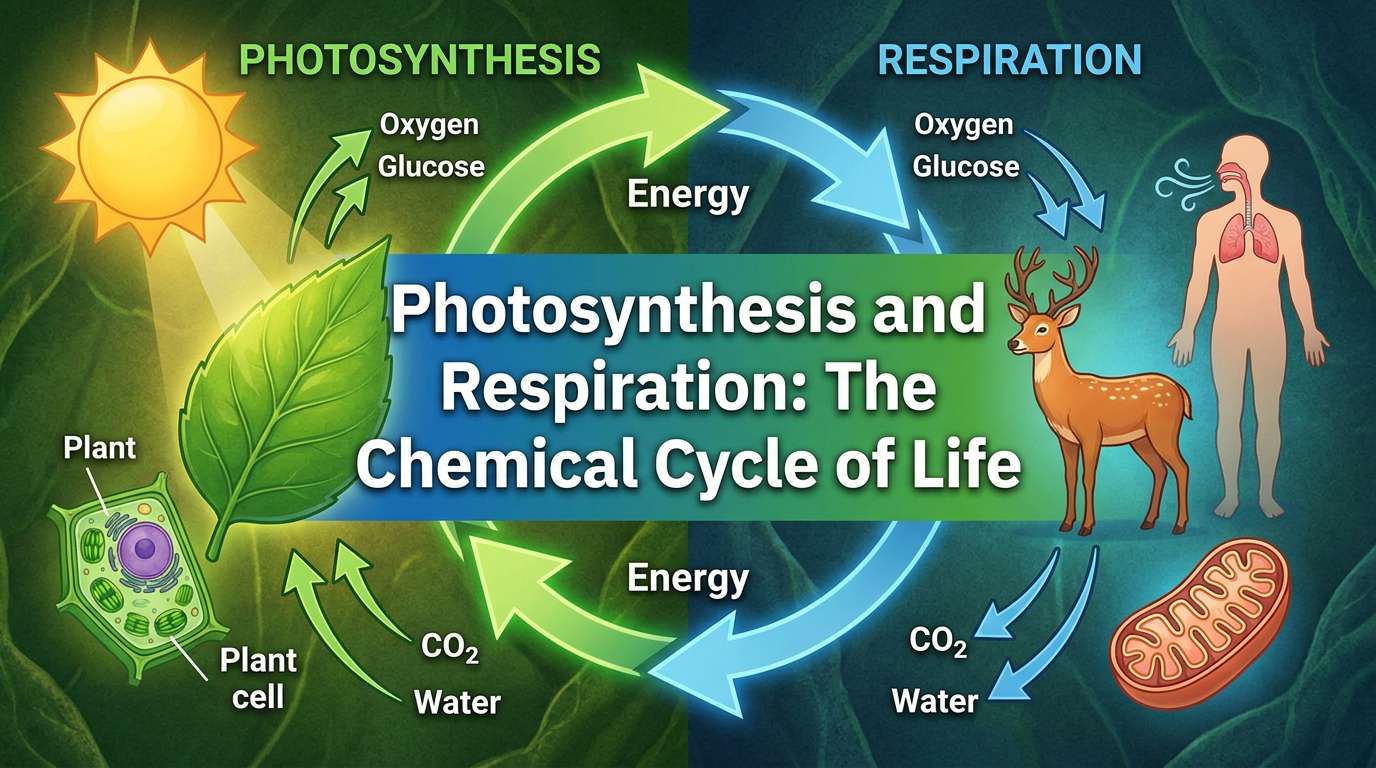
Photosynthesis and Respiration: The Chemical Cycle of Life
Introduction
Somewhere on Earth right now, a leaf is quietly capturing sunlight and turning it into sugar. Somewhere else, an animal's cells are breaking that very sugar back down to power a heartbeat, a thought, a single step forward. These two processes — photosynthesis and cellular respiration — are not separate curiosities of biology. They are two halves of a single chemical relationship, each one producing exactly what the other needs to run.
Strip away the biology textbook language, and what remains is pure chemistry: two balanced equations, mirror images of each other, quietly cycling carbon, oxygen, and energy through nearly every living thing on the planet.
Photosynthesis: Building Glucose from Sunlight
Photosynthesis is the process by which plants, algae, and certain bacteria convert light energy, along with carbon dioxide and water, into glucose and oxygen.1 In simple word-equation form:
Carbon dioxide + Water + Light energy → Glucose + Oxygen2
And in balanced chemical form:
6CO₂ + 6H₂O + light energy → C₆H₁₂O₆ + 6O₂1
Where Photosynthesis Happens
In plant cells, photosynthesis takes place inside organelles called chloroplasts.3 Within the chloroplast, a green pigment called chlorophyll absorbs sunlight — specifically blue-violet and red wavelengths of light, while reflecting green light, which is why plants appear green to our eyes.4 Chlorophyll is packed into stacked membrane structures called grana, where much of this light absorption takes place.3
The Two Stages of Photosynthesis
Photosynthesis occurs in two closely linked stages:
- Light-dependent reactions: Occurring in the thylakoid membranes of the chloroplast, light energy absorbed by chlorophyll excites electrons, and water molecules are split apart — a process called photolysis — releasing oxygen as a byproduct.4 The energised electrons are used to generate ATP and NADPH, two energy-carrying molecules.5
- Light-independent reactions (Calvin cycle): The ATP and NADPH produced in the first stage are then used to convert carbon dioxide into glucose, without requiring light directly.5
Sunlight is ultimately converted into chemical energy in the form of ATP (adenosine triphosphate), the primary energy-storing molecule used throughout living organisms.3
Cellular Respiration: Releasing Energy from Glucose
Cellular respiration is the set of metabolic reactions that cells use to break down glucose in the presence of oxygen, releasing the chemical energy stored within it as ATP.6 Its word equation is essentially the reverse of photosynthesis:
Glucose + Oxygen → Carbon dioxide + Water + Chemical energy (ATP)2
And in balanced chemical form:
C₆H₁₂O₆ + 6O₂ → 6CO₂ + 6H₂O + ATP6
Where Respiration Happens
Cellular respiration begins in the cytoplasm of the cell with a process called glycolysis, but most of its energy-releasing steps take place inside mitochondria.7 There, a series of metabolic pathways — including pyruvate oxidation, the citric acid (Krebs) cycle, and oxidative phosphorylation — progressively break down glucose, ultimately liberating the energy stored in its chemical bonds.7
How Much Energy Does Respiration Release?
Cellular respiration can theoretically yield up to around 36–38 molecules of ATP for every single molecule of glucose broken down.7 This makes respiration a remarkably efficient way for cells to extract usable chemical energy from the food organisms eat.
Two Reactions, Mirrored: Why They Depend on Each Other
Look closely at the two balanced equations and a striking pattern emerges: the products of photosynthesis are precisely the reactants of respiration, and the products of respiration are precisely the reactants of photosynthesis.8
| Photosynthesis | Cellular Respiration |
|---|---|
| 6CO₂ + 6H₂O + light → C₆H₁₂O₆ + 6O₂ | C₆H₁₂O₆ + 6O₂ → 6CO₂ + 6H₂O + ATP |
Photosynthesis takes in carbon dioxide and water, and releases oxygen and glucose as products.8 Cellular respiration does exactly the opposite: it takes in oxygen and glucose, and releases carbon dioxide and water as products.8 In effect, water is broken apart to release oxygen during photosynthesis, while oxygen is combined with hydrogen to reform water during respiration.8
This mirrored relationship means that the glucose plants build through photosynthesis becomes the very fuel that cellular respiration later breaks down to produce ATP — in the plant's own cells, or in the cells of any animal that eats the plant.2
Anabolism and Catabolism: Building Up vs. Breaking Down
In biochemical terms, photosynthesis and respiration represent the two fundamental directions of metabolism:
- Photosynthesis is anabolic — it builds larger, more complex molecules (glucose) from smaller ones (carbon dioxide and water), storing energy in the process.9
- Cellular respiration is catabolic — it breaks larger molecules (glucose) down into smaller ones (carbon dioxide and water), releasing the stored energy as it does so.9
Why This Chemical Partnership Sustains Life on Earth
Because animals — including humans — cannot photosynthesise their own food, they must obtain glucose by eating plants or other organisms, which then powers cellular respiration inside their own cells.6 At the same time, respiring organisms produce carbon dioxide, which photosynthesising plants require as a raw material to make more glucose.6
This continuous global exchange of carbon dioxide and oxygen between photosynthesis and respiration helps to maintain the relatively stable levels of both gases in Earth's atmosphere.10 On a planetary scale, this exchange is not a coincidence — it is essentially two halves of one chemical cycle, running continuously across the entire biosphere.
Photosynthesis, Respiration, and WAEC/JAMB Chemistry & Biology
- Balanced equations: Writing and balancing the chemical equations for both photosynthesis and cellular respiration is directly examinable.
- Reactants and products: Correctly identifying the reactants and products of each process, and recognising how they mirror one another.
- Energy transformations: Explaining how light energy is converted to chemical energy in photosynthesis, and how chemical energy is released as ATP in respiration.
- Gas exchange and the atmosphere: Understanding the role of these two processes in maintaining stable atmospheric oxygen and carbon dioxide levels.
- Cell structures: Identifying chloroplasts as the site of photosynthesis and mitochondria as the site of cellular respiration.
Common Mistakes Students Make
- Thinking only plants respire. All living cells — plant and animal alike — carry out cellular respiration to produce ATP; only plants (and some other organisms) additionally carry out photosynthesis.
- Reversing the equations. Photosynthesis converts CO₂ and water into glucose and oxygen; respiration does the reverse. Mixing up which gas is a reactant and which is a product in each process is a very common error.
- Forgetting chlorophyll's specific role. Chlorophyll absorbs light energy — it does not itself become part of the glucose molecule produced.
- Leaving equations unbalanced. Both equations must be properly balanced, with six molecules each of carbon dioxide, water, and oxygen, matched correctly against one molecule of glucose.
Conclusion
Photosynthesis and cellular respiration are not two unrelated topics that happen to appear in the same textbook chapter — they are one continuous chemical relationship, running in opposite directions, each supplying exactly what the other consumes. Sunlight becomes sugar; sugar becomes energy; the leftover carbon dioxide and water cycle right back around to start the process again.
Every breath you take, every leaf that turns toward the sun, is part of this same quiet chemical exchange — a cycle of building up and breaking down that has powered life on Earth for billions of years, and continues, invisibly, in every living cell around you right now.