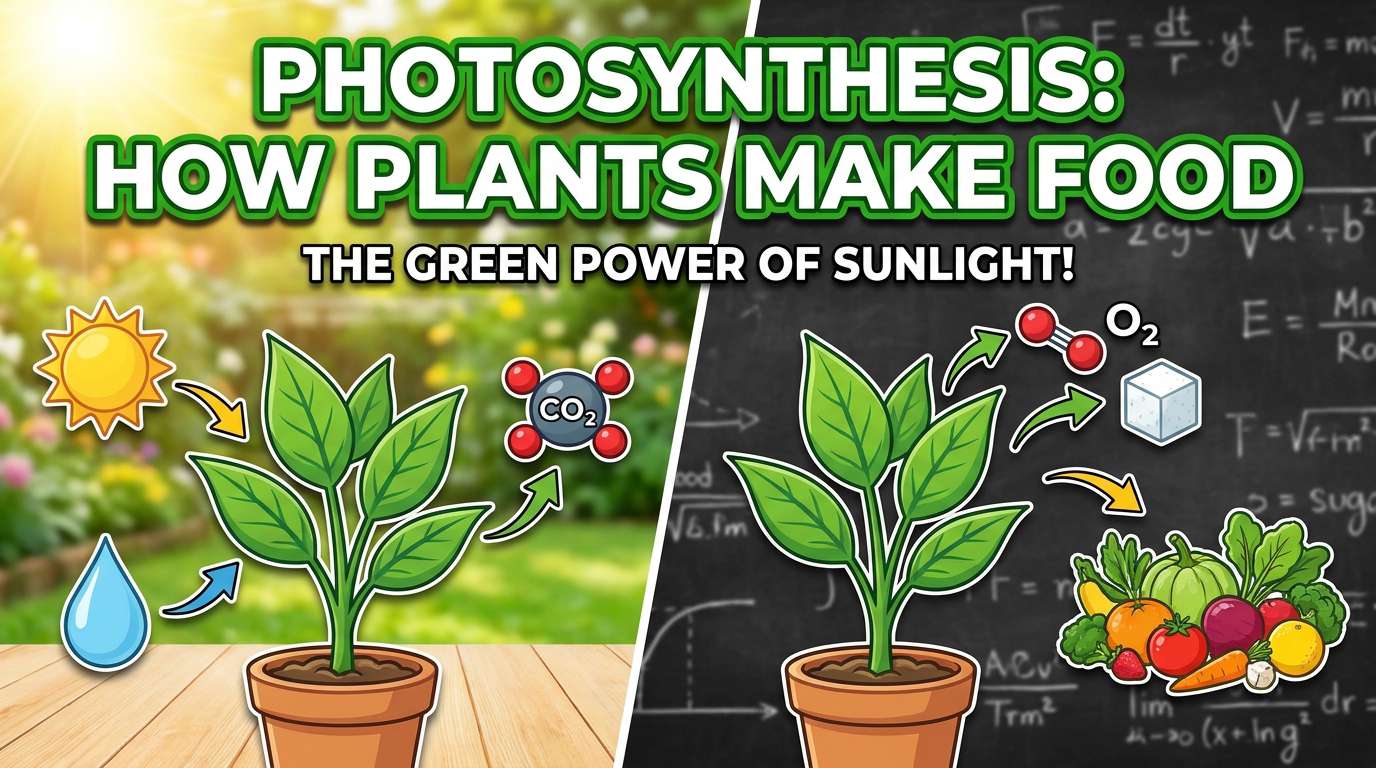
Photosynthesis: How Plants Make Food
Introduction
Plants are unique living organisms because they can produce their own food. Unlike animals, which depend directly or indirectly on other organisms for nutrition, green plants have the remarkable ability to manufacture food using sunlight, water, and carbon dioxide.
This food-making process is known as photosynthesis. It is one of the most important biological processes on Earth because it provides food, releases oxygen into the atmosphere, and supports nearly all forms of life.
Without photosynthesis, food chains would collapse, oxygen levels would decrease, and life as we know it would not exist.
What Is Photosynthesis?
Photosynthesis is the process by which green plants use sunlight energy to convert carbon dioxide and water into glucose (food) and oxygen.
This process occurs mainly in the leaves of green plants and requires chlorophyll, the green pigment found in plant cells.
The Word Photosynthesis
The term "photosynthesis" comes from two Greek words:
- Photo meaning light.
- Synthesis meaning putting together.
Therefore, photosynthesis literally means "putting together using light."
The Photosynthesis Equation
The chemical equation for photosynthesis is:
6CO₂ + 6H₂O + Light Energy → C₆H₁₂O₆ + 6O₂
This means that six molecules of carbon dioxide combine with six molecules of water in the presence of sunlight to produce one molecule of glucose and six molecules of oxygen.
Requirements for Photosynthesis
Several essential factors are required for photosynthesis to occur successfully.
1. Sunlight
Sunlight provides the energy needed to drive the photosynthetic process.
Without sunlight, plants cannot manufacture food effectively.
2. Water
Water is absorbed from the soil through the roots and transported to the leaves.
It supplies hydrogen needed for glucose production.
3. Carbon Dioxide
Carbon dioxide is obtained from the atmosphere through tiny openings on the leaves called stomata.
4. Chlorophyll
Chlorophyll is the green pigment found in chloroplasts.
It absorbs sunlight and converts light energy into chemical energy.
Where Does Photosynthesis Occur?
Photosynthesis occurs mainly in the leaves of plants.
Within the leaves are tiny structures called chloroplasts, which contain chlorophyll.
Why Leaves Are Important
- They contain large amounts of chlorophyll.
- They have a broad surface area for capturing sunlight.
- They contain stomata for gas exchange.
- They are connected to transport tissues.
Structure of a Leaf and Photosynthesis
Stomata
Stomata are tiny pores found mostly on the underside of leaves.
They allow:
- Carbon dioxide to enter.
- Oxygen to leave.
- Water vapor to escape.
Chloroplasts
Chloroplasts are specialized structures that contain chlorophyll and serve as the site of photosynthesis.
Stages of Photosynthesis
Photosynthesis can be divided into two major stages.
1. Light-Dependent Stage
This stage requires sunlight.
- Light energy is absorbed by chlorophyll.
- Water molecules are split.
- Oxygen is released.
- Energy-rich compounds are produced.
2. Light-Independent Stage
This stage uses the energy captured during the light-dependent stage.
- Carbon dioxide is converted into glucose.
- Food is synthesized for plant growth and storage.
Products of Photosynthesis
Glucose
Glucose is the food produced during photosynthesis.
Plants use glucose for:
- Respiration.
- Growth.
- Storage as starch.
- Production of fruits and seeds.
Oxygen
Oxygen is released into the atmosphere as a by-product of photosynthesis.
Humans and animals depend on this oxygen for respiration.
Factors Affecting Photosynthesis
1. Light Intensity
Increasing light intensity generally increases the rate of photosynthesis up to a certain point.
2. Carbon Dioxide Concentration
Higher carbon dioxide levels can increase the rate of photosynthesis.
3. Temperature
Photosynthesis depends on enzymes, which work best within specific temperature ranges.
4. Water Availability
Water shortages can reduce photosynthesis significantly.
5. Chlorophyll Content
Plants with insufficient chlorophyll photosynthesize less efficiently.
Importance of Photosynthesis
1. Food Production
Photosynthesis provides food for plants and forms the foundation of most food chains.
2. Oxygen Supply
The oxygen released during photosynthesis supports life on Earth.
3. Energy Transfer
Photosynthesis converts solar energy into chemical energy stored in food.
4. Carbon Dioxide Removal
Plants help reduce atmospheric carbon dioxide levels.
5. Environmental Balance
Photosynthesis helps maintain ecological stability.
Photosynthesis and Agriculture
Farmers depend on photosynthesis for crop production.
- Healthy plants produce higher yields.
- Good sunlight exposure improves growth.
- Proper irrigation supports photosynthesis.
- Fertilizers help plants develop chlorophyll.
Photosynthesis and the Environment
Photosynthesis plays a major role in combating climate change.
- Absorbs carbon dioxide.
- Produces oxygen.
- Supports biodiversity.
- Maintains ecosystems.
Experiments Demonstrating Photosynthesis
Test for Starch in Leaves
Scientists test leaves for starch to demonstrate that photosynthesis has occurred.
The presence of starch indicates that glucose was produced and stored.
Common Misconceptions About Photosynthesis
- Plants do not obtain food from soil.
- Plants also respire, not only photosynthesize.
- Photosynthesis mainly occurs in green parts of plants.
- Sunlight alone is not sufficient without water and carbon dioxide.
Common Examination Questions
- Define photosynthesis.
- State the requirements for photosynthesis.
- Write the photosynthesis equation.
- Explain the role of chlorophyll.
- List five importance of photosynthesis.
Summary
- Photosynthesis is the process by which plants make food.
- It requires sunlight, water, carbon dioxide, and chlorophyll.
- Glucose and oxygen are produced.
- Photosynthesis supports food chains and oxygen supply.
- It is essential for agriculture and environmental sustainability.
Conclusion
Photosynthesis is one of the most important biological processes on Earth. Through this process, plants convert sunlight into food, release oxygen, and support virtually all life forms. Understanding photosynthesis helps students appreciate the vital role plants play in sustaining ecosystems, supporting agriculture, and maintaining environmental balance.