Political Parties and Their Role in a Democracy
Introduction
Imagine an election in which every candidate ran entirely independently, with no shared platform, no organized campaign structure, and no clear way for voters to understand what a candidate's broader political philosophy or priorities might be. Coordinating a functioning government from such a scattered field of individual candidates would be extraordinarily difficult, and voters would have little practical way to hold any coherent group accountable for the government's overall performance.
Political parties solve this problem. They organize individuals who share broadly similar political goals and values into a single, identifiable group, capable of contesting elections together, coordinating policy positions, and forming coherent, functioning governments once elected. This article explores what political parties are, the essential functions they perform in a democracy, and how party politics has developed and continues to operate within Nigeria.
What Is a Political Party?
A political party is an organized group of individuals who share similar political beliefs, goals, and policy positions, who come together with the aim of winning elections, gaining control of government, and implementing their shared political programme once in office. Political parties typically have their own internal structure, leadership, membership, and a defined set of policies or ideological positions, often summarized in a document called a manifesto.
The Functions of Political Parties in a Democracy
Aggregating and Organizing Political Interests
A modern society contains an enormous range of individual opinions and interests. Political parties help organize this diversity of views into a smaller number of broadly coherent political programmes, making it easier for citizens to understand their choices and for government to function with some degree of coordinated direction.
Selecting and Presenting Candidates
Political parties typically select candidates to contest elections at every level of government, from the presidency down to local government positions, often through internal party primary elections. This provides a structured process through which individuals seeking office are vetted and selected before appearing on a general election ballot.
Educating and Mobilizing Voters
Parties play a significant role in informing citizens about political issues, explaining their policy positions, and encouraging voter participation in elections, both through direct campaigning and broader public political engagement.
Forming and Organizing Government
Once elected, members of a political party typically work together to form a functioning government, coordinating policy and legislative priorities based on their shared party platform, rather than governing as a collection of entirely unconnected individuals.
Providing Opposition and Accountability
Parties that do not win a given election typically continue to play an important role as an opposition, scrutinizing and challenging the actions of the governing party, offering alternative policy positions, and helping hold the government accountable to the public.
Political Recruitment and Leadership Development
Political parties often serve as a training ground for future political leaders, offering individuals opportunities to develop political experience and public recognition, often beginning at more local levels of party or government activity before advancing to more senior positions.
Party Systems: One-Party, Two-Party, and Multi-Party
Democracies vary considerably in how many political parties genuinely compete for power:
- One-party system: Only a single political party is permitted to operate, often associated with authoritarian rather than genuinely democratic government, since it denies citizens a meaningful choice between competing parties.
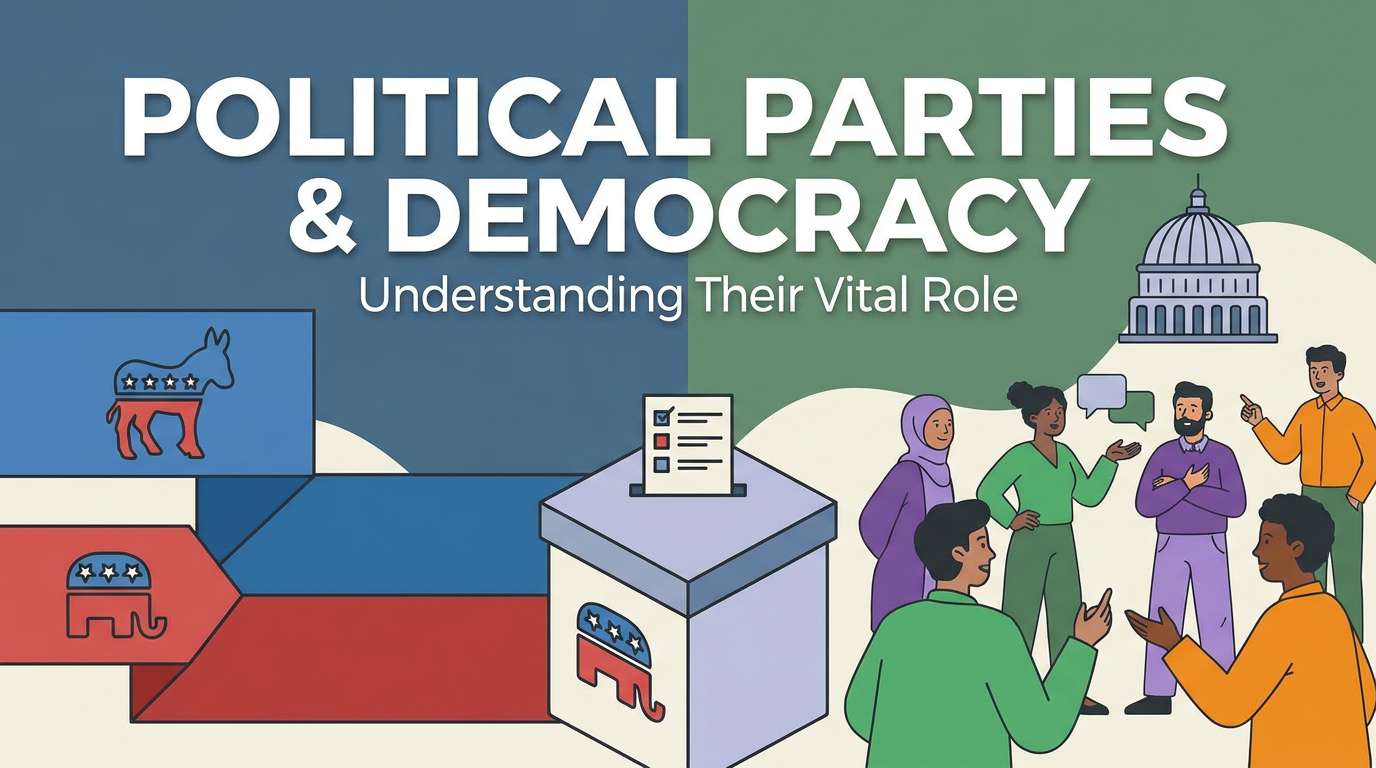
- Two-party system: Two major parties dominate political competition, though smaller parties may still exist, as seen in the United States with the Democratic and Republican parties.
- Multi-party system: Several parties compete for power on a genuinely significant scale, often requiring coalition governments when no single party wins an outright majority.
Nigeria formally operates a multi-party system, with numerous registered political parties permitted to contest elections, though in practice, a smaller number of major parties have tended to dominate electoral outcomes at any given time.
A Brief History of Political Parties in Nigeria
The Pre-Independence and First Republic Era
Nigeria's earliest political parties emerged during the late colonial period, often reflecting significant regional and ethnic bases of support. Prominent parties during this era included the National Council of Nigeria and the Cameroons (NCNC), the Action Group (AG), and the Northern People's Congress (NPC), each drawing much of its support from a particular region of the country.
Military Rule and the Suspension of Party Politics
Following the military coups beginning in 1966, political party activity was banned for extended periods throughout Nigeria's subsequent military eras, as military governments generally prohibited organized political competition.
The Second Republic
Ahead of the return to civilian rule in 1979, several new political parties were formed and permitted to register, including the National Party of Nigeria (NPN), the Unity Party of Nigeria (UPN), and others, contesting Nigeria's first presidential elections under the new constitution.
The Fourth Republic and the Present Multi-Party Era
Since the return to civilian rule in 1999, Nigeria has operated under a continuous multi-party system, with the People's Democratic Party (PDP) initially dominant for an extended period, and the All Progressives Congress (APC) later emerging as a major alternative, alongside numerous other registered parties contesting elections at various levels.
The Independent National Electoral Commission (INEC)
Political parties in Nigeria are registered, regulated, and monitored by the Independent National Electoral Commission (INEC), which is responsible for organizing and conducting elections at the federal and state levels, registering political parties, and enforcing compliance with relevant electoral laws and regulations governing party conduct and campaign activity.
Advantages of a Multi-Party System
- Offers voters genuine choice, allowing citizens to select from a range of political programmes and priorities, rather than a single option.
- Encourages accountability, since a genuine opposition can scrutinize and challenge the party in power.
- Reflects diversity, allowing different parties to represent different regional, ideological, or interest-based constituencies within a large and diverse country.
- Prevents excessive concentration of power within a single political organization over an extended period.
Challenges of a Multi-Party System
- Fragmentation of the vote, where a large number of competing parties can divide support so thinly that no party achieves a clear governing mandate.
- Coalition instability, where governments formed from multiple parties with differing priorities can struggle to maintain unity and consistent policy direction.
- Weak ideological distinction, a challenge sometimes raised in the Nigerian context, where critics argue that some parties differ more in personality and regional support than in clearly defined policy positions.
- Party defections (cross-carpeting), where elected officials switch parties after being elected, sometimes complicating voter accountability and party discipline.
Political Parties and WAEC/NECO Government
Key examinable areas of this topic include:
- The definition and functions of political parties within a democratic system.
- Differences between one-party, two-party, and multi-party systems, with appropriate examples.
- The historical development of political parties in Nigeria, from the pre-independence era through to the present Fourth Republic.
- The role of INEC in registering and regulating political parties.
- Advantages and challenges associated with multi-party democracy, particularly within the Nigerian context.
Common Mistakes Students Make
- Confusing political parties with pressure groups. Political parties seek to contest elections and directly control government; pressure groups seek to influence government policy without themselves seeking to hold political office.
- Assuming Nigeria has always operated a multi-party system. Nigeria experienced extended periods of banned political party activity during military rule, and party politics has been reintroduced and reshaped at several distinct points in its history.
- Describing INEC as a political party or government ministry. INEC is an independent electoral body responsible for regulating elections and political parties, not a political party itself or a regular government department under executive control.
- Overstating the ideological differences between Nigerian political parties without acknowledging genuine, ongoing academic and political debate about how distinct their policy platforms actually are in practice.
- Assuming a multi-party system always produces a stable government. Multi-party systems can, in some cases, lead to fragmented support and coalition instability, which is an important nuance often missed in simpler explanations.
Conclusion
Political parties serve as one of the essential organizing structures of modern democratic government, transforming a wide and often unwieldy range of individual political views into coherent programmes that voters can meaningfully choose between, and that elected officials can use to coordinate government once in office. Nigeria's own political party history — from its ethnically and regionally rooted First Republic parties, through periods of military-imposed suspension, to today's continuous multi-party Fourth Republic — reflects the country's broader, ongoing effort to build a stable, functioning democratic system suited to its unique scale and diversity.
Understanding how political parties function, and the genuine advantages and challenges of Nigeria's particular multi-party arrangement, gives students real insight into how political competition, government formation, and democratic accountability actually operate in practice, well beyond what a simple definition alone could offer.