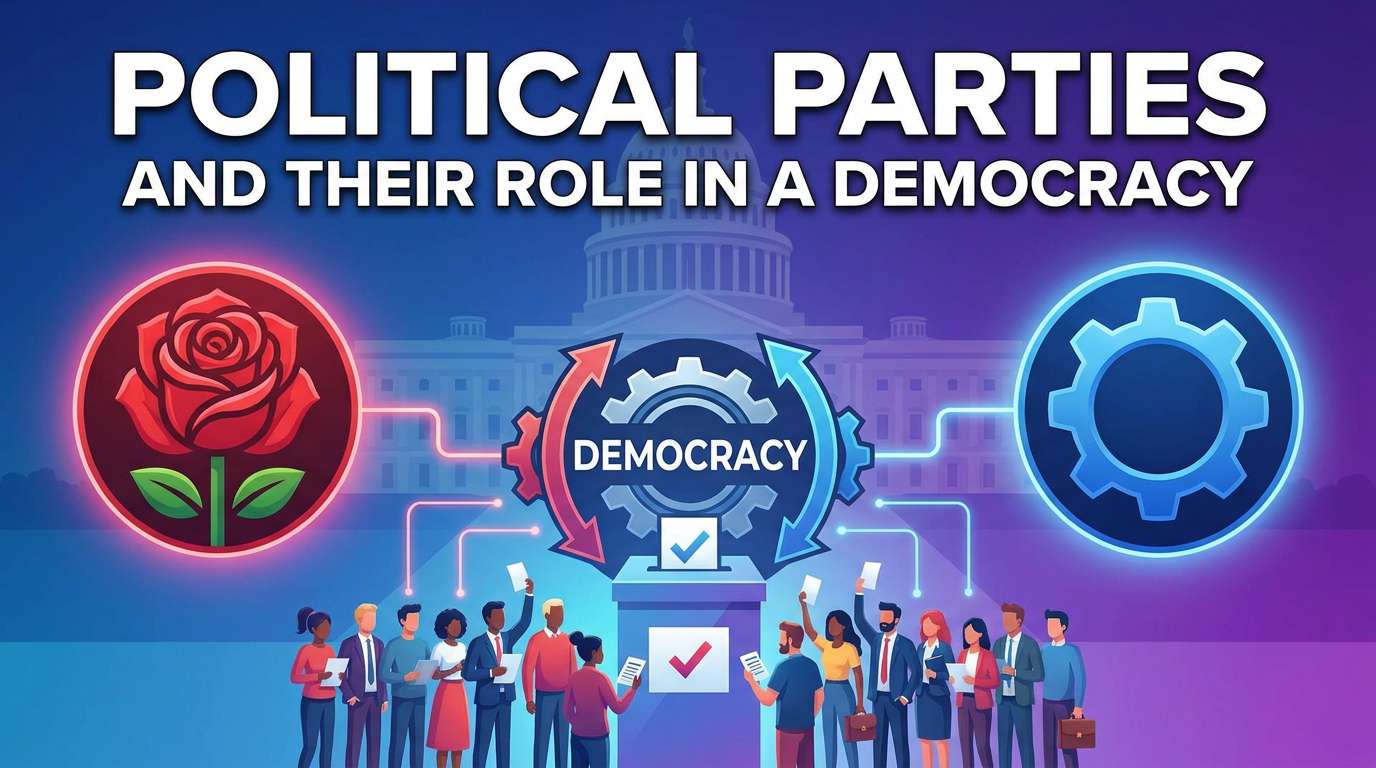
Political Parties and Their Role in a Democracy
Introduction
Political parties are essential institutions in any democratic system of government. They serve as the main vehicle through which citizens participate in politics, choose leaders, and influence government policies.
Without political parties, organizing elections, forming governments, and holding leaders accountable would be extremely difficult. In Nigeria, political parties play a central role in the democratic process, from grassroots mobilization to the formation of government at federal, state, and local levels.
Understanding political parties helps students appreciate how democratic choices are organized and how citizens can get involved in shaping governance.
Meaning of a Political Party
A political party is an organized group of people who share similar political ideas, values, and goals, and who work together to gain political power through winning elections in order to control the government and implement their policies.
Political parties differ from pressure groups in that their primary aim is to win elections and govern, rather than merely influence government decisions from outside.
Features of a Political Party
- Has an organized structure with leadership at national, state, and local levels.
- Has a defined ideology, manifesto, or set of policy goals.
- Seeks to win elections and control government.
- Sponsors candidates for public office.
- Has a membership drawn from the general public.
- Operates according to a constitution or set of internal rules.
Types of Party Systems
1. One-Party System
Only one political party is allowed to exist and operate, often controlling all aspects of government. This system limits political competition and is common in some authoritarian states.
2. Two-Party System
Two major political parties dominate the political landscape, though smaller parties may exist. The United States, with the Democratic and Republican parties, is a classic example.
3. Multi-Party System
Several political parties compete for power, offering citizens a wide range of choices. Nigeria practices a multi-party system, with numerous registered political parties contesting elections.
Functions of Political Parties
1. Political Recruitment
Political parties identify, train, and sponsor candidates for elective political offices at various levels of government.
2. Formulation of Policies
Parties develop manifestos and policy programs that outline their vision for governance, which they present to voters during elections.
3. Political Education and Mobilization
Parties educate citizens on political issues, encourage political participation, and mobilize voters during elections.
4. Formation of Government
The party that wins the majority of votes or seats forms the government and implements its policies through its elected officials.
5. Opposition and Checks on Government
Parties that do not win elections serve as the opposition, monitoring the ruling party, criticizing its policies, and offering alternative viewpoints to keep government accountable.
6. Aggregation of Interests
Political parties bring together diverse interests and opinions of citizens into coherent policy positions and programs.
7. Political Socialization
Parties help citizens develop political awareness, values, and attitudes about government and civic responsibility.
Requirements for Registration of Political Parties in Nigeria
- Must have a name, symbol, and motto that does not have ethnic or religious connotations.
- Must submit a copy of its constitution to the Independent National Electoral Commission (INEC).
- Membership must be open to all Nigerian citizens regardless of ethnicity, religion, or gender.
- Must have its headquarters in the Federal Capital Territory, Abuja.
- Must not be founded on ethnic, religious, or regional grounds.
Major Political Parties in Nigeria
Since the return to democracy in 1999, several political parties have emerged and competed in Nigerian elections, with parties merging, forming alliances, or dissolving over time. Political parties are registered and regulated by the Independent National Electoral Commission (INEC), which also monitors their compliance with electoral laws.
Importance of Political Parties in a Democracy
- Provide a structured platform for citizens to participate in governance.
- Offer voters clear choices between different policies and candidates.
- Help organize and simplify the electoral process.
- Promote political stability by channeling political competition through legal means.
- Serve as a link between the government and the governed.
- Provide checks on the ruling government through opposition parties.
Challenges Facing Political Parties in Nigeria
- Weak internal democracy, including flawed primary elections.
- Excessive influence of money in politics ("godfatherism" and vote buying).
- Frequent defection of members between parties for personal gain.
- Weak ideological differences between major parties.
- Violence and thuggery during party primaries and campaigns.
Ways to Strengthen Political Parties in Nigeria
- Enforcing internal democracy and transparent primary elections.
- Reducing the influence of money in the political process.
- Encouraging parties to develop clear, distinct ideologies and policies.
- Strengthening the regulatory powers of the Independent National Electoral Commission.
- Promoting civic education to encourage issue-based rather than sentiment-based voting.
Conclusion
Political parties are a cornerstone of democratic governance, providing the structure through which citizens choose leaders, hold government accountable, and participate in shaping national development. A strong, well-functioning multi-party system is essential for deepening democracy and ensuring good governance in Nigeria.