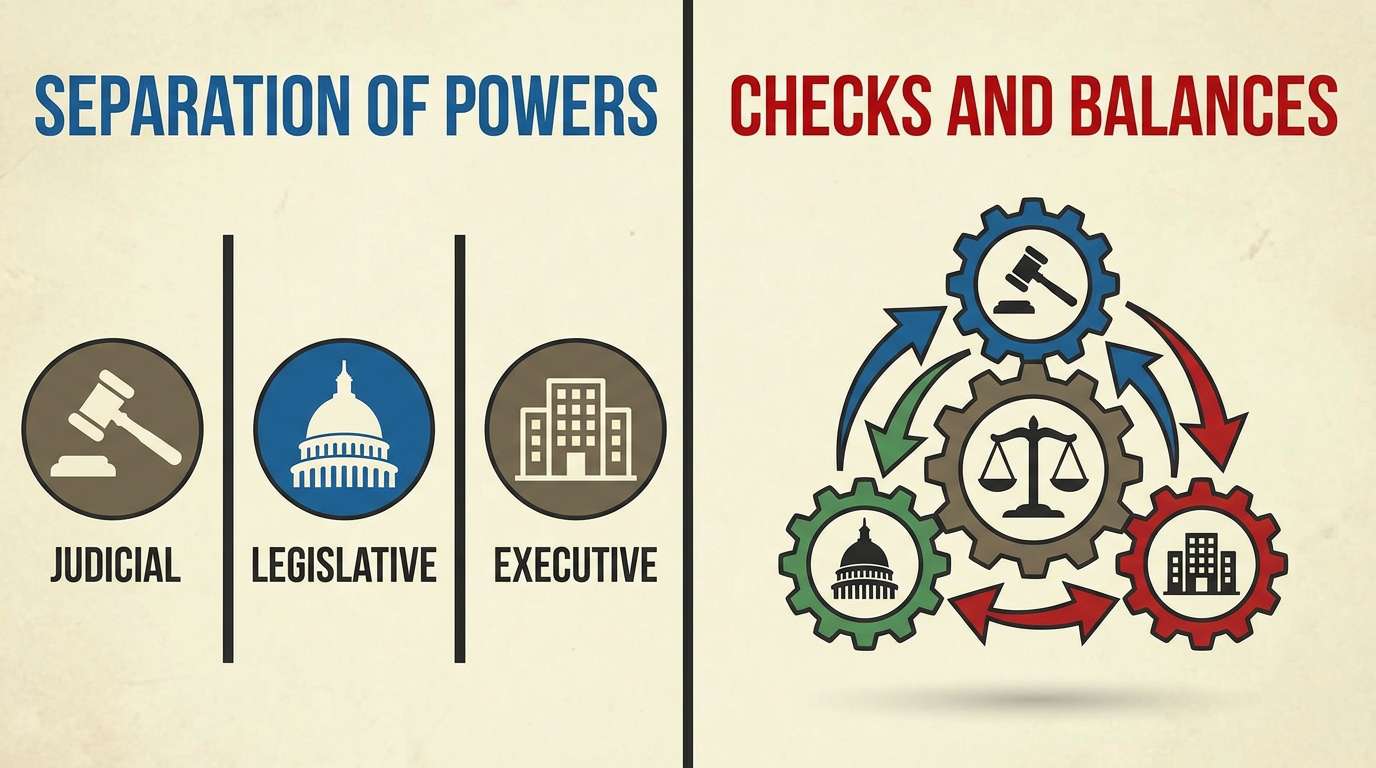
Separation of Powers and Checks and Balances
Introduction
One of the most important principles of modern democratic governance is the separation of powers. It is a doctrine that prevents any single arm of government from becoming too powerful by dividing governmental functions among three distinct arms: the legislature, the executive, and the judiciary.
Closely linked to this doctrine is the system of checks and balances, which ensures that each arm of government has some measure of control over the others, preventing abuse of power and promoting accountability.
Understanding these two concepts helps students appreciate how democratic governments are structured to protect citizens from tyranny and misuse of power.
Meaning of Separation of Powers
Separation of powers is a doctrine that divides the functions of government among three separate and independent arms: the legislature (law-making), the executive (law implementation), and the judiciary (law interpretation), with each arm having distinct personnel and functions.
This principle was famously articulated by the French philosopher Baron de Montesquieu in his work "The Spirit of the Laws," where he argued that liberty is best protected when governmental powers are separated rather than concentrated in one body or person.
The Three Arms of Government
1. The Legislature
Responsible for making, amending, and repealing laws. In Nigeria, this is the National Assembly at the federal level and the House of Assembly at the state level.
2. The Executive
Responsible for implementing and enforcing laws made by the legislature. Headed by the President at the federal level and the Governor at the state level.
3. The Judiciary
Responsible for interpreting laws and settling disputes. Made up of courts headed by the Chief Justice of Nigeria at the apex.
Features of Separation of Powers
- Each arm of government has distinct and separate functions.
- No single arm should perform the functions of another.
- Personnel of one arm should not simultaneously serve in another arm.
- Each arm operates independently within its constitutional powers.
- Power is distributed to prevent concentration in a single body or individual.
Meaning of Checks and Balances
Checks and balances refer to the mechanisms by which each arm of government is given some power to monitor, limit, or influence the actions of the other arms. This ensures that no single arm exceeds its constitutional authority or abuses its powers.
While separation of powers divides functions, checks and balances ensures that the arms remain interdependent enough to hold one another accountable.
Examples of Checks and Balances in Nigeria
1. Legislature Over the Executive
- Approves or rejects the national budget presented by the President.
- Confirms or rejects certain appointments made by the President, such as ministers.
- Has the power to impeach the President or Governor for gross misconduct.
- Can override a presidential veto with a two-thirds majority vote.
- Investigates the conduct of executive agencies and public officials.
2. Executive Over the Legislature
- The President can veto (withhold assent to) bills passed by the National Assembly.
- The President can call for special sessions of the legislature when necessary.
- The executive prepares and presents the budget for legislative approval.
3. Judiciary Over the Legislature and Executive
- Courts can declare laws made by the legislature unconstitutional (judicial review).
- Courts can nullify actions of the executive that violate the constitution.
- Courts settle disputes over elections and government appointments.
4. Legislature and Executive Over the Judiciary
- The executive appoints judges, usually based on recommendations from the National Judicial Council.
- The legislature (Senate) confirms judicial appointments to certain higher courts.
- The legislature controls the budgetary allocation for the judiciary.
Importance of Separation of Powers and Checks and Balances
- Prevents abuse of power and tyranny by any single arm of government.
- Promotes accountability and transparency in governance.
- Protects the fundamental rights and freedoms of citizens.
- Encourages efficiency through specialization of functions.
- Strengthens democracy by ensuring no arm becomes overly dominant.
- Provides a system of dispute resolution between arms of government.
Limitations of Separation of Powers in Practice
- Complete separation is difficult to achieve since arms of government often overlap in function.
- The executive sometimes influences the legislature through political party structures.
- Judicial appointments can be politically influenced, affecting independence.
- Conflict between arms can cause delays in governance and policy implementation.
- In practice, the executive arm sometimes appears to wield disproportionate power.
Separation of Powers in Nigeria's 1999 Constitution
The 1999 Constitution of the Federal Republic of Nigeria (as amended) clearly separates the powers of government into three chapters, assigning legislative powers to the National Assembly, executive powers to the President, and judicial powers to the courts. This constitutional arrangement forms the legal basis for Nigeria's practice of separation of powers and checks and balances.
Conclusion
Separation of powers and checks and balances are fundamental to preventing the abuse of political power and safeguarding democracy. By dividing government functions among the legislature, executive, and judiciary, and allowing each arm to check the others, constitutional democracies like Nigeria aim to protect citizens' rights, promote accountability, and ensure good governance.