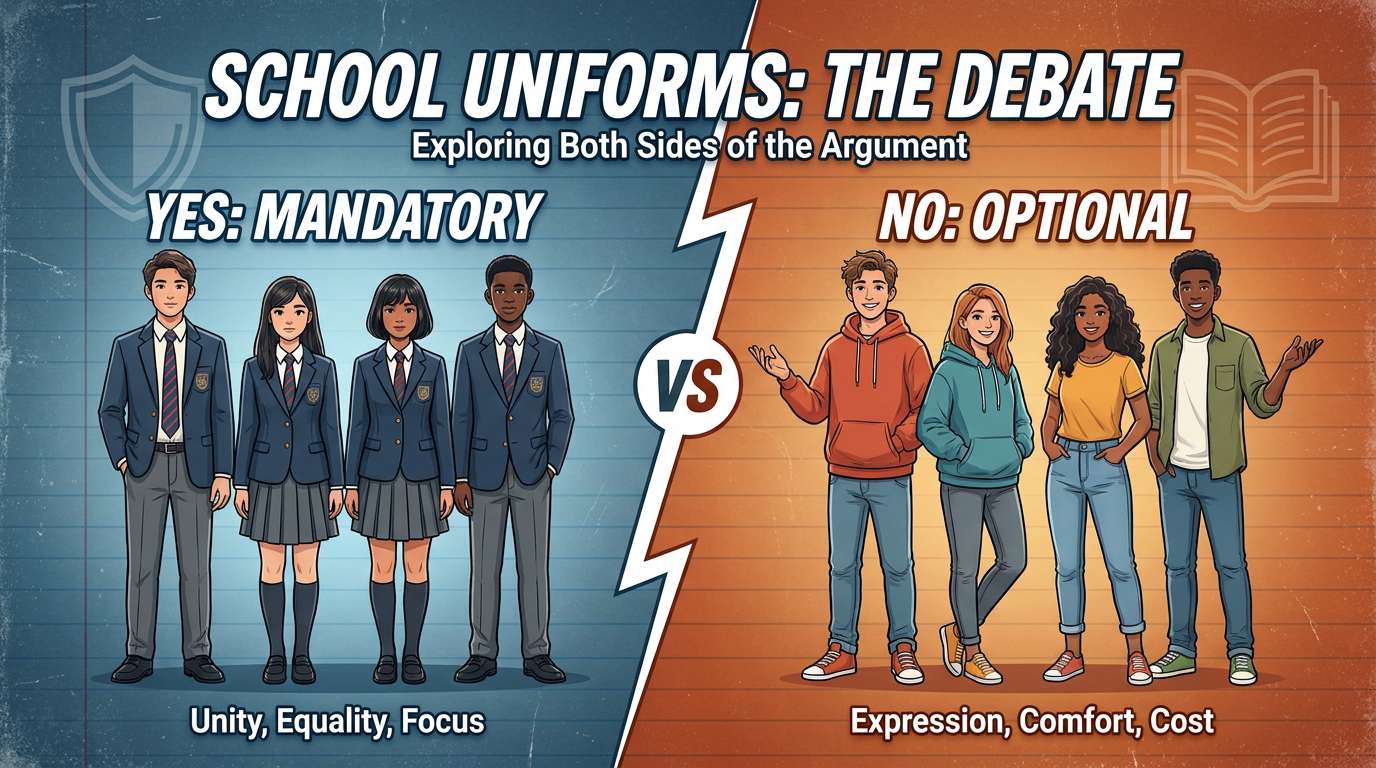
Should School Uniforms Be Mandatory? Exploring Both Sides of the Debate
Introduction
Walk into almost any secondary school and you are likely to see students dressed in matching colours — blazers, ties, and polished shoes forming a sea of uniformity. For decades, school uniforms have been a standard feature of education in many countries, particularly in Africa, the United Kingdom, and parts of Asia.
Yet the debate over whether uniforms should be mandatory remains very much alive. Some believe that uniforms are essential for maintaining discipline, equality, and a sense of identity. Others argue that they suppress individuality and place an unnecessary financial burden on families.
So, should school uniforms be compulsory? This article examines both sides of the argument to help you decide for yourself.
What Is a School Uniform?
A school uniform is a standardised set of clothing prescribed by a school for its students to wear during school hours. Uniforms typically include items such as:
- A shirt or blouse in the school's colours.
- Trousers, skirts, or pinafores.
- A blazer or sweater bearing the school's logo.
- Specific footwear, such as black shoes.
- A tie or badge representing the school.
The specific design varies from school to school, but the purpose remains the same — to give all students a shared appearance.
The Case For School Uniforms
Supporters of mandatory school uniforms put forward several compelling arguments.
Uniforms promote equality. When all students wear the same clothing, visible differences in wealth are reduced. Students from wealthier families cannot use expensive designer clothing to signal their social status, and those from poorer backgrounds are not made to feel inferior because of what they wear. In this way, uniforms can help create a more level playing field.
Uniforms encourage a sense of belonging. Wearing the same colours as fellow students can foster school pride and a shared identity. Many schools find that a strong uniform culture contributes to a more positive school community and a greater sense of purpose among students.
Uniforms reduce distractions. When students do not have to think about what to wear each morning, they can focus their attention on learning. Additionally, competitive dressing — where students feel pressure to wear the latest trends — is eliminated, reducing social distractions in the classroom.
Uniforms may improve discipline and behaviour. Several studies have suggested a link between school uniforms and improved student behaviour. The argument is that a uniform puts students in the right mindset for learning, much like a work uniform signals professionalism to an employee.
The Case Against School Uniforms
Opponents of mandatory uniforms, however, raise equally valid points.
Uniforms suppress individuality. Adolescence is a critical time for young people to develop their identities. Clothing is one of the most personal ways in which people express who they are. Forcing all students to dress the same may prevent them from developing their sense of self and creativity.
Uniforms can be expensive. Contrary to the argument that uniforms save money, compulsory school uniforms can place a heavy financial burden on families, particularly those with several school-age children. Branded uniforms that must be purchased from specific suppliers are often costly, and children grow quickly, requiring frequent replacements.
Uniforms do not necessarily improve academic performance. While some studies suggest that uniforms have a positive effect on behaviour, the evidence linking uniforms directly to improved academic results is far from conclusive. Critics argue that other factors — such as teaching quality, parental support, and school resources — have a far greater impact on student achievement.
Uniforms may mask social issues rather than solve them. Making all students look the same does not eliminate bullying or social inequality — it simply changes the form they take. Students may still be judged on the basis of their hairstyles, accessories, or the condition of their uniforms.
What Do Students Think?
Opinions among students themselves are divided. Many students who attend schools with strict uniform policies report that they find uniforms convenient and appreciate not having to worry about fashion. Others feel frustrated by the lack of freedom and believe that the rules are unnecessarily rigid.
Interestingly, some students who initially resented wearing uniforms later came to appreciate them — particularly when they entered the working world and recognised the value of dressing appropriately for different environments.
A Middle Ground?
Some schools have attempted to find a compromise by introducing smart casual dress codes rather than strict uniforms. Under such policies, students are required to dress neatly and appropriately but are given some freedom in their choices of colour and style.
This approach aims to preserve the benefits of a professional appearance while allowing students some room for self-expression. Whether it achieves the best of both worlds depends largely on how it is implemented.
Conclusion
The debate over school uniforms is unlikely to be resolved any time soon. Both sides make valid and thoughtful arguments, and the right answer may depend on the specific needs and values of each school community.
What is clear is that clothing alone cannot determine the quality of a student's education. Whether in uniform or not, what matters most is a safe, supportive learning environment where every student is given the opportunity to thrive.
The question of whether uniforms should be mandatory is ultimately one that schools, parents, and students must answer together — thoughtfully, respectfully, and with the best interests of young people at heart.