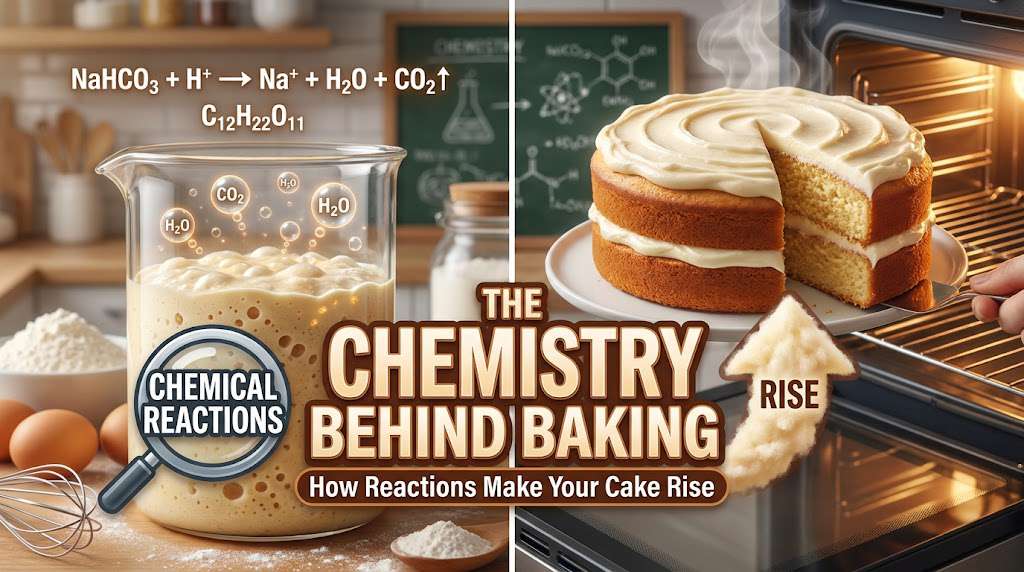
The Chemistry Behind Baking: How Reactions Make Your Cake Rise
Introduction
Every time someone bakes a cake, they are running a chemistry experiment — measuring reactants, controlling temperature, and triggering reactions that transform a runny batter into a soft, risen, golden-brown cake. No chemistry set required. Just flour, eggs, sugar, a raising agent, and an oven.
Baking looks like cooking, but underneath it is pure chemistry: gases forming and expanding, proteins unfolding and reshaping, and sugars breaking down to create colour and flavour. Understanding these reactions doesn't just explain why cakes rise — it explains why recipes fail when a single step is skipped or a single ingredient is left out.
What Makes a Cake Rise?
A cake rises because gas bubbles form inside the batter and expand when heated, pushing the surrounding structure upward. The gas is usually carbon dioxide (CO₂), and it comes from one of two chemical sources: baking soda or baking powder.
Baking Soda: An Acid-Base Reaction
Baking soda is the chemical compound sodium bicarbonate (NaHCO₃). On its own, it does very little. But when it comes into contact with an acid — such as buttermilk, yoghurt, lemon juice, or vinegar — it undergoes an acid-base reaction that releases carbon dioxide gas:
NaHCO₃ + acid → sodium salt + water + CO₂
For example, when baking soda reacts with the acetic acid in vinegar:
NaHCO₃ + CH₃COOH → CH₃COONa + H₂O + CO₂
This is the same reaction behind the classic "volcano" experiment using baking soda and vinegar — the fizzing is carbon dioxide gas escaping. In a cake batter, that same gas gets trapped inside the mixture instead of escaping into the air, forming tiny bubbles that expand and lighten the batter.
Baking Powder: A Self-Contained Reaction
Baking powder is more than baking soda alone — it is a mixture of sodium bicarbonate, a dry acid (commonly cream of tartar or sodium aluminium sulphate), and a filler such as cornflour to keep it dry and stable. Because it already contains both an acid and a base, baking powder can react and release carbon dioxide simply by being mixed with a liquid, without needing an additional acidic ingredient in the recipe.
Most baking powders sold today are double-acting, meaning they release gas in two separate stages:
- First reaction: A small amount of gas is released as soon as the powder is mixed with liquid, at room temperature.
- Second reaction: A larger release of gas occurs once the batter is heated in the oven, giving the cake its main rise.
This two-stage release is why cake batter can sit for a short while before baking without immediately losing all its rising power.
Why Bubbles Make the Cake Rise — and Stay Risen
As the oven heats the batter, two things happen at once: the trapped carbon dioxide bubbles expand due to heat, and the surrounding batter begins to set. If everything is timed correctly, the structure firms up around the expanded bubbles just as they reach their largest size — trapping the light, airy texture in place permanently. If the structure sets too early, the cake stays dense; if it sets too late, the bubbles escape and the cake collapses.
Eggs: Structure Through Protein Chemistry
Eggs play a very different chemical role in baking. Egg whites and yolks are rich in proteins — long chains of amino acids folded into specific three-dimensional shapes.
Denaturation: Unfolding Under Heat
When eggs are heated, or whipped vigorously, the folded protein structures break apart and unfold — a process called denaturation. Once unfolded, these protein chains bump into each other and form new bonds, linking together into a stretchy network. This is the same chemical process that turns a clear, runny raw egg white into a firm, opaque, solid white when cooked.
In cake batter, this protein network forms around the gas bubbles produced by baking soda or baking powder, giving the cake its structure and helping it hold its risen shape once the reaction is complete and the cake cools.
Whipping Eggs: Mechanical Foam Formation
When egg whites are whipped, mechanical energy unfolds the proteins and traps air bubbles within the protein network, forming a foam. This is a physical process rather than a chemical reaction, but it works alongside the chemistry of baking soda and baking powder in many recipes — particularly sponge cakes — to produce a light, airy texture.
Gluten: The Protein Network in Flour
Flour contains two proteins — glutenin and gliadin — which, when mixed with water and disturbed by stirring or kneading, link together to form a stretchy, elastic network called gluten.
Gluten gives baked goods their structure and chewiness. Bread dough is kneaded extensively to build a strong gluten network capable of trapping large amounts of gas and holding a well-risen shape. Cake batter, in contrast, is mixed gently and briefly, because too much gluten development would make the cake tough and dense instead of soft and light.
Caramelisation and the Maillard Reaction: Why Cakes Turn Brown
The golden-brown crust on a baked cake is not simply "burning" — it is the result of two distinct chemical reactions that occur at high temperature.
Caramelisation
Caramelisation occurs when sugars alone are heated to high temperatures (typically above 150°C), breaking down and recombining into hundreds of new compounds responsible for brown colour and rich, toasty, slightly bitter flavours. This is the same reaction that turns plain sugar into caramel when heated in a pan.
The Maillard Reaction
The Maillard reaction is a separate reaction between amino acids (from proteins) and reducing sugars, triggered by heat. Named after the French chemist Louis-Camille Maillard, who first described it in 1912, this reaction produces the complex brown colours and savoury, toasted flavours found on the crust of cakes, bread, and roasted meat. It generally begins around 140–165°C — which is part of why cake surfaces brown while the moist interior, which stays cooler and wetter during baking, does not.
Why Recipes Fail: Common Chemistry Mistakes
- Using baking soda without enough acid. Without sufficient acid to react with it, baking soda cannot release its carbon dioxide gas, and any excess leftover baking soda can leave a bitter, soapy taste in the finished cake.
- Substituting baking soda for baking powder in equal amounts. Baking soda is roughly three to four times stronger than baking powder gram for gram and needs its own acidic ingredient in the recipe to work correctly.
- Overmixing cake batter. Excessive mixing develops too much gluten from the flour, producing a tough, dense cake instead of a soft, light one.
- Opening the oven door too early. A sudden drop in temperature can cause the expanded gas bubbles to contract before the surrounding protein and starch structure has fully set, causing the cake to sink in the middle.
- Expired raising agents. Baking soda and baking powder lose their reactive strength over time as they slowly absorb moisture from the air, leading to flat, dense bakes even when the recipe is followed correctly.
Baking Chemistry and WAEC/JAMB Chemistry
- Acid-base reactions: The reaction between sodium bicarbonate and an acid is a classic, examinable example of acids reacting with carbonates to release carbon dioxide.
- Tests for gases: Carbon dioxide is identified by turning limewater milky/cloudy — a standard practical test directly relevant to this reaction.
- Rates of reaction: Heat speeding up the second stage of baking powder's reaction connects directly to the effect of temperature on reaction rate.
- Denaturation of proteins: A key concept in biology and chemistry syllabuses, often illustrated using the cooking of egg white as a real-world example.
- Chemical vs physical changes: Baking is a useful real-world context for distinguishing chemical changes (gas-releasing reactions, Maillard reaction) from physical changes (whipping air into eggs, melting butter).
Conclusion
A rising, browning, perfectly textured cake is the visible result of several invisible chemical reactions working together in careful balance: an acid-base reaction releasing carbon dioxide gas, proteins denaturing and forming supportive networks, gluten providing structure, and sugars and amino acids reacting under heat to create colour and flavour.
Baking is not the opposite of chemistry — it is chemistry, measured out in cups and teaspoons instead of beakers and burettes, and tested not with litmus paper but with a toothpick and a taste.