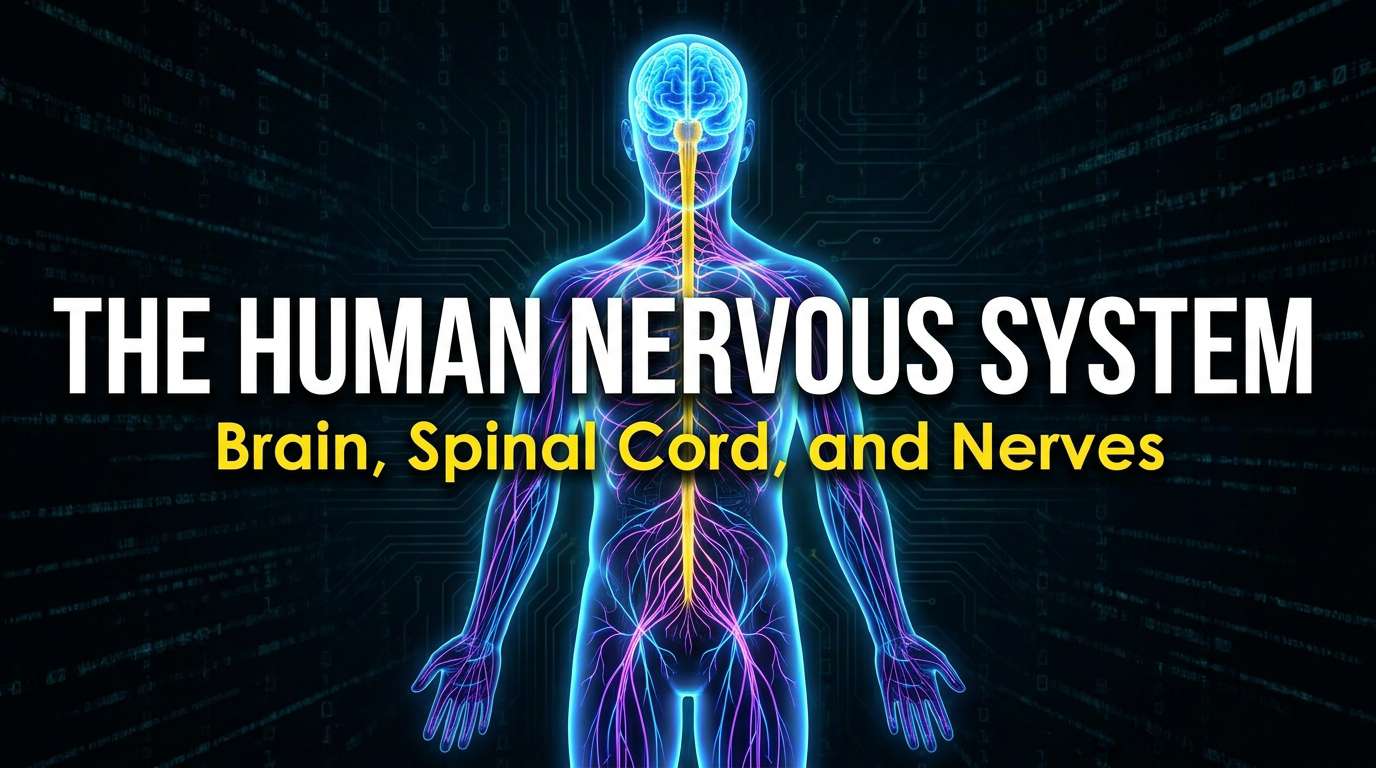
The Human Nervous System: Brain, Spinal Cord, and Nerves
Introduction
Touch a hot pot by accident, and your hand pulls away before you have even consciously registered the pain. Read these words on a page, and somewhere behind your eyes, an extraordinarily complex process is converting light into meaning faster than you can notice it happening. Decide to lift your arm, and within a fraction of a second, muscles you cannot see are contracting exactly as instructed.
All of this — reflexes, sensation, thought, decision, and movement — is the work of the nervous system, the body's rapid communication and control network. Where the endocrine system (covered elsewhere in this syllabus) communicates through slower-acting hormones carried in the blood, the nervous system communicates through fast-travelling electrical impulses, allowing the body to respond to changes in its environment in a fraction of a second.
This article explores the structure and function of the nervous system in depth — from the individual nerve cell to the coordinated action of the brain, spinal cord, and reflex pathways.
The Two Main Divisions of the Nervous System
The human nervous system is organized into two major divisions:
- Central nervous system (CNS): Consisting of the brain and spinal cord, this is the body's main control and processing centre.
- Peripheral nervous system (PNS): Consisting of all the nerves branching out from the CNS to the rest of the body, carrying information to and from the central nervous system.
The Neuron: The Basic Unit of the Nervous System
Just as the cell is the basic unit of the body generally, the neuron (nerve cell) is the basic functional unit of the nervous system. Neurons are specifically adapted to carry electrical impulses, sometimes over remarkably long distances — a single neuron running from the spinal cord to the foot can be over a metre long in an adult.
Structure of a Neuron
- Cell body (soma): Contains the nucleus and most of the cell's organelles, similar to a typical cell.
- Dendrites: Short, branching extensions that receive signals from other neurons and carry impulses toward the cell body.
- Axon: A long, slender extension that carries the electrical impulse away from the cell body toward the next neuron, muscle, or gland.
- Myelin sheath: A fatty, insulating layer surrounding many axons, which significantly increases the speed at which electrical impulses travel.
- Synapse: The small gap between the end of one neuron and the next, across which impulses are transmitted chemically.
Types of Neurons
Neurons are classified according to the direction in which they carry impulses:
- Sensory neurons carry impulses from receptors (such as those in the skin, eyes, or ears) toward the central nervous system.
- Relay (interneurons) connect sensory and motor neurons within the central nervous system, allowing information to be processed and coordinated.
- Motor neurons carry impulses from the central nervous system out to effectors — typically muscles or glands — instructing them to respond.
How Nerve Impulses Travel
A nerve impulse is essentially a rapidly moving change in electrical charge that travels along the length of a neuron's axon. This impulse moves in only one direction along a given neuron, from dendrite through the cell body to the axon terminal.
When the impulse reaches the end of one neuron, it must cross the synapse to reach the next neuron. Rather than jumping directly as an electrical signal, the arriving impulse triggers the release of chemical messengers called neurotransmitters into the tiny gap of the synapse. These neurotransmitters diffuse across the gap and bind to receptors on the next neuron, triggering a new electrical impulse to begin travelling along it. This combination of electrical signalling within neurons and chemical signalling between them allows for both speed and a remarkable degree of control over how signals are passed on.
The Brain
The brain is the most complex organ in the human body, housing billions of interconnected neurons and serving as the primary control centre for nearly all bodily functions, thought, and behaviour. It is protected by the skull and by three protective membranes called the meninges, and it is cushioned by cerebrospinal fluid.
Major Regions of the Brain
- Cerebrum: The largest part of the brain, divided into two hemispheres and responsible for higher functions such as conscious thought, memory, reasoning, language, and voluntary movement.
- Cerebellum: Located beneath the cerebrum, responsible for coordinating balance, posture, and the fine control of voluntary movements.
- Medulla oblongata: Located at the base of the brain, connecting to the spinal cord, and responsible for regulating essential, largely automatic functions such as heart rate and breathing rate, as discussed in the article on the respiratory system.
The Spinal Cord
The spinal cord is a long, cylindrical bundle of nerve tissue extending from the base of the brain down through the vertebral column (spine), which surrounds and protects it. The spinal cord serves two crucial roles:
- It acts as the main communication pathway, carrying sensory information up to the brain and motor instructions back down to the rest of the body.
- It coordinates certain automatic responses, called reflex actions, without requiring direct involvement from the brain.
Reflex Actions
A reflex action is a rapid, automatic, and involuntary response to a particular stimulus, occurring without conscious thought. Pulling your hand away from something painfully hot, blinking when an object suddenly approaches your eye, and the knee-jerk response to a tap just below the kneecap are all classic examples of reflex actions.
Why Reflexes Are Important
Reflex actions exist because, in certain situations, the split-second delay involved in sending information all the way to the brain, processing it consciously, and then sending a motor response back down could result in serious harm. By allowing the spinal cord to process certain urgent signals directly, reflex actions protect the body far more quickly than a fully conscious decision ever could.
The Reflex Arc
The pathway followed by a reflex action is called a reflex arc, and it typically follows this sequence:
- Stimulus: A change in the environment, such as touching something hot.
- Receptor: A specialized cell, often in the skin, that detects the stimulus.
- Sensory neuron: Carries the impulse from the receptor to the spinal cord.
- Relay neuron: Located within the spinal cord, connects the sensory neuron directly to a motor neuron.
- Motor neuron: Carries the impulse from the spinal cord to an effector.
- Effector: Typically a muscle, which contracts to produce the appropriate response.
Because this pathway involves the spinal cord directly, without requiring the signal to travel all the way to the brain and back, reflex actions occur significantly faster than actions requiring conscious decision-making — though the brain does typically become aware of what happened shortly afterward, which is why you feel pain from a hot surface just after your hand has already pulled away.
Voluntary vs. Involuntary Actions
Beyond simple reflexes, it is useful to distinguish more broadly between two types of bodily action:
- Voluntary actions are consciously controlled, initiated deliberately by the brain — for example, deciding to walk, speak, or pick up a pen.
- Involuntary actions occur automatically, without conscious control — including reflex actions, as well as ongoing processes such as heartbeat, digestion, and breathing rate (though breathing rate can also be consciously overridden to some extent, such as when holding your breath).
The Sense Organs and the Nervous System
The nervous system relies on specialized receptors, often grouped into sense organs, to detect stimuli from both inside and outside the body:
- Eyes contain photoreceptors that detect light, enabling vision.
- Ears contain receptors that detect sound waves and also help maintain balance.
- Skin contains receptors that detect touch, pressure, temperature, and pain.
- Nose contains receptors that detect chemical particles in the air, enabling smell.
- Tongue contains receptors that detect dissolved chemicals, enabling taste.
Each of these receptors converts a specific type of stimulus into an electrical nerve impulse, which is then carried by sensory neurons toward the central nervous system for processing.
How the Nervous System Coordinates With the Endocrine System
The nervous system is not the body's only communication network — it works alongside the endocrine system, which uses hormones carried in the blood rather than electrical impulses. Broadly speaking, the nervous system tends to produce fast, short-lived responses (such as a reflex), while the endocrine system tends to produce slower, longer-lasting responses (such as growth or long-term changes in metabolism). Some responses, such as the body's reaction to fear or danger, involve both systems working together closely.
Common Disorders Affecting the Nervous System
Stroke
A stroke occurs when blood supply to part of the brain is interrupted, either by a blockage or a rupture of a blood vessel, depriving that region of oxygen and causing brain cells to die rapidly. Depending on which part of the brain is affected, this can impair movement, speech, memory, or other functions.
Epilepsy
Epilepsy is a condition characterized by sudden, abnormal bursts of electrical activity in the brain, resulting in seizures that can range from brief lapses in awareness to more intense convulsions.
Meningitis
Meningitis is inflammation of the meninges, the protective membranes surrounding the brain and spinal cord, usually caused by bacterial or viral infection. It can be extremely serious and requires urgent medical treatment, and it has periodically affected communities across parts of Nigeria and the wider West African "meningitis belt."
The Nervous System and WAEC/NECO/JAMB Biology
Key examinable areas of this topic include:
- Structure of a typical neuron, including labelled diagrams distinguishing dendrites, cell body, and axon.
- The reflex arc, including the correct sequence of stimulus, receptor, sensory neuron, relay neuron, motor neuron, and effector.
- Differences between voluntary and involuntary actions, with clear examples of each.
- Major regions of the brain and their specific functions, particularly the cerebrum, cerebellum, and medulla oblongata.
- The role of synapses in transmitting nerve impulses between neurons.
- Comparing the nervous and endocrine systems as the body's two main communication networks.
Common Mistakes Students Make
- Describing nerve impulses as travelling directly from neuron to neuron with no gap. Impulses must cross the synapse using neurotransmitters, not by direct electrical contact.
- Placing the relay neuron incorrectly in the reflex arc sequence. It connects the sensory neuron to the motor neuron and is located within the spinal cord, not before the sensory neuron or after the motor neuron.
- Assuming all reflexes involve the brain. A defining feature of a true reflex action is that the spinal cord processes it directly, without requiring the brain's involvement, even though the brain does register the event shortly afterward.
- Confusing the cerebrum and cerebellum. The cerebrum handles higher conscious functions like thought and voluntary movement; the cerebellum specifically coordinates balance and fine motor control.
- Describing heartbeat as entirely voluntary. It is an involuntary action, regulated automatically, primarily through the medulla oblongata and the heart's own internal pacemaker.
Conclusion
The nervous system is, in many ways, the most remarkable coordination system found anywhere in biology — a vast network of specialized cells capable of detecting the world, processing information, making decisions, and generating responses, much of it happening faster than conscious awareness itself. From the split-second reflex that pulls your hand away from danger, to the complex thought required to solve a Mathematics problem, every action ultimately traces back to electrical impulses travelling along neurons, crossing synapses, and arriving precisely where they are needed.
Understanding this system — its structures, its pathways, and the elegant logic behind reflex actions in particular — offers genuine insight into how the human body manages to respond to an unpredictable world with such extraordinary speed and precision.