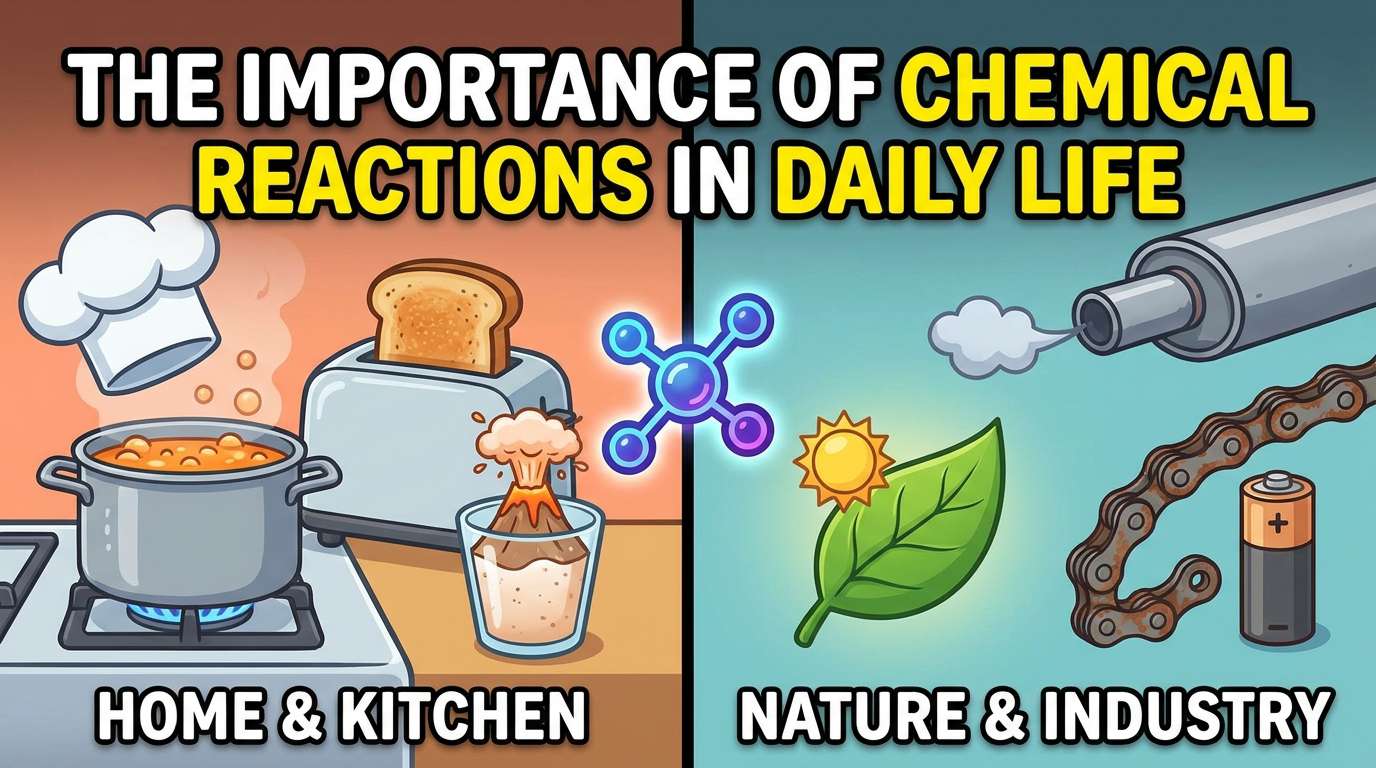
The Importance of Chemical Reactions in Daily Life
Introduction
Every day, countless chemical reactions occur around us and within our bodies. From the food we cook and eat to the fuel that powers vehicles, chemical reactions are responsible for many of the changes we observe in our environment.
Chemistry is often described as the science of change because chemical reactions transform substances into entirely new substances with different properties. Understanding these reactions helps us explain natural phenomena, improve industrial production, develop medicines, and solve environmental problems.
This article explores the meaning of chemical reactions, the conditions necessary for them to occur, their various types, and their significance in everyday life.
What Is a Chemical Reaction?
A chemical reaction is a process in which one or more substances, known as reactants, are converted into new substances called products.
During a chemical reaction, chemical bonds are broken and new bonds are formed, resulting in substances with different chemical compositions and properties.
Examples include:
- Burning wood.
- Rusting of iron.
- Digestion of food.
- Photosynthesis in plants.
- Cooking food.
Reactants and Products
Every chemical reaction involves reactants and products.
- Reactants: The substances present before the reaction occurs.
- Products: The new substances formed after the reaction.
Example:
Hydrogen + Oxygen → Water
Hydrogen and oxygen are the reactants, while water is the product.
Characteristics of Chemical Reactions
Chemical reactions are usually accompanied by observable changes.
1. Change in Colour
A colour change often indicates that a chemical reaction has occurred.
Example:
Iron changes from a shiny grey colour to reddish-brown rust.
2. Evolution of Gas
Some reactions produce gases.
Example:
Vinegar reacting with baking soda produces carbon dioxide gas.
3. Formation of a Precipitate
A precipitate is an insoluble solid formed during a reaction between two solutions.
4. Change in Temperature
Reactions may release or absorb heat.
- Exothermic reactions release heat.
- Endothermic reactions absorb heat.
5. Production of Light
Some chemical reactions produce light energy.
Examples:
- Fireworks.
- Burning magnesium ribbon.
Conditions Necessary for Chemical Reactions
Certain conditions are often required before a chemical reaction can occur.
- Heat.
- Light.
- Pressure.
- Catalysts.
- Electricity.
Role of Catalysts
Catalysts are substances that increase the rate of chemical reactions without being consumed during the reaction.
Enzymes in the human body are examples of biological catalysts.
Types of Chemical Reactions
1. Combination Reaction
Two or more substances combine to form a single product.
Example:
Hydrogen + Oxygen → Water
2. Decomposition Reaction
A compound breaks down into simpler substances.
Example:
Calcium Carbonate → Calcium Oxide + Carbon Dioxide
3. Displacement Reaction
A more reactive element replaces a less reactive element in a compound.
Example:
Zinc + Copper Sulphate → Zinc Sulphate + Copper
4. Neutralization Reaction
An acid reacts with a base to produce salt and water.
Example:
Hydrochloric Acid + Sodium Hydroxide → Sodium Chloride + Water
5. Combustion Reaction
A substance reacts with oxygen and releases heat energy.
Example:
Burning petrol in vehicle engines.
Chemical Reactions in the Human Body
Life depends on numerous chemical reactions occurring continuously within the body.
Digestion
Food is broken down into nutrients through chemical reactions involving digestive enzymes.
Respiration
Cells release energy from food through respiration.
Glucose + Oxygen → Carbon Dioxide + Water + Energy
Blood Clotting
Chemical reactions help stop bleeding when injuries occur.
Chemical Reactions in Agriculture
Agriculture depends heavily on chemical reactions.
- Production of fertilizers.
- Soil nutrient improvement.
- Pesticide production.
- Plant growth processes.
Photosynthesis is one of the most important agricultural chemical reactions.
Chemical Reactions in Industry
Modern industries rely on chemical reactions to manufacture products.
- Production of cement.
- Manufacture of plastics.
- Production of soaps and detergents.
- Petroleum refining.
- Steel manufacturing.
- Food processing.
Chemical Reactions in Medicine
Many medicines are produced through carefully controlled chemical reactions.
- Antibiotic production.
- Vaccine development.
- Pain-relieving drugs.
- Antiseptics and disinfectants.
Chemical Reactions and the Environment
Chemical reactions play significant roles in environmental processes.
Positive Effects
- Photosynthesis produces oxygen.
- Waste decomposition recycles nutrients.
- Water purification processes.
Negative Effects
- Air pollution.
- Acid rain.
- Ozone layer depletion.
- Global warming.
Common Examples Around the Home
- Cooking food.
- Baking bread.
- Rusting gates.
- Ripening fruits.
- Burning candles.
- Cleaning with bleach.
Common Examination Questions
- Define a chemical reaction.
- State five signs of a chemical reaction.
- Explain the role of catalysts.
- Differentiate between reactants and products.
- List five uses of chemical reactions in industry.
Summary
- Chemical reactions produce new substances.
- Reactants are converted into products.
- Reactions may involve heat, light, gas production, or colour change.
- Chemical reactions occur in living organisms and industries.
- They are essential for agriculture, medicine, manufacturing, and environmental processes.
Conclusion
Chemical reactions are the foundation of countless natural and industrial processes. They enable life, power industries, produce medicines, support agriculture, and influence the environment. By understanding how chemical reactions occur and their practical applications, students gain a deeper appreciation of chemistry and its importance in everyday life.