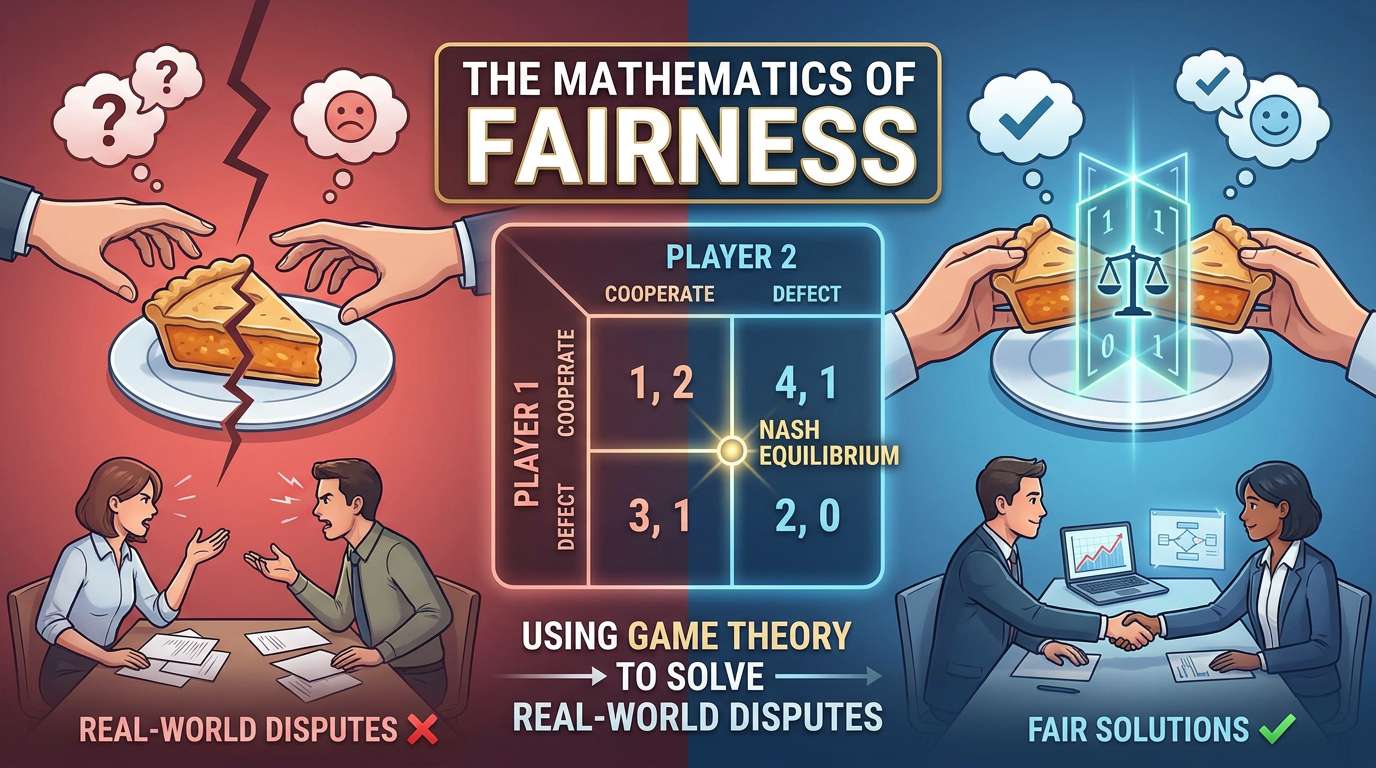
The Mathematics of Fairness: Using Game Theory to Solve Real-World Disputes
Introduction
Two suspects are arrested and held in separate cells. The police lack enough evidence to convict either on the main charge, so they offer each suspect the same deal: betray your partner and go free while they serve ten years, or stay silent and risk everything. If both stay silent, both serve one year on a lesser charge. If both betray each other, both serve five years.
What should each suspect do? The answer seems obvious — stay loyal, both serve one year, everyone goes home relatively quickly. But when you think carefully about what each person will rationally choose, something disturbing happens. The mathematics shows that two perfectly rational people, each acting entirely in their own interest, will both betray each other and both serve five years — a worse outcome for everyone than if they had simply cooperated.
This scenario — the Prisoner's Dilemma — is the most famous problem in game theory, the branch of mathematics that studies strategic decision-making. It captures something profound and uncomfortable about human behaviour: that individual rationality can produce collective catastrophe. And it is just one of dozens of mathematical models that reveal how conflicts arise, how they resolve, and how fairness — real, durable, mathematically grounded fairness — can be designed into the systems that govern our lives.
Game theory has been used to end Cold War standoffs, design spectrum auctions worth billions of dollars, reform kidney donor matching systems, expose why cartels collapse, explain why animals share food, and determine how to divide an inheritance fairly among quarrelling heirs. This is mathematics as the science of human interaction — and it is far stranger and more powerful than it first appears.
What Is Game Theory?
Game theory is the mathematical study of strategic situations — scenarios in which the outcome for each participant depends not only on their own choices but on the choices of others. It provides a framework for analysing conflict, cooperation, negotiation, and competition with the same rigour that algebra applies to equations or geometry applies to shapes.
A game in the mathematical sense has three essential components:
- Players — the decision-makers involved. These can be people, companies, countries, animals, or any entity that makes choices.
- Strategies — the complete set of actions available to each player.
- Payoffs — the outcomes each player receives for every possible combination of strategies chosen by all players.
Game theory does not assume that people are kind, cooperative, or altruistic. It assumes they are rational — that each player will choose the strategy that best serves their own interests, given what they expect others to do. This assumption is sometimes wrong in practice, which is itself one of the most interesting findings in the field.
A Brief History of Game Theory
Von Neumann and the Birth of a Field
The formal foundations of game theory were laid by the Hungarian-American mathematician John von Neumann, one of the most extraordinary intellects of the twentieth century. In 1928, he proved the minimax theorem: in any two-player zero-sum game (where one player's gain is exactly the other's loss), there always exists an optimal strategy for each player that minimises their maximum possible loss.
In 1944, von Neumann and economist Oskar Morgenstern published Theory of Games and Economic Behavior, a monumental work that established game theory as a serious mathematical discipline and applied it systematically to economic behaviour. The book introduced the idea of representing strategic situations mathematically and solving them with the same rigour as equations.
John Nash and the Equilibrium That Changed Everything
The most important single concept in game theory was contributed by John Nash, the American mathematician whose life was dramatised in the film A Beautiful Mind. In his 1950 doctoral dissertation — just 27 pages long — Nash proved a result that transformed economics, political science, biology, and international relations.
The Nash Equilibrium: in any finite game with any number of players, there exists at least one combination of strategies such that no player can improve their outcome by changing their strategy alone, assuming all other players keep their strategies fixed.
A Nash Equilibrium is a stable resting point — a state from which no individual has any incentive to deviate unilaterally. It does not guarantee that the outcome is good for anyone. It simply means that, given what everyone else is doing, each player is already doing the best they can. Nash won the Nobel Prize in Economics in 1994 for this insight.
The Prisoner's Dilemma: Why Rational People Make Irrational Outcomes
Return to our two suspects. Their situation can be summarised in a payoff matrix:
- If both stay silent: both serve 1 year.
- If Suspect A betrays and B stays silent: A goes free, B serves 10 years.
- If Suspect B betrays and A stays silent: B goes free, A serves 10 years.
- If both betray: both serve 5 years.
Now think from Suspect A's perspective. If B stays silent, A is better off betraying (0 years instead of 1). If B betrays, A is still better off betraying (5 years instead of 10). Betrayal is the better choice regardless of what B does. Mathematicians call this a dominant strategy — a strategy that is always better than the alternative, no matter what others do.
Since the situation is symmetric, B reasons identically. Both betray. Both serve five years. Yet if both had stayed silent, both would have served only one year. This is the dilemma: individual rationality produces a collectively irrational outcome. The Nash Equilibrium (both betray) is worse for everyone than the cooperative alternative.
The Prisoner's Dilemma is not just a puzzle. It is a model for arms races, environmental destruction, price wars, and any situation where individual incentives pull people away from outcomes that would benefit everyone. Understanding it is the first step toward designing systems that overcome it.
Zero-Sum and Non-Zero-Sum Games
A zero-sum game is one in which the total payoff across all players is fixed: whatever one player wins, the others lose by exactly the same amount. Chess, poker, and most competitive sports are zero-sum. In these games, cooperation is impossible by definition — there is nothing to cooperate about.
A non-zero-sum game is one in which the total payoff can vary depending on the choices made. Trade negotiations, environmental agreements, and business partnerships are non-zero-sum: both parties can gain simultaneously, or both can lose simultaneously. The Prisoner's Dilemma is non-zero-sum — mutual cooperation produces two years of total prison time, while mutual betrayal produces ten.
Most real-world disputes are non-zero-sum. This is the crucial insight that game theory offers to diplomats, negotiators, and policymakers: in most conflicts, there exists a cooperative outcome that makes everyone better off than the outcome produced by pure self-interest. The challenge is designing the conditions that make cooperation the rational choice.
The Nash Equilibrium in Action
Traffic and Braess's Paradox
Every driver on a congested road is playing a game against every other driver. Each chooses a route to minimise their own journey time, taking the routes of other drivers as given. The Nash Equilibrium is the traffic pattern from which no driver can benefit by unilaterally switching routes.
In 1968, German mathematician Dietrich Braess proved a counterintuitive result now known as Braess's Paradox: adding a new road to a network can make traffic worse for everyone. When a new fast road is built, every driver rationally switches to use it — but when everyone does so, congestion on the new road destroys the time saving, leaving all drivers slower than before. Several cities, including Seoul in South Korea, have removed roads and found that traffic flow improved. Individual rationality, again, produces collective irrationality.
Auctions and Spectrum Sales
When governments sell radio frequency licences to telecommunications companies, they face a design problem: how do you structure the auction to raise maximum revenue while allocating licences efficiently? The wrong auction format creates incentives for companies to bid strategically in ways that reduce competition and lower revenues.
Game theorists — including 2020 Nobel laureates Paul Milgrom and Robert Wilson — designed the simultaneous ascending auction format used in spectrum sales around the world, including Nigerian spectrum auctions. By analysing the strategic incentives of bidders mathematically, they designed a format in which truthful bidding is the rational strategy. The result: spectrum auctions worldwide have raised hundreds of billions of dollars and allocated licences to the companies that value them most.
Cooperative Game Theory: The Mathematics of Fairness
So far we have considered games where players act independently. Cooperative game theory studies situations where players can form binding agreements and asks a different question: not what will rational players do, but what constitutes a fair division of the gains from cooperation?
The Shapley Value
Suppose three companies — A, B, and C — can form a coalition. Together, all three generate ₦300,000 in profit. A and B together generate ₦200,000. A and C together generate ₦150,000. B and C together generate ₦100,000. A alone generates ₦80,000. B alone generates ₦50,000. C alone generates ₦20,000. How should the ₦300,000 be divided fairly among the three?
The Shapley Value, developed by Lloyd Shapley (who shared the 2012 Nobel Prize in Economics), answers this question with mathematical precision. It assigns to each player the average of their marginal contribution across all possible orderings in which players could join the coalition.
The Shapley Value satisfies four fairness axioms:
- Efficiency: The total payoff is divided completely — nothing is wasted.
- Symmetry: Players who contribute equally receive equal shares.
- Dummy player: A player who contributes nothing to any coalition receives nothing.
- Additivity: If two separate games are played, a player's payoff in the combined game equals the sum of their payoffs in each separate game.
These axioms uniquely determine the Shapley Value — there is only one division of the payoff that satisfies all four. It is, in a mathematically precise sense, the uniquely fair solution to the problem of dividing cooperative gains. Today the Shapley Value is used to allocate costs in joint ventures, determine voting power in legislatures, attribute credit among features in machine learning models, and divide costs in shared infrastructure projects.
Bankruptcy Problems and the Talmud
A company goes bankrupt with ₦60,000 in assets. Three creditors are owed ₦30,000, ₦40,000, and ₦60,000 respectively — a total of ₦130,000 in claims against only ₦60,000 in assets. How should the money be divided?
Simple proportional division is the most intuitive answer. But game theory reveals other principled solutions. Remarkably, a solution described in the ancient Jewish legal text the Talmud — written two thousand years ago — turns out to correspond precisely to the nucleolus, a solution concept in cooperative game theory that minimises the maximum dissatisfaction of any coalition of creditors. A solution arrived at by ancient legal reasoning matches a solution derived by twentieth-century mathematics. The Talmudic scholars were doing game theory without knowing it.
Repeated Games and the Emergence of Cooperation
The Prisoner's Dilemma seems to prove that cooperation is irrational. But this conclusion holds only when the game is played once. When the same players interact repeatedly — which is far more realistic — the mathematics changes completely.
In a repeated game, players can reward cooperation and punish betrayal in future rounds. This transforms the incentive structure. If I betray you today, you will betray me tomorrow — and we will both suffer for the rest of the game. The threat of future punishment makes cooperation rational even for self-interested players.
This result is formalised in the Folk Theorem: in an infinitely repeated game, any outcome that makes all players better off than their worst-case scenario can be sustained as a Nash Equilibrium, provided players are patient enough. Cooperation, fairness, and even altruistic-looking behaviour can all be rational strategies in a world of ongoing relationships.
The Axelrod Tournament
In the 1980s, political scientist Robert Axelrod ran a computer tournament to find the best strategy for the repeated Prisoner's Dilemma. Dozens of strategies competed against each other over hundreds of rounds. The winner, by a significant margin, was the simplest strategy submitted: Tit for Tat. Cooperate on the first move. Then do whatever your opponent did on the previous move.
Tit for Tat succeeded because it embodied four properties that turned out to be mathematically optimal: it was nice (never the first to betray), retaliatory (it punished betrayal immediately), forgiving (it returned to cooperation as soon as the opponent did), and clear (its behaviour was simple enough for opponents to understand). The mathematics of the repeated Prisoner's Dilemma suggests that the golden rule — treat others as you would like to be treated — is not merely a moral prescription but a rational strategy.
Game Theory and Fairness in the Real World
Kidney Exchange
A patient needs a kidney transplant. Their willing donor is incompatible with them but compatible with another patient whose donor is compatible with the first patient. A swap saves both lives. Now scale this to thousands of patients and donors across a country: finding the optimal set of swaps to save the most lives is a problem solved using cooperative game theory and matching algorithms.
Alvin Roth, who shared the 2012 Nobel Prize with Lloyd Shapley, designed kidney exchange programmes in the United States using game-theoretic matching mechanisms. These programmes have facilitated thousands of transplants that would not otherwise have occurred. The mathematics of fairness, applied to organ donation, saves lives.
School and University Admissions
How should students be matched to schools when both students and schools have preferences? The naive approach produces unstable matchings where students and schools both wish they had been paired with someone else. The Gale-Shapley algorithm, developed in 1962, produces a stable matching: an assignment in which no student and school both prefer each other to their current match. It is used to match medical graduates to hospital residencies, students to secondary schools in many countries, and children to daycare places.
Voting Systems and Arrow's Impossibility Theorem
Is there a perfectly fair voting system? Kenneth Arrow proved in 1951 that the answer is no. Arrow's Impossibility Theorem states that no voting system can simultaneously satisfy all of the following conditions:
- Unanimity: If every voter prefers A to B, the collective ranking prefers A to B.
- Independence of irrelevant alternatives: The collective ranking of A versus B depends only on individual rankings of A versus B, not on how a third option C is ranked.
- Non-dictatorship: No single voter's preferences automatically determine the collective outcome.
Every voting system used in practice violates at least one of these conditions. There is no perfect democratic procedure. This is not a political statement — it is a mathematical theorem, proved as rigorously as the Pythagorean theorem.
Game Theory in Biology: Evolution and the Selfish Gene
In the 1970s, biologist John Maynard Smith applied game theory to evolutionary biology, asking: if natural selection favours whatever traits maximise reproductive success, why do animals cooperate, share food, and refrain from fighting to the death?
The answer lies in the concept of an Evolutionarily Stable Strategy (ESS): a strategy that, if adopted by most members of a population, cannot be invaded by any alternative strategy. The ESS is the biological analogue of the Nash Equilibrium.
The classic example is the Hawk-Dove game. Hawks always fight for resources; Doves always retreat from conflict. A population of all Hawks constantly injures itself in fights. A population of all Doves is exploitable by any Hawk that arises. The ESS is a mixed population where the costs and benefits of fighting and retreating balance exactly. This mathematical prediction matches observed animal behaviour with remarkable accuracy across hundreds of species.
Game Theory and WAEC/JAMB Mathematics
While game theory does not appear directly as an examination topic in standard WAEC and JAMB mathematics, its underlying ideas connect to several topics that do:
- Probability and expected value: Calculating payoffs under uncertainty is a core game theory technique and a direct application of probability theory, which is examined at both levels.
- Matrices: Payoff matrices in two-player games are literal matrices. Reading, interpreting, and performing operations on matrices are examined topics.
- Optimisation: Finding the best strategy in a game is an optimisation problem — the same methods of calculus used to find maxima and minima apply directly.
- Logic and reasoning: The structured logical reasoning required to analyse strategic situations mirrors the formal logical reasoning examined in mathematics.
- Statistics and decision theory: Game theory is an extension of decision theory, which overlaps with the statistics and data handling components of the syllabus.
Common Misconceptions About Game Theory
- "Game theory assumes people are purely selfish." Game theory assumes players pursue their objectives — but those objectives can include the wellbeing of others. A player who cares about fairness can be modelled by including that concern in their payoff function.
- "The Nash Equilibrium is always the best outcome." It is not. The Prisoner's Dilemma is a famous example where the Nash Equilibrium is worse for everyone than the cooperative alternative. Nash Equilibrium is stable, not optimal.
- "Game theory only applies to competitive situations." Cooperative game theory, matching theory, and mechanism design are all branches of game theory concerned with designing fair and efficient cooperative outcomes.
- "If I know game theory I can always win." In a zero-sum game against an equally informed opponent playing their Nash Equilibrium strategy, you cannot expect to do better than the equilibrium payoff. Game theory tells you the best you can guarantee, not how to beat a rational opponent.
Conclusion
Game theory began as an attempt to understand card games and economic competition. It became something far larger: a mathematical language for analysing every situation in which the outcome depends on the choices of multiple decision-makers — which is to say, nearly every important situation in human life.
Its deepest finding is both sobering and hopeful. Sobering: rational self-interest frequently produces outcomes that are bad for everyone, from arms races to environmental collapse. Hopeful: once you understand the mathematics of why this happens, you can design mechanisms, institutions, and incentives that make cooperation the rational choice — building fairness not on appeals to goodwill, but on structures that align individual interest with collective benefit.
The Prisoner's Dilemma is not just a puzzle. It is a diagnosis. Game theory is the cure — or at least, the beginning of one. And the mathematics behind it turns out to be the mathematics of how human civilisation holds itself together: through the careful, rigorous, surprisingly beautiful design of systems in which it pays to be fair.