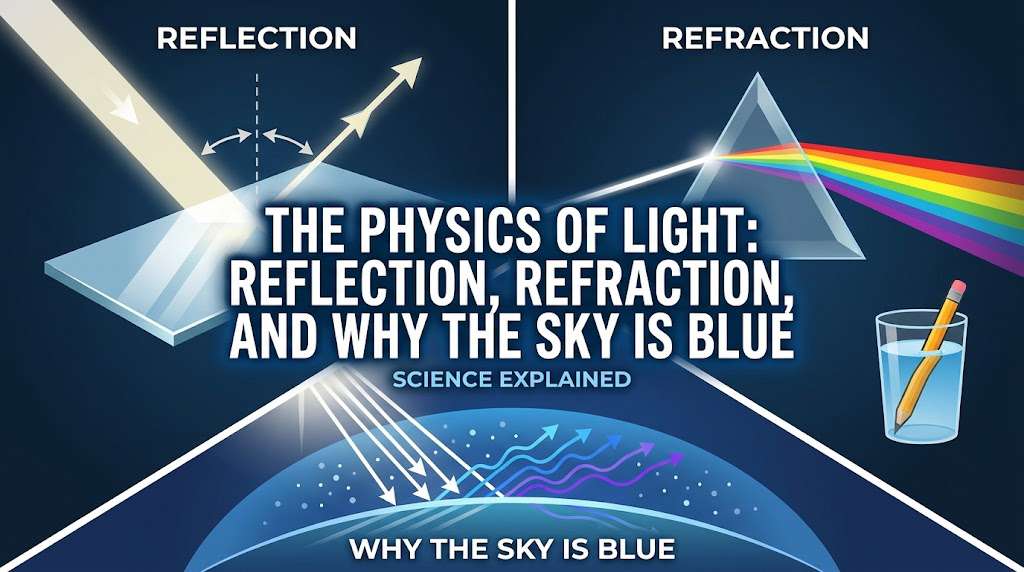
The Physics of Light: Reflection, Refraction, and Why the Sky Is Blue
Introduction
Look up at the sky on a clear day, and you will see an expanse of brilliant blue. Watch the sun set in the evening, and that same sky transforms into a glowing palette of orange, pink, and red. Step into a swimming pool, and a straight pole held at an angle will appear to bend sharply at the water's surface. Stand in front of a mirror, and your reflection appears instantly, perfectly mirrored.
Each of these everyday phenomena, though they may seem unrelated, can be explained through the same fundamental branch of physics: optics, the study of how light behaves as it travels, bounces, bends, and scatters through different materials. Understanding a few key principles — reflection, refraction, and scattering — reveals the hidden physics behind some of the most familiar sights in our daily lives.
What Is Light?
Light is a form of electromagnetic radiation, travelling as waves through space at an extraordinary speed of approximately three hundred million metres per second in a vacuum. Visible light represents only a narrow band of the much larger electromagnetic spectrum, but it is the part our eyes are specifically adapted to detect. Different wavelengths of visible light correspond to the different colours we perceive, ranging from longer-wavelength red light to shorter-wavelength violet light.
When light encounters a different material — such as glass, water, or a solid object — its behaviour can change dramatically, depending on the properties of that material. Three key behaviours explain most of what we observe: reflection, refraction, and scattering.
Reflection: Bouncing Light
Reflection occurs when light strikes a surface and bounces back, rather than passing through it or being absorbed. The way light reflects depends heavily on the texture of the surface it strikes.
On a smooth, polished surface, such as a mirror or still water, light rays reflect in a highly organised, predictable pattern, with each ray bouncing off at the same angle at which it arrived — a principle known as the law of reflection. This organised reflection, called specular reflection, is what allows mirrors to produce clear, sharp images.
On a rough or uneven surface, such as paper, fabric, or an unpolished wall, incoming light rays strike countless tiny irregularities and scatter off in many different directions. This is called diffuse reflection, and it is the reason most everyday objects do not produce a clear, mirror-like reflection, even though they are still reflecting light — it is, in fact, diffuse reflection that allows us to see most objects around us at all, since scattered light reaches our eyes from many different angles.
Refraction: Bending Light
Refraction occurs when light passes from one transparent material into another — for example, from air into water or from air into glass — and changes speed as a result. Light travels at different speeds through different materials, moving fastest through a vacuum and more slowly through denser materials such as water or glass.
This change in speed causes light to bend as it crosses the boundary between two materials, provided it strikes that boundary at an angle rather than straight on. This bending effect is what causes a straight stick to appear bent or broken at the point where it enters water, and it is the principle exploited by lenses in eyeglasses, cameras, telescopes, and microscopes, all of which use carefully shaped pieces of glass or plastic to bend light in controlled and useful ways.
Refraction is also responsible for one of nature's most beautiful phenomena: the rainbow. White light from the sun is, in fact, a combination of many different wavelengths, each corresponding to a different colour. When sunlight enters a raindrop, it refracts, and because different wavelengths of light bend by slightly different amounts, the white light is split apart into its full range of component colours. The light then reflects off the back of the raindrop and refracts again as it exits, spreading the colours further and producing the familiar arc of a rainbow.
Scattering: Why the Sky Is Blue
The third key behaviour, scattering, occurs when light interacts with very small particles or molecules, causing it to be redirected in many different directions. This phenomenon is the key to understanding why the sky is blue.
Sunlight entering Earth's atmosphere is made up of all the colours of visible light combined. As this sunlight passes through the atmosphere, it collides with the tiny molecules of nitrogen and oxygen that make up most of the air. This particular type of scattering, known as Rayleigh scattering, affects shorter wavelengths of light — such as blue and violet — far more strongly than longer wavelengths, such as red and orange.
As a result, blue light is scattered repeatedly in all directions across the sky, while red and orange light largely continues travelling in a straight line. This is why, when we look up at the sky away from the sun, we see scattered blue light arriving from all directions, giving the sky its familiar blue colour. Although violet light is scattered even more strongly than blue light, our eyes are less sensitive to violet and the sun emits comparatively less of it, which is why the sky appears blue rather than violet.
Why Sunsets Are Orange and Red
The same scattering effect also explains why sunsets and sunrises often appear dramatically orange and red. When the sun is low on the horizon, its light must travel through a much greater thickness of atmosphere to reach an observer's eyes than it does at midday, when the sun is directly overhead.
Over this much longer path through the atmosphere, the shorter blue wavelengths of light are scattered away so extensively that very little remains travelling in the direct line toward an observer's eyes. The longer wavelengths — orange and red — are scattered far less and are therefore able to continue travelling directly toward the observer, producing the warm, glowing colours so often associated with sunrise and sunset.
Why This Matters
Understanding reflection, refraction, and scattering does far more than explain beautiful natural phenomena. These principles underpin an enormous range of technologies, including eyeglasses and contact lenses, cameras, microscopes, telescopes, optical fibres used to transmit internet data at the speed of light, and even the design of solar panels, which must be engineered to minimise unwanted reflection in order to capture as much sunlight as possible.
Conclusion
From the clear reflection in a still pond to the dramatic colours of a sunset, the behaviour of light reveals an elegant and consistent set of physical principles at work all around us, often without us ever realising it. Reflection explains how we see ourselves in a mirror, refraction explains why a rainbow forms and why lenses can correct our vision, and scattering explains why the sky above us is blue by day and ablaze with colour at dusk.
The next time you watch the sun set over the horizon, you will be witnessing a spectacular, real-world demonstration of physics in action — a beautiful reminder that even the simplest, most familiar sights often have a remarkable scientific story behind them.