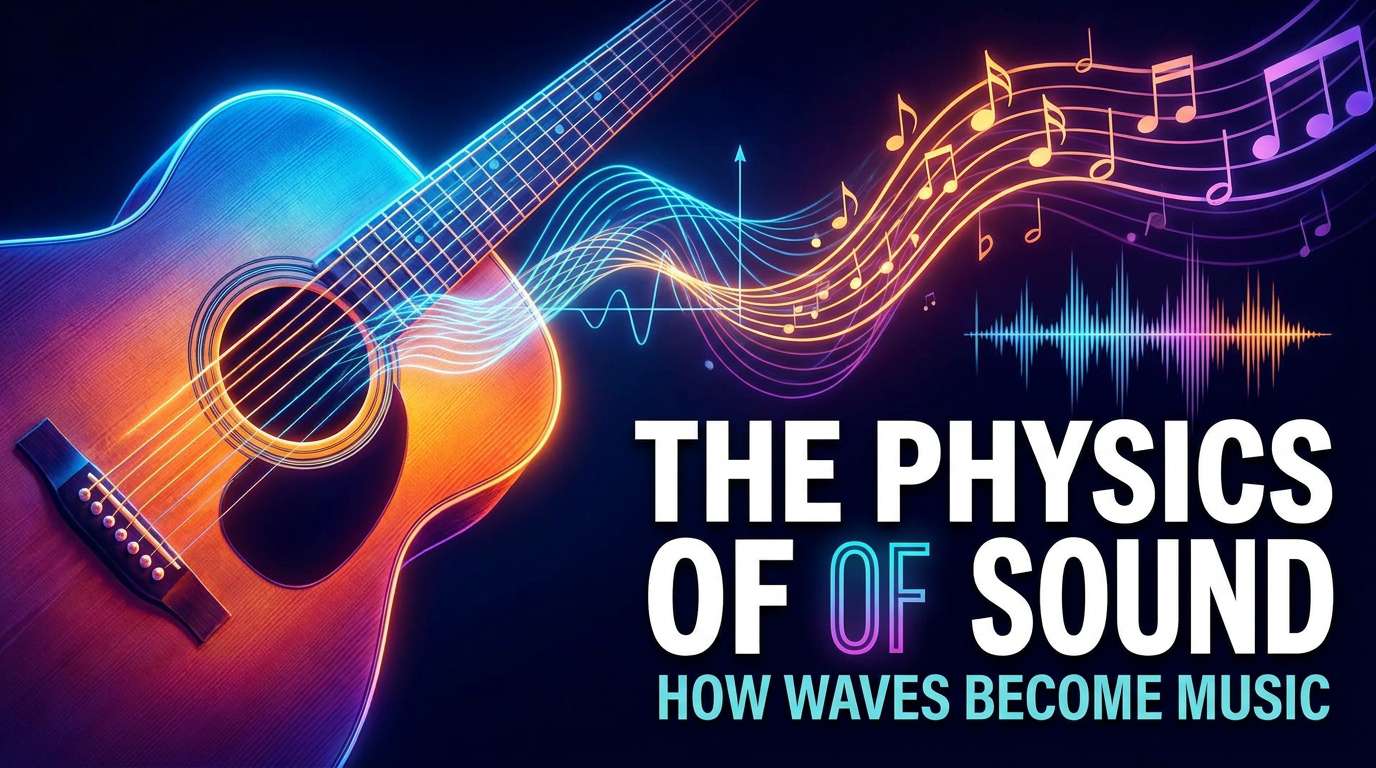
The Physics of Sound: How Waves Become Music
Introduction
Close your eyes and listen to a piece of music. A deep cello note, the bright ring of a cymbal, the warmth of a singer's voice — each of these sounds feels completely different, yet they all share the same basic origin. Every sound you have ever heard, from a whisper to a thunderclap, from a violin's melody to the roar of a jet engine, is the result of the same simple physical process: something vibrating, and those vibrations travelling through a medium until they reach your ears.
Sound is one of the most familiar phenomena in our daily lives, yet the physics behind it reveals a fascinating world of waves, frequencies, and resonance — a world that musicians, instrument makers, and sound engineers have been exploring and exploiting for thousands of years, often long before the underlying physics was properly understood.
What Is Sound?
Sound is a type of mechanical wave — a disturbance that travels through a physical medium such as air, water, or a solid material, carrying energy from one place to another without permanently moving the medium itself. Unlike light, which can travel through the vacuum of space, sound requires a medium to travel through. This is why, famously, "in space, no one can hear you scream" — there is no air for sound waves to travel through.
Sound is produced whenever an object vibrates. A guitar string plucked by a musician's finger vibrates rapidly back and forth. As it does so, it pushes against the surrounding air molecules, compressing them slightly, then pulling away and leaving a region of slightly lower pressure behind. This pattern of compressions and rarefactions (areas of higher and lower pressure) spreads outward through the air as a sound wave, much like ripples spreading across the surface of a pond after a stone is dropped into it.
When these waves of pressure reach your ear, they cause your eardrum to vibrate. Tiny bones in the middle ear amplify these vibrations and pass them to the cochlea, a fluid-filled structure in the inner ear, where specialised cells convert the vibrations into electrical signals that travel to the brain — which interprets them as sound.
Pitch and Frequency
One of the most important properties of a sound wave is its frequency — the number of vibrations, or wave cycles, that occur each second. Frequency is measured in hertz (Hz), where one hertz equals one cycle per second.
Frequency determines what we perceive as pitch — how high or low a sound seems. A high-frequency wave, with many vibrations occurring every second, produces a high-pitched sound, such as a bird's chirp or a piccolo's highest notes. A low-frequency wave, with fewer vibrations per second, produces a low-pitched sound, such as a foghorn or the lowest notes of a double bass.
Human ears can typically detect frequencies ranging from about twenty hertz to twenty thousand hertz, although this range narrows with age. Sounds below this range are called infrasound, and sounds above it are called ultrasound — both are used in nature and technology, from the infrasonic calls of elephants communicating over long distances to the ultrasonic waves used in medical scanning.
Volume and Amplitude
While frequency determines pitch, a different property — amplitude — determines volume, or how loud a sound seems. Amplitude refers to the size of the vibration, or how much the air pressure changes as the sound wave passes through it.
A gently plucked guitar string vibrates with a small amplitude, displacing the surrounding air only slightly, and producing a quiet sound. A forcefully struck string vibrates with a much larger amplitude, displacing more air and producing a louder sound. Volume is measured in decibels (dB), a logarithmic scale that reflects how dramatically loudness can vary — a sound of eighty decibels, such as heavy traffic, is actually ten times more intense than a sound of seventy decibels, not simply ten units louder.
Timbre: Why Instruments Sound Different
If a flute and a violin play the exact same note at the exact same volume, why do they still sound completely different? The answer lies in a property called timbre (pronounced "tam-ber"), sometimes described as tone colour.
When an instrument produces a note, it rarely produces a single pure frequency. Instead, it produces a fundamental frequency — which determines the perceived pitch — along with a series of additional frequencies called overtones or harmonics, which are typically whole-number multiples of the fundamental frequency. The unique combination and relative strength of these overtones gives each instrument its distinctive sound, even when playing identical notes. This is also why two different voices singing the same note remain instantly recognisable as different people.
Resonance: The Secret Behind Musical Instruments
Musical instruments rely heavily on a phenomenon called resonance — the tendency of an object to vibrate with a much larger amplitude at certain specific frequencies, known as its natural or resonant frequencies.
In a guitar, for example, the vibrating string alone produces a relatively quiet sound. However, the string is connected to the guitar's hollow wooden body, which resonates in sympathy with the string's vibrations, amplifying the sound and giving it a richer, fuller tone. This is why a guitar sounds dramatically louder and richer than a single vibrating string stretched between two fixed points.
Wind instruments such as flutes and trumpets work by causing a column of air inside the instrument to resonate. Musicians change the pitch by altering the effective length of this air column — using finger holes on a flute or valves on a trumpet — which changes the resonant frequency and therefore the note produced.
The Speed of Sound
Sound does not travel instantaneously; it moves at a finite speed that depends on the medium through which it is travelling. In dry air at room temperature, sound travels at approximately three hundred and forty-three metres per second — fast, but far slower than the speed of light. This is why you often see a flash of lightning before hearing the accompanying thunder, even though both are produced at the same moment.
Sound travels even faster through liquids and solids, where molecules are packed more closely together and can transmit vibrations more efficiently. Sound travels roughly four times faster through water than through air, and roughly fifteen times faster through steel.
Conclusion
From the simple vibration of a guitar string to the complex resonance inside a concert hall, the physics of sound reveals an elegant and intricate system underlying something we often take for granted. Understanding frequency, amplitude, timbre, and resonance not only explains how music works, but also illuminates countless technologies that shape our world — from the design of concert halls and headphones to medical ultrasound imaging and the architecture of a simple musical instrument.
The next time you listen to your favourite song, consider the invisible waves of compressed and rarefied air carrying that music to your ears — a beautifully simple physical process producing one of humanity's most cherished art forms.