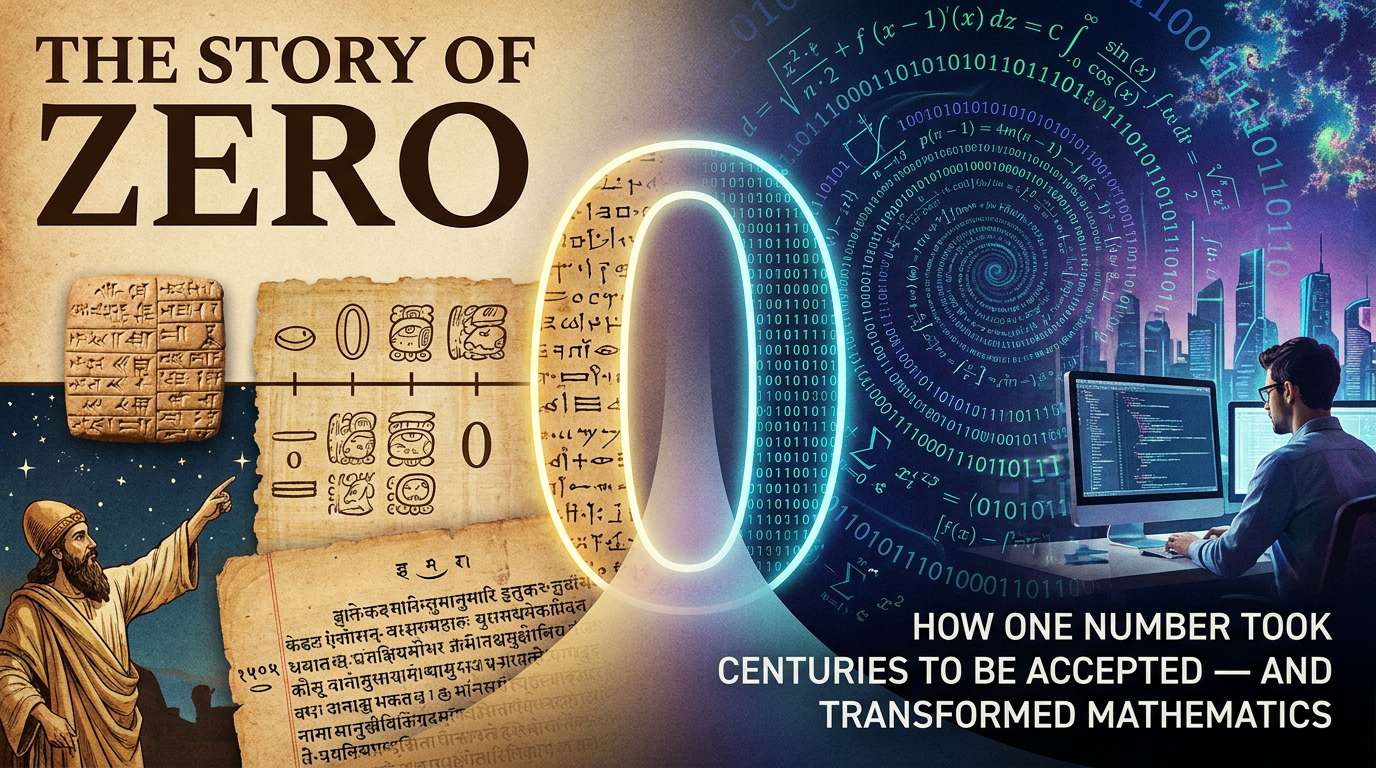
The Story of Zero: How One Number Took Centuries to Be Accepted — and Transformed Mathematics
Introduction
Consider the number 205. It contains a two, a zero, and a five. The two means two hundreds. The five means five ones. The zero means — nothing. No tens. An empty column. A placeholder sitting between the two and the five to make sure we read the number correctly.
This seems so obvious it barely warrants comment. But the zero in 205 represents one of the most profound and hard-won conceptual achievements in the history of human thought. For thousands of years, civilisations that built pyramids, mapped the stars, designed irrigation systems, and conducted sophisticated commerce managed their mathematics without any symbol for nothing. The very idea was considered paradoxical, dangerous, or simply absurd.
When zero finally arrived — invented independently in multiple places, across centuries of mathematical development — it was resisted, suppressed, and in at least one era of European history, actively banned. A number representing nothing was, to many thinkers, a philosophical scandal. How can nothing be something? How can you calculate with absence?
The answers to those questions unlocked algebra, calculus, modern computing, and our entire number system. Without zero, there are no negative numbers. Without negative numbers, no algebra. Without algebra, no calculus. Without calculus, no physics, no engineering, no digital technology. The number that means nothing turns out to be the foundation of everything.
This is the story of zero — one of the strangest, most consequential, and most underappreciated ideas in the history of mathematics.
A World Without Zero
To appreciate what zero's invention meant, it helps to understand what mathematics looked like without it. Consider the number systems used by the greatest ancient civilisations.
Egyptian Numerals
The ancient Egyptians used a system of hieroglyphs to represent numbers. A single stroke represented 1, a heel bone represented 10, a coil of rope represented 100, a lotus flower represented 1,000, and so on up to one million. To write 253, you would draw two lotus flowers, five coils of rope, and three heel bones, in any order. There was no zero — no symbol for an empty quantity — because there was no need for one. If you had no hundreds, you simply drew no lotus flowers.
Roman Numerals
The Romans used a system still encountered today on clock faces, film credits, and official documents. I is 1, V is 5, X is 10, L is 50, C is 100, D is 500, M is 1,000. The year 2025 in Roman numerals is MMXXV. The system has no zero — and it is, in consequence, extraordinarily clumsy for arithmetic. Try multiplying MCDXLVII by CCCIX using only Roman numerals. The difficulty is not intellectual — it is the absence of a positional system, which zero makes possible, that makes the calculation so painful.
The Roman numeral system was adequate for recording quantities but deeply unsuitable for calculation. Roman merchants and engineers relied on the abacus — a physical counting device — for arithmetic, and recorded results in Roman numerals afterward. The numerals were notation, not a calculating tool. The absence of zero meant arithmetic and written number representation remained separated by a conceptual gap that would not be bridged for centuries.
The First Zeros: Placeholder Without a Number
The earliest uses of zero were not as a number in its own right but as a placeholder — a way of indicating an empty position in a positional number system.
Babylon: The First Placeholder
The Babylonians, who flourished in Mesopotamia from around 2000 BCE, used a positional number system with base 60 — the same base that survives today in our measurement of time (60 seconds in a minute, 60 minutes in an hour) and angles (360 degrees in a circle). In a positional system, the position of a digit matters: in our system, the 3 in 300 means something different from the 3 in 30 or the 3 in 3, because of where it sits.
But early Babylonian mathematics had no way to distinguish, say, between what we would write as 3, 30 (= 3 × 10), or 300 (= 3 × 100), other than context. Around 300 BCE, Babylonian scribes introduced a placeholder symbol — two small wedge marks — to indicate an empty position in a number. This is the earliest known precursor to zero.
Crucially, this Babylonian placeholder was never used at the end of a number, only in the middle. It was a punctuation mark, not a number. You could not calculate with it. You could not ask "what is three minus three?" and write the answer as the placeholder. The concept of zero as a quantity — as the answer to "how many?" when there are none — had not yet been born.
The Maya: Zero in the Americas
Independently of developments in Asia and the Middle East, the Maya civilisation of Central America developed a sophisticated positional number system with base 20, used primarily for their extraordinarily accurate calendar calculations. By at least 350 CE — and possibly much earlier — the Maya were using a shell-shaped symbol to represent zero as a placeholder in their numerical notation.
The Maya zero was more advanced than the Babylonian placeholder in that it was used at the end of numbers as well as the middle. But like the Babylonian system, Maya zero remained primarily a positional placeholder. Its influence did not spread beyond Mesoamerica, and the mathematical tradition it was part of remained isolated from the developments in India that would eventually transform world mathematics.
India: Where Zero Became a Number
The most consequential development in the history of zero took place in India, where mathematicians made the leap from zero as a placeholder to zero as a number in its own right — something you could calculate with, add to other numbers, subtract from them, and incorporate into mathematical rules.
Brahmagupta and the Rules of Zero
The pivotal figure is Brahmagupta, the Indian mathematician and astronomer who lived in the seventh century CE. In his 628 CE treatise Brahmasphutasiddhanta (The Opening of the Universe), Brahmagupta set out, for the first time in recorded history, explicit rules for arithmetic with zero:
- A number plus zero equals that number.
- A number minus zero equals that number.
- Zero plus zero equals zero.
- A number multiplied by zero equals zero.
- Zero multiplied by zero equals zero.
- Zero divided by zero equals zero.
Most of these rules are correct and remain the foundation of arithmetic with zero today. The last rule — zero divided by zero equals zero — was Brahmagupta's one significant error, a problem that would occupy mathematicians for centuries and which we now understand differently: division by zero is undefined.
But the achievement was monumental. For the first time, zero had a place in the number line. It was not merely a placeholder or an absence. It was a number — a quantity with its own arithmetic properties, capable of participating in calculations as an equal partner to 1, 2, 3, and all the rest.
The Decimal Place-Value System
Indian mathematicians also developed — and zero made possible — the decimal place-value system: the number system we use today, in which ten digits (0 through 9) and the position of each digit within a number together express any quantity, however large or small.
This system is so deeply familiar that its genius is invisible. But consider what it achieves. With just ten symbols, we can write any number: 7, 42, 1,000,000, 0.000001, or any number with arbitrarily many digits. We can perform addition, subtraction, multiplication, and division using simple algorithms that work the same way regardless of the size of the numbers. We can extend the system to decimals by placing digits to the right of a decimal point, following the same positional logic.
None of this works without zero. Zero is the digit that occupies the empty positions. It is what distinguishes 205 from 25, 1,000 from 1, and 3.04 from 3.4. Remove zero from the decimal system and the system collapses. Zero is not a component of the system — it is a precondition of it.
The Journey to the Islamic World
From India, the decimal system and the concept of zero travelled westward through trade and scholarship. The pivotal intermediary was the Islamic Golden Age — the period from roughly the eighth to the thirteenth century CE when Islamic scholars in Baghdad, Cairo, and across the Muslim world preserved, translated, extended, and transmitted the mathematical knowledge of Greece, India, and Persia.
Al-Khwarizmi and Algebra
The most significant figure in this transmission was Muhammad ibn Musa al-Khwarizmi, the ninth-century Persian mathematician who worked at the House of Wisdom in Baghdad. His treatise on the Indian numeral system introduced the decimal place-value system — including zero — to the Islamic world. His name, latinised as Algoritmi, gave us the word algorithm.
Al-Khwarizmi's other great work, Al-Kitab al-mukhtasar fi hisab al-jabr wal-muqabala (The Compendious Book on Calculation by Completion and Balancing), founded algebra as a systematic discipline. The word al-jabr in the title gave us the word algebra. The zero that Indian mathematicians had defined now powered the algebraic manipulations that al-Khwarizmi systematised.
Europe's Reluctant Embrace
The decimal system and its zero reached Europe through two main channels: the translation of Arabic mathematical texts into Latin, and the commercial contacts between European merchants and the Islamic world through trade in the Mediterranean.
Fibonacci and the Introduction to Europe
The mathematician most responsible for introducing the Hindu-Arabic numeral system to medieval Europe was Leonardo of Pisa, better known as Fibonacci. Born around 1170, Fibonacci had grown up in North Africa where his father was a customs official, and he studied mathematics under Arab teachers who used the decimal system.
In 1202, Fibonacci published Liber Abaci (Book of Calculation), which introduced the Hindu-Arabic numerals — including zero — to European audiences and demonstrated their superiority for commercial arithmetic over Roman numerals. The book begins: "The nine Indian figures are: 9 8 7 6 5 4 3 2 1. With these nine figures, and with the sign 0 which the Arabs call zephyr, any number may be written."
The word zephyr — from the Arabic sifr, meaning empty — became zefiro in Italian, then zero. The word sifr also became cifra in Italian and eventually cipher in English — originally meaning zero, later extended to mean any digit, and eventually to mean a secret code.
The Ban on Zero
European adoption of zero was not smooth. The city of Florence banned the use of Hindu-Arabic numerals — including zero — in 1299, ostensibly because the new numerals were easier to falsify in commercial documents than Roman numerals (a 0 could be altered into a 6 or 9, while Roman numerals required adding additional characters). Merchants who wanted to use the new system were required to use Roman numerals for official records or write numbers out in full words.
Behind the official objection lurked a deeper unease. Zero was philosophically troubling. Medieval European thought was deeply influenced by Aristotle, who had argued that a vacuum — empty space, the physical analogue of zero — was impossible. Nature, Aristotle taught, abhors a vacuum. If nothingness cannot exist in the physical world, how can it exist in mathematics? The Church, which had incorporated Aristotelian philosophy into its theology, found the idea of zero theologically suspect. A number representing nothing seemed to challenge the idea that God had created a universe filled with being, not absence.
These objections were ultimately swept aside by the overwhelming practical superiority of the decimal system. By the fifteenth century, Hindu-Arabic numerals and zero were in common use throughout Europe. By the sixteenth century, Roman numerals had been almost entirely displaced for calculation, surviving mainly as decoration and in contexts where tradition demanded them.
The Mathematics Zero Made Possible
Negative Numbers
Once zero exists as a number, negative numbers follow naturally. If zero is the point of balance on the number line — the boundary between positive and negative — then quantities less than zero are simply numbers on the other side of that boundary. Debts, temperatures below freezing, positions below sea level, electric charges: all of these become representable and calculable once the number line extends through zero in both directions.
Indian mathematicians had worked with negative numbers (representing debts) as early as the seventh century — the same tradition that gave us zero. European mathematicians resisted negative numbers even longer than they resisted zero: as late as the seventeenth century, prominent European mathematicians referred to negative numbers as "absurd" or "fictitious." The resistance followed the same pattern as the resistance to zero: philosophical discomfort with the idea that mathematics could represent less than nothing.
Algebra
Zero is indispensable to algebra. Every algebraic equation involves finding values that make an expression equal to zero — the roots or solutions of the equation. The quadratic formula finds the values of x where ax² + bx + c = 0. Polynomial equations are studied by finding their zeros. The entire architecture of algebra is built on the question "when does this equal zero?" — a question that has no meaning without zero.
Calculus
As we saw in the article on calculus, the derivative — the instantaneous rate of change of a function — is defined using a limit: what happens to the average rate of change as the time interval approaches zero? The integral is the limit of a sum as the width of each strip approaches zero. Calculus is, at its heart, the mathematics of what happens as quantities approach zero — the mathematics of the infinitely small. Without zero as a precisely defined number with well-understood arithmetic properties, calculus cannot be rigorously formulated.
The Binary System and Computing
Every computer, smartphone, and digital device that has ever existed operates on the binary number system — a positional system using only two digits: 0 and 1. Every piece of information processed by a computer — every image, every word, every calculation, every instruction — is ultimately represented as a sequence of zeros and ones.
The binary system, like the decimal system, is a positional place-value system, and it requires zero as a digit just as the decimal system does. Without zero, there is no binary. Without binary, there is no digital computing. Without digital computing, there is no internet, no smartphone, no satellite navigation, no modern medicine, no global financial system.
The entire digital civilisation — every screen, every server, every line of code — rests on a foundation of zeros and ones. The zeros are not merely present; they are equal partners with the ones in every computation ever performed.
Coordinate Geometry
When René Descartes introduced the coordinate plane in the seventeenth century — the system of x and y axes that allows geometric shapes to be described with algebraic equations — zero became the origin: the central point from which all positions are measured. The origin (0, 0) is not merely a convenience. It is the reference point that gives every other coordinate its meaning. Without zero as the origin, coordinate geometry has no anchor.
The Peculiar Arithmetic of Zero
Zero behaves differently from every other number, and its peculiarities are among the most important rules in elementary mathematics:
- Addition: Any number plus zero equals that number. Zero is the additive identity — adding it changes nothing.
- Subtraction: Any number minus zero equals that number. Zero subtracted from zero equals zero.
- Multiplication: Any number multiplied by zero equals zero. This rule — seemingly simple — has profound consequences throughout mathematics.
- Division by zero: Division by zero is undefined. It is not zero, not infinity, not any number. It is simply not a valid mathematical operation. This is perhaps the most important rule about zero, and the most commonly misunderstood.
Why Can You Not Divide by Zero?
Division asks: how many times does one number fit into another? How many times does 5 fit into 20? Four times. How many times does 0.1 fit into 1? Ten times. How many times does 0.01 fit into 1? One hundred times. As the divisor gets smaller and smaller, the result gets larger and larger — approaching infinity.
But infinity is not a number. And asking "how many times does 0 fit into 1?" is asking a question with no meaningful answer — because no matter how many times you add zero to itself, you never reach 1. There is no number of times zero fits into one. Division by zero is not a very large number, or infinity, or zero. It is undefined — a question that mathematics cannot answer because the question itself is malformed.
In computing, attempting to divide by zero causes a programme to crash or produce an error — a direct reflection of the mathematical fact that the operation has no valid result. One of the most common sources of software bugs is code that accidentally divides by zero in some edge case the programmer did not anticipate.
Zero as a Philosophical Concept
The resistance to zero was not merely conservative stubbornness. It reflected genuine philosophical difficulties that took centuries to resolve.
Is zero a number or the absence of a number? The question is not trivial. In one sense, zero represents nothing — no quantity, no objects, no amount. In another sense, it is clearly something: it has a position on the number line, it obeys arithmetic rules, it can be added, subtracted, and multiplied. It is simultaneously the most nothing of all numbers and a very definite something.
This dual nature connects to deep questions in philosophy and metaphysics. What is nothingness? Can nothing exist? Aristotle said no. Buddhist philosophy has long engaged with the concept of emptiness — sunyata in Sanskrit, the same root as the Sanskrit word for zero, sunya, meaning empty. The mathematical and philosophical concepts of zero developed in parallel in Indian thought, and their convergence was not coincidental.
In modern mathematics, zero is rigorously defined within set theory as the cardinality of the empty set — the set containing no elements. The empty set exists (it is the set with nothing in it), and its size is zero. Nothingness, in this framework, is not absence but a precisely defined mathematical object. Zero is the measure of the void.
Zero and WAEC/JAMB Mathematics
Zero appears throughout the WAEC and JAMB mathematics syllabuses, often in ways that students find confusing because zero's unique properties make it behave differently from every other number:
- Number classification: Zero is an integer, a rational number, and a real number. It is neither positive nor negative. It is even (divisible by 2 with no remainder). These classifications are examined directly.
- Multiplication by zero: Any expression multiplied by zero equals zero. This is used in solving equations: if (x − 3)(x + 2) = 0, then either x − 3 = 0 or x + 2 = 0, giving x = 3 or x = −2. This principle — the zero product property — is fundamental to solving quadratic and polynomial equations.
- Division by zero: Students must know that division by zero is undefined. Expressions like 5/0 or 0/0 have no value. This arises in rational expressions and asymptotes of graphs.
- Zero as an exponent: Any non-zero number raised to the power zero equals 1: a⁰ = 1 for any a ≠ 0. This follows from the laws of indices and is directly examined. Students often find this counterintuitive and must understand why it is true, not merely memorise it.
- Zeros of functions: The zeros (or roots) of a function f(x) are the values of x where f(x) = 0. Finding these — using factorisation, the quadratic formula, or graphical methods — is one of the most frequently examined skills in both WAEC and JAMB mathematics.
- The number line and signed arithmetic: Zero as the origin of the number line is the foundation for understanding positive and negative numbers, directed quantities, and operations with integers.
- Place value: Zero as a placeholder in the decimal system is tested in questions about place value, rounding, significant figures, and standard form (scientific notation).
Common Mistakes Students Make With Zero
- Thinking zero is positive. Zero is neither positive nor negative. When a question asks for positive integers or positive values, zero is excluded. When it asks for non-negative values, zero is included. The distinction matters in inequalities, probability, and number theory questions.
- Thinking 0⁰ = 0. The expression 0⁰ is actually a matter of mathematical convention and context. In most examinations, you will not be asked to evaluate it directly, but knowing that a⁰ = 1 for any non-zero a is essential.
- Treating division by zero as infinity. Dividing by zero does not give infinity. It is undefined. Writing 1/0 = ∞ is a mathematical error, even though the intuition of "getting very large" as the divisor approaches zero is understandable.
- Forgetting the zero solution. When solving equations by factorisation, students sometimes find one factor and forget to check whether zero is also a solution. For example, in x² − 3x = 0, factorising gives x(x − 3) = 0, so x = 0 or x = 3. Omitting x = 0 loses a mark.
- Mishandling zero in significant figures. Zeros between non-zero digits are always significant (205 has three significant figures). Zeros after a decimal point following a non-zero digit are significant (2.50 has three significant figures). Leading zeros are never significant (0.005 has one significant figure). These rules are directly examined and frequently confused.
Conclusion
Zero began as an absence — a gap in a clay tablet, a shell-shaped symbol in a Mayan codex, an empty column in an accountant's ledger. It took millennia for mathematicians to recognise that this absence was itself a kind of presence: a number, a quantity, a mathematical object with its own rules and its own power.
The resistance to zero was not stupidity. The greatest minds in the ancient world — Greek philosophers, Roman engineers, medieval European scholars — managed extraordinary achievements without it. But they were working with one hand tied behind their backs. The mathematics that zero made possible — algebra, calculus, coordinate geometry, binary computing — was simply not accessible without it. The number that means nothing opened the door to everything.
Today zero is so embedded in our thinking that we cannot imagine its absence. We write our phone numbers, account balances, and examination scores with it. We use it in every calculation. It sits at the centre of our number line, the origin of our coordinate systems, the silence between the ones in our computers. It is the foundation on which modern mathematics stands.
A number representing nothing. The most important number ever invented. Simple enough that a child learns it before they start school. Deep enough that it took the entire ancient world thousands of years to discover. That is the story of zero — and it is one of the greatest stories mathematics has to tell.