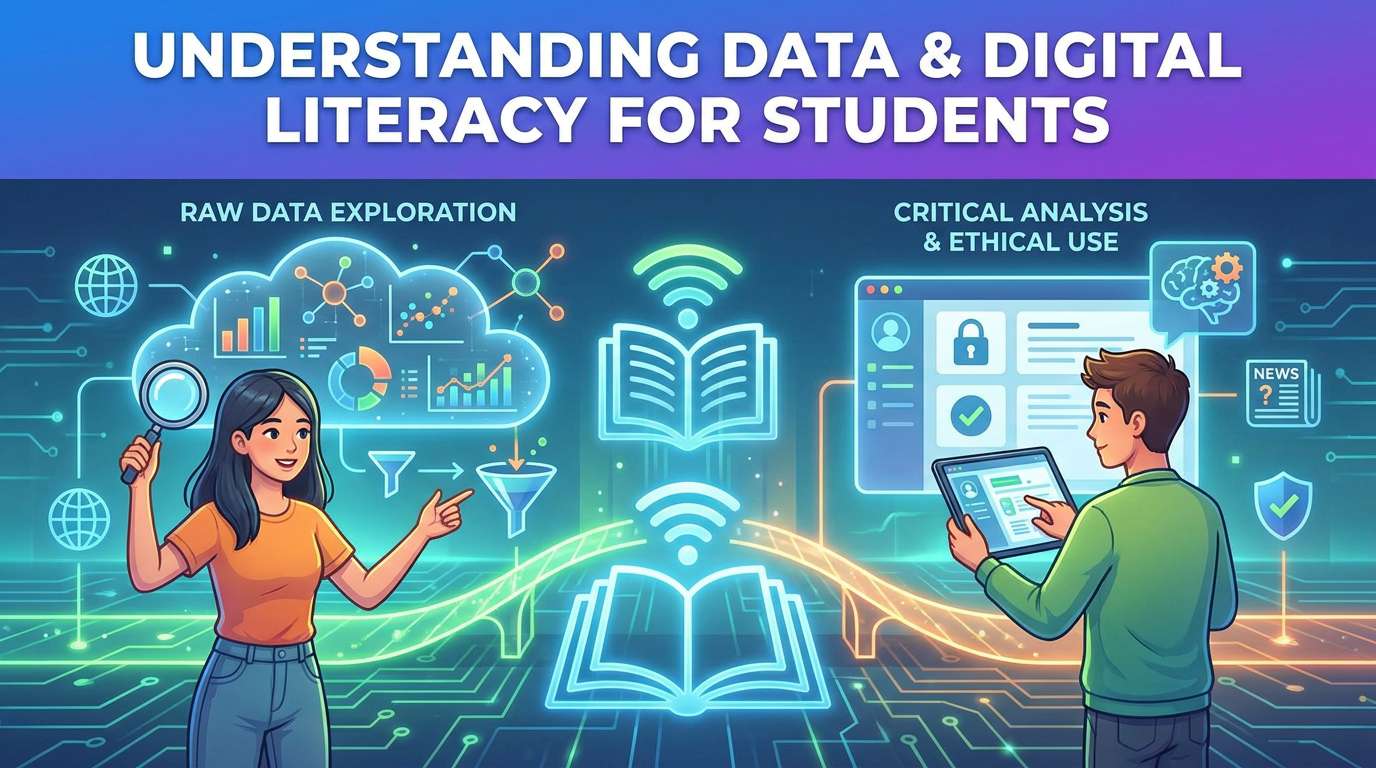
Understanding Data and Digital Literacy for Students
Introduction
Every search you type, every photo you upload, every quiz you complete on an online learning platform generates something valuable and, in many ways, invisible: data. Understanding what data actually is, how it is used, and how to navigate an increasingly data-driven digital world has become an essential skill for students — one closely connected to the broader concept of digital literacy.
This article explores data and digital literacy in practical, accessible terms — what data actually means in a computing context, how it flows through the digital services students use every day, and the essential digital skills every student should work to develop.
What Is Data?
In a computing context, data refers to raw facts, figures, or pieces of information that can be processed, stored, and analyzed by computer systems. Data can take many forms, including numbers, text, images, audio, and video, and it forms the essential raw material that software applications and digital services are built to process and act upon.
Data vs. Information: An Important Distinction
It is useful to distinguish between raw data and processed information. Data on its own is often unorganized and lacks immediate meaning — for example, a long list of individual quiz scores. Once that data is processed, organized, and interpreted — such as calculating an average score, or identifying which topics a particular student consistently struggles with — it becomes meaningful information that can actually inform a decision or action.
Types of Data
Structured Data
Structured data is highly organized, typically stored in a clearly defined format such as rows and columns within a database or spreadsheet, making it relatively straightforward for computer systems to search, sort, and analyze.
Unstructured Data
Unstructured data lacks a predefined, consistent format, such as free-form text, images, audio recordings, or video content, generally requiring more sophisticated processing techniques, such as those found in artificial intelligence systems, to extract meaningful information from it.
How Data Is Collected From Everyday Digital Activity
Many everyday digital activities generate data, often automatically and sometimes without users fully realizing the extent of it, including:
- Searches entered into a search engine.
- Posts, likes, and interactions on social media platforms.
- Location information shared through mobile apps.
- Purchase history and browsing activity on online shopping platforms.
- Quiz results, study patterns, and progress tracked on educational platforms.
How Companies and Organizations Use Data
Improving Products and Services
Organizations often analyze usage data to understand how their products or services are actually being used, helping identify areas for improvement or new features that would genuinely benefit users.
Personalization
Data such as browsing history or past preferences is frequently used to personalize the content, recommendations, or advertisements a particular user sees, aiming to make digital experiences more relevant to individual users.
Research and Analysis
Large collections of data can reveal broader patterns and trends useful for research, business decision-making, or public policy, particularly when analyzed using statistical methods or, increasingly, artificial intelligence techniques.
Targeted Advertising
Many free digital platforms generate revenue partly by using collected data to display advertising more precisely targeted to users' apparent interests, an important factor to understand when considering the true "cost" of seemingly free online services.
What Is Digital Literacy?
Digital literacy refers to the ability to effectively find, evaluate, use, create, and communicate information using digital technologies. It extends well beyond simply knowing how to operate a device or app, involving a broader set of practical and critical thinking skills necessary to navigate the digital world confidently and responsibly.
Core Digital Literacy Skills Every Student Should Develop
Information Evaluation
The ability to critically assess the credibility, accuracy, and reliability of online information — recognizing the difference between a well-sourced, credible piece of information and misleading or false content — is one of the most important digital literacy skills in an era of widespread online misinformation.
Basic Technical Proficiency
Practical comfort using common digital tools — including word processors, email, web browsers, and basic troubleshooting of common technical issues — forms a foundational layer of digital literacy relevant to nearly every modern academic or career context.
Understanding Digital Privacy
A clear understanding of what personal data is being collected by the digital services one uses, and how to manage privacy settings appropriately, connects closely to the broader cybersecurity principles discussed elsewhere in this syllabus.
Digital Communication Skills
The ability to communicate clearly, appropriately, and professionally across different digital contexts — including email, messaging platforms, and collaborative online tools — is increasingly essential across both academic and professional settings.
Understanding Digital Footprints
A digital footprint refers to the trail of data a person leaves behind through their online activity, including posts, comments, and shared content. Understanding that this digital footprint can be long-lasting, and potentially visible to others including future employers or institutions, encourages more thoughtful, deliberate online behaviour.
Basic Coding and Computational Thinking
As discussed in the article on coding, even a basic understanding of how software and algorithms work supports stronger overall digital literacy, helping students better understand how the digital tools and platforms they use actually function.
Why Digital Literacy Matters for Nigerian Students
- Academic success, since much of modern education, including research, online learning platforms, and digital assignments, requires solid digital literacy skills.
- Future employability, since a growing proportion of jobs, across nearly every industry, require at least foundational digital skills.
- Informed citizenship, since evaluating online information critically supports better-informed civic and political participation, connecting to broader civic education themes discussed elsewhere in this syllabus.
- Personal safety and privacy, since understanding how data is collected and used supports safer, more intentional digital behaviour.
- Access to economic opportunity, particularly relevant given Nigeria's rapidly growing digital economy and technology sector.
Practical Steps to Improve Digital Literacy
- Practicing critical evaluation of online sources before accepting information as accurate, including checking for credible sourcing and cross-referencing important claims.
- Regularly reviewing privacy settings across the digital platforms and apps you use most frequently.
- Deliberately exploring and practicing with new digital tools relevant to your studies or interests, rather than relying only on familiar, limited technology use.
- Staying informed about basic cybersecurity practices, as discussed in the dedicated article within this syllabus.
- Reflecting thoughtfully on your own digital footprint and online conduct.
Data and Digital Literacy and WAEC/JAMB Technology
Key examinable areas of this topic include:
- The definition of data, and the distinction between data and information.
- Structured versus unstructured data.
- How data is collected and used by organizations and digital platforms.
- The definition of digital literacy and its core component skills.
- The concept of a digital footprint and its practical significance.
- Why digital literacy matters for academic, professional, and civic life.
Common Mistakes Students Make
- Treating "data" and "information" as interchangeable terms. Data refers to raw, often unorganized facts; information refers to data that has been processed and organized into a meaningful form.
- Assuming digital literacy simply means knowing how to operate a smartphone or computer. It encompasses a much broader set of skills, including critical evaluation of information and understanding of digital privacy.
- Overlooking how data is collected through seemingly ordinary digital activity, such as searches or app usage, assuming data collection only occurs through deliberate, obvious means.
- Assuming free digital services have no cost at all, without recognizing that user data is often collected and used as part of these services' underlying business models.
- Underestimating the permanence of a digital footprint, assuming online content is easily and completely erasable once posted.
Conclusion
Data has become one of the most valuable and consequential resources of the digital age, quietly generated through nearly every online interaction and increasingly shaping the products, services, and experiences we encounter every day. Understanding both what data actually is, and developing genuine digital literacy — the practical and critical skills needed to navigate an increasingly digital world confidently and safely — has become essential knowledge for students, extending well beyond simple technical familiarity with devices and apps.
As Nigeria's digital economy continues to expand and digital tools become ever more embedded in education, work, and civic life, these skills offer students genuine, lasting value — equipping them not just to use technology, but to understand, evaluate, and engage with it thoughtfully and effectively.