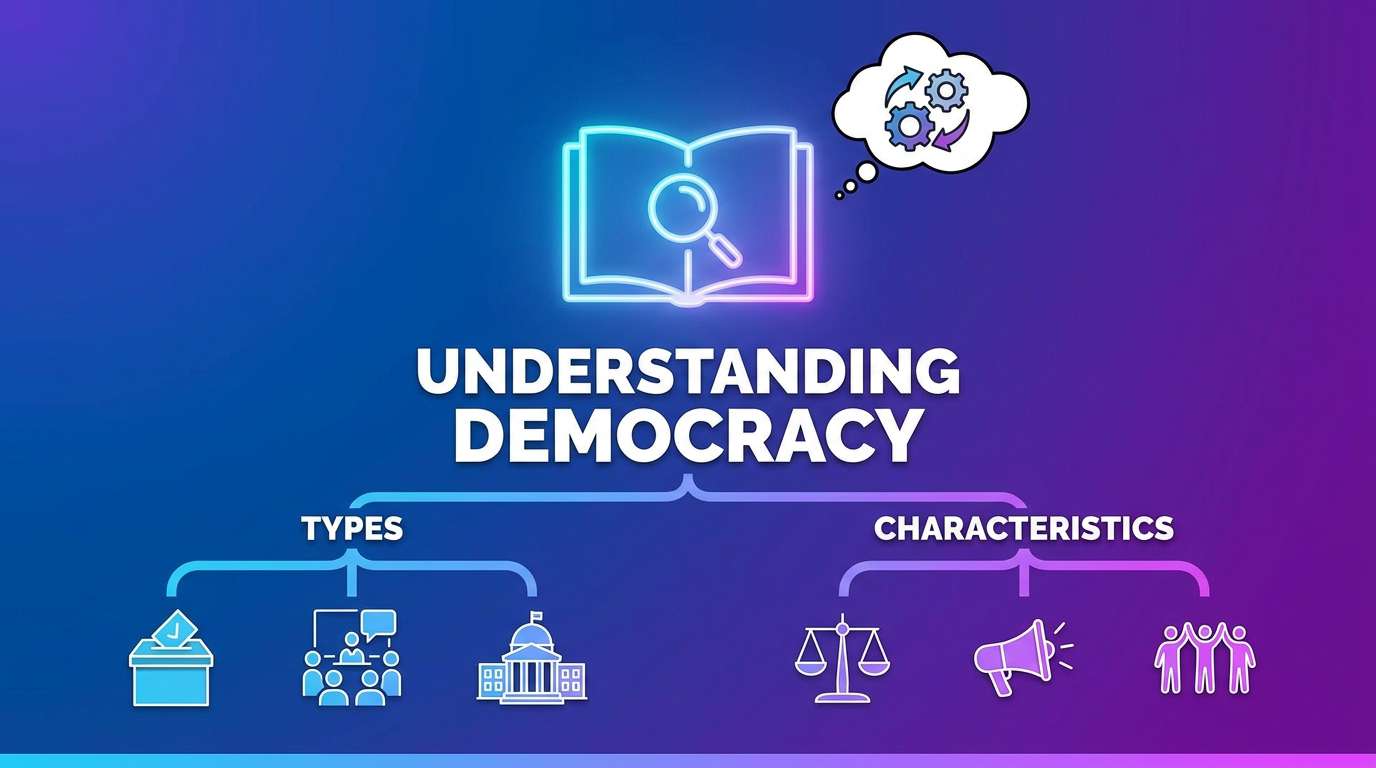
Understanding Democracy: Types and Characteristics
Introduction
Of all the political concepts studied in Government class, few are referenced as often — or, sometimes, as loosely — as democracy. Politicians across vastly different systems of government routinely describe their countries as democratic, news reports discuss "democratic backsliding" in various nations, and ordinary citizens frequently debate whether their own government is "truly democratic" or not.
But what does democracy actually mean in a precise, analytical sense? What specific characteristics distinguish a genuinely democratic system from other forms of government? And what different types of democracy exist across the world today? This article explores democracy in depth — its definition, origins, essential characteristics, major types, and its particular relevance to Nigeria's own political development.
What Is Democracy?
The word democracy derives from the ancient Greek words demos (people) and kratos (power or rule), literally meaning "rule by the people." In its broadest sense, democracy is a system of government in which political power ultimately derives from and is exercised on behalf of the people, typically through their participation, whether directly or through elected representatives, in the processes of governance.
One of the most widely cited definitions of democracy comes from a speech by United States President Abraham Lincoln, who described democratic government as "government of the people, by the people, for the people" — a phrase that remains a useful, memorable summary of democracy's core essence.
The Historical Origins of Democracy
Democracy's earliest recorded form emerged in ancient Athens, Greece, around the fifth century BCE, where eligible citizens (a category that, notably, excluded women, enslaved people, and non-citizens) could participate directly in political decision-making through open assemblies. This early form is often referred to as direct democracy, distinct from the representative systems that dominate most modern democracies today.
Modern democratic government developed considerably further over subsequent centuries, influenced significantly by Enlightenment-era political thought, gradual expansions of voting rights across many nations, and the eventual spread of democratic constitutional models — including to Nigeria, whose own democratic development is explored throughout this Government syllabus.
Core Characteristics of Democracy
Popular Sovereignty
In a democracy, ultimate political authority rests with the people, who confer legitimacy on their government, typically through free and fair elections and other mechanisms of political participation.
Free and Fair Elections
Regular, competitive, and genuinely free elections allow citizens to choose their political leaders and hold them accountable, with a realistic possibility of voting an unsatisfactory government out of office.
Political Pluralism
Genuine democracy requires the existence of multiple political parties or viewpoints permitted to compete openly for public support, rather than a single party or ideology holding an unchallenged monopoly on political power.
Protection of Fundamental Rights and Freedoms
Democratic systems typically guarantee fundamental rights, including freedom of expression, freedom of association, and freedom of the press, allowing citizens to organize, express dissenting views, and hold their government accountable without fear of arbitrary punishment.
Rule of Law
As explored in a separate article, genuine democracy requires that government officials, like all citizens, remain subject to the law, with an independent judiciary capable of holding government accountable.
Separation of Powers and Checks and Balances
Most modern democracies divide governmental authority among distinct branches — the executive, legislature, and judiciary — with mechanisms in place to prevent any single branch from dominating the others.
Government Accountability and Transparency
Democratic governments are expected to operate with a reasonable degree of transparency and to remain answerable to citizens for their decisions and use of public resources.
Types of Democracy
Direct Democracy
In a direct democracy, citizens participate personally and directly in political decision-making, rather than through elected representatives — for example, voting directly on specific laws or policy questions through a referendum. Direct democracy in its pure, ancient Athenian form is rarely practiced at a national scale today, given the impracticality of involving every citizen directly in every decision within large modern nations, though elements of direct democracy, such as referendums on specific major issues, remain in use in various countries.
Representative (Indirect) Democracy
In a representative democracy, citizens elect representatives who make political decisions on their behalf, rather than participating directly in every decision themselves. This is by far the most common form of democracy in the modern world, including in Nigeria, where citizens elect representatives such as the President, Governors, Senators, and members of the House of Representatives, who then exercise governmental authority on behalf of the electorate.
Presidential Democracy
In a presidential democracy, the head of government (the President) is elected separately and directly by the people, rather than being selected from within the legislature, and generally serves for a fixed term largely independent of ongoing legislative confidence. Nigeria, as discussed in the article on Nigeria's Constitution, operates a presidential system, similar in structure to that of the United States.
Parliamentary Democracy
In a parliamentary democracy, the head of government (typically a Prime Minister) is generally drawn from and remains accountable to the legislature (parliament), and can typically be removed through a vote of no confidence if they lose the ongoing support of a legislative majority. The United Kingdom is a well-known example of a parliamentary democracy, and Nigeria itself briefly operated under a parliamentary system during its First Republic, before later adopting its current presidential model.
Liberal Democracy
A liberal democracy combines democratic political processes, such as free elections, with strong constitutional protections for individual rights and freedoms, alongside the rule of law and independent judicial oversight — generally the model most Western-style democracies, and Nigeria's own constitutional system, aim to embody.
Advantages of Democratic Government
- Government accountability, since citizens can vote out leaders whose performance they consider unsatisfactory.
- Protection of individual rights and freedoms, typically guaranteed through constitutional provisions and enforced by an independent judiciary.
- Peaceful transfer of power, allowing changes in government leadership to occur through elections rather than conflict.
- Broader political participation, allowing a wide range of citizens and groups to influence government policy through voting, pressure groups, and public opinion.
- Greater government responsiveness, since elected officials generally have strong incentives to address genuine public concerns in order to secure re-election.
Challenges and Criticisms of Democratic Government
- Potential for short-term policy focus, where elected officials may prioritize policies likely to yield visible results before the next election, over policies with greater long-term benefit but slower or less visible results.
- Risk of "tyranny of the majority," where the interests or rights of numerical minorities might, without adequate constitutional protections, be overridden by the preferences of a larger majority.
- Vulnerability to misinformation and manipulation, particularly where citizens' political decisions are influenced by inaccurate or misleading information.
- Costly and resource-intensive electoral processes, particularly significant challenges for democracies operating with more limited government resources.
- Risk of electoral malpractice, including vote buying, rigging, or intimidation, which can undermine the genuine democratic legitimacy of an election's outcome.
Democracy in Nigeria: A Brief Reflection
Nigeria's own democratic journey has been marked by periods of civilian, democratic government interspersed with extended periods of military rule, before the establishment of its current, continuous period of civilian government beginning in 1999 — often referred to as the Fourth Republic. This history reflects a broader, ongoing national effort to build and strengthen democratic institutions — including free elections, an independent judiciary, a free press, and constitutionally protected rights — capable of genuinely embodying the core democratic characteristics discussed throughout this article.
Democracy and WAEC/NECO Government
Key examinable areas of this topic include:
- The definition and origins of democracy, including its ancient Athenian roots.
- Core characteristics of a democratic system of government.
- Types of democracy, including direct versus representative, and presidential versus parliamentary systems.
- Advantages and challenges associated with democratic government.
- Nigeria's own democratic development, including its transition between civilian and military rule, and its current presidential system.
Common Mistakes Students Make
- Assuming democracy simply means "holding elections." Genuine democracy requires a broader set of characteristics, including protected rights, rule of law, and political pluralism, not merely the occurrence of an election.
- Confusing direct and representative democracy. Direct democracy involves citizens making decisions personally; representative democracy involves citizens electing others to make decisions on their behalf — Nigeria practices the latter.
- Confusing presidential and parliamentary systems. In a presidential system, the head of government is elected separately from the legislature; in a parliamentary system, the head of government is drawn from and accountable to the legislature.
- Assuming Nigeria has always operated under a presidential system. Nigeria briefly practiced a parliamentary system during its First Republic before adopting its current presidential model in 1979.
- Treating "democracy" and "liberal democracy" as identical terms, without recognizing that liberal democracy specifically combines democratic processes with strong constitutional rights protections, a more specific concept than democracy in its broadest sense.
Conclusion
Democracy, at its core, represents a system of government in which political authority genuinely derives from and remains accountable to the people it governs — expressed through free elections, protected individual rights, the rule of law, and meaningful political participation. Yet as this article has shown, democracy is far from a single, uniform model; it takes multiple forms across the world, from direct to representative systems, and from presidential to parliamentary structures, each reflecting different historical traditions and constitutional choices.
For Nigerian students, understanding both the essential characteristics of democracy and the specific form it has taken within their own country's constitutional history offers valuable insight into the ongoing, continually evolving project of building and strengthening genuine democratic governance — a project that remains as relevant to Nigeria's future as it has been to its past.