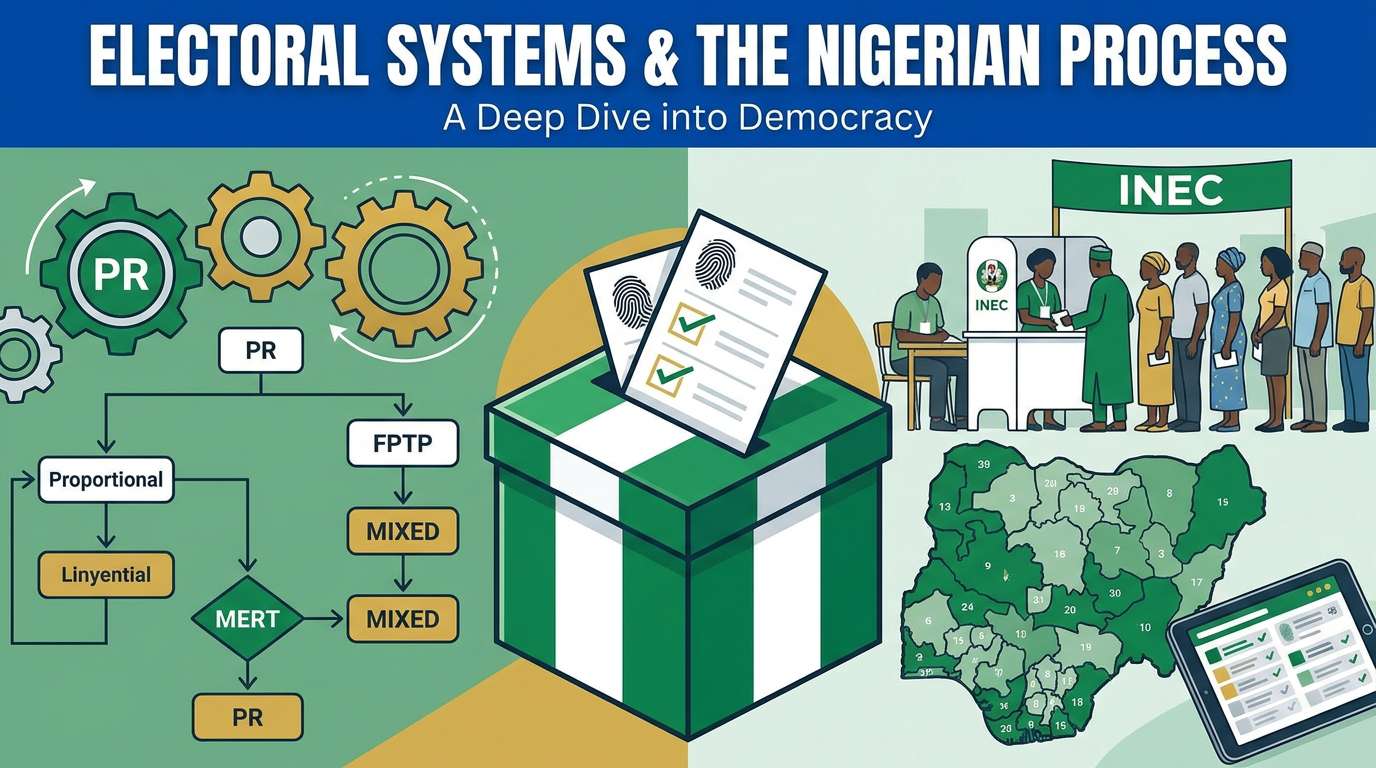
Understanding Elections and the Electoral Process in Nigeria
Introduction
Every few years, tens of millions of Nigerians queue at polling units across the country — sometimes under the early morning sun, sometimes late into the evening — to cast a vote that will help determine who leads their local government, their state, or the entire nation. This process, repeated at scheduled intervals across every level of government, is one of the most visible and important expressions of democracy in action.
Elections are the formal process through which citizens choose their political representatives and leaders. This article explores how elections work in Nigeria in detail — the electoral system used, the institutions responsible for organizing elections, the stages involved in the electoral process, and the genuine challenges that continue to shape Nigerian elections today.
Why Elections Matter in a Democracy
Elections serve several essential functions within a democratic system:
- Legitimizing government, since leaders chosen through a free and fair electoral process are generally recognized as holding genuine authority to govern.
- Providing accountability, since elected officials must periodically return to the electorate, who may choose to re-elect them or select an alternative candidate.
- Enabling peaceful transitions of power, allowing changes in government leadership to occur through an orderly, agreed process rather than through conflict or force.
- Representing the will of the people, translating individual citizen preferences into collective political decisions about who should hold power.
The Independent National Electoral Commission (INEC)
Elections in Nigeria at the federal and state levels are organized and conducted by the Independent National Electoral Commission (INEC), an independent body established under the Constitution specifically to ensure that elections are conducted fairly, transparently, and without improper political interference.
Key responsibilities of INEC include:
- Registering eligible voters and maintaining the national voter register.
- Registering and regulating political parties.
- Organizing and supervising the conduct of elections, including presidential, gubernatorial, and legislative elections.
- Announcing official election results.
- Enforcing compliance with electoral laws and regulations.
A separate body, the State Independent Electoral Commission (SIEC), exists in each state specifically to organize elections at the local government level, distinct from INEC's federal and state-level responsibilities.
Who Can Vote? Voter Eligibility in Nigeria
To be eligible to vote in Nigerian elections, a person must generally meet the following requirements:
- Be a Nigerian citizen.
- Be at least 18 years of age.
- Be registered as a voter with INEC, typically requiring the individual to appear in person during a designated voter registration period and obtain a Permanent Voter's Card (PVC).
- Not be legally disqualified from voting under specific provisions of Nigerian electoral law, such as those affecting individuals found to be of unsound mind or convicted of certain electoral offences.
Who Can Contest? Candidate Eligibility
Different elective offices in Nigeria carry different eligibility requirements, generally set out in the Constitution, including minimum age requirements and educational qualifications. For example, candidates for the office of President or Governor must generally meet a higher minimum age requirement than candidates for certain other elective offices, and all candidates must generally hold at least a specified minimum level of education, in addition to being a Nigerian citizen and a member of a registered political party.
The Electoral System: First-Past-the-Post
Nigeria primarily uses a first-past-the-post (plurality) electoral system for most elections, in which the candidate who receives the highest number of votes in a given constituency or contest wins that election outright, regardless of whether that candidate secured an outright majority (more than 50%) of the total votes cast.
Special Requirements for Presidential Elections
Nigeria's presidential election includes an additional constitutional requirement beyond simply securing the most votes nationally. To be declared the winner, a presidential candidate must secure:
- The highest number of total votes cast nationally, and
- At least one-quarter (25%) of the votes cast in at least two-thirds of all the states in the Federation (including the Federal Capital Territory).
This additional requirement is specifically intended to ensure that a successful presidential candidate demonstrates a genuine, geographically broad base of national support, rather than support concentrated narrowly within only one region of the country. If no candidate meets both conditions, the Constitution provides for a further run-off process between the leading candidates.
The Stages of the Electoral Process
1. Voter Registration
Eligible citizens register with INEC ahead of scheduled election dates, providing biometric data (such as fingerprints) and receiving a Permanent Voter's Card, which is required for voting on election day.
2. Party Primaries
Political parties conduct internal primary elections to select the specific candidates who will represent the party in the general election for a given office.
3. Campaigning
Candidates and parties campaign publicly, presenting their policies and priorities to voters through rallies, media appearances, debates, and other forms of public engagement, within a designated campaign period regulated by INEC.
4. Election Day (Voting)
Registered voters cast their votes at designated polling units, typically using a manual paper ballot process, with voter identity verified through the Permanent Voter's Card and, in recent elections, an electronic Bimodal Voter Accreditation System (BVAS) device used to verify voter fingerprints or facial recognition data before voting.
5. Vote Counting and Collation
Votes are counted publicly at each polling unit immediately after voting closes, with results then transmitted and collated upward — from polling units, to wards, to local government areas, and finally to state and national collation centres — before a final result is officially announced.
6. Declaration of Results
INEC officially declares the winner of each election once collation is complete, and the successful candidate is subsequently sworn into office at the appropriate time specified by law.
7. Post-Election Petitions
Candidates who dispute the conduct or outcome of an election may file a legal petition before an election tribunal, and further appeal through the court system, potentially reaching the Supreme Court in significant cases, particularly presidential election disputes.
Levels of Elections in Nigeria
- Presidential elections, held every four years, to elect the President and Vice President.
- National Assembly elections, to elect members of the Senate and House of Representatives.
- Gubernatorial elections, to elect state Governors and Deputy Governors.
- State House of Assembly elections, to elect members of each state's legislature.
- Local government elections, organized by the State Independent Electoral Commissions, to elect local government chairpersons and councillors.
Challenges Facing Nigerian Elections
Despite significant reforms over successive election cycles, Nigerian elections continue to face a number of genuine, well-documented challenges:
- Electoral violence, including intimidation of voters or election officials in some areas, particularly during periods of heightened political tension.
- Vote buying, where some candidates or their supporters attempt to influence voters through direct financial or material inducements.
- Logistical challenges, including delays in the delivery of voting materials or the late opening of polling units in some locations.
- Technology-related issues, including occasional technical malfunctions affecting biometric verification devices or result transmission systems.
- Disputed results and litigation, with a significant number of election outcomes at various levels routinely challenged before election tribunals and the courts.
- Voter apathy, reflected in relatively low voter turnout in a number of recent elections, sometimes attributed to public distrust in the process or perceived limited impact of voting.
Ongoing Electoral Reforms
In response to some of these challenges, Nigeria has introduced a number of reforms in recent election cycles, including the introduction of biometric voter accreditation technology and efforts to enable more direct electronic transmission of results from polling units, aimed at improving the transparency, accuracy, and credibility of the electoral process.
Elections and WAEC/NECO Government
Key examinable areas of this topic include:
- The role and functions of INEC in organizing and regulating elections.
- Voter and candidate eligibility requirements under Nigerian law.
- The first-past-the-post electoral system, and the special additional requirements for presidential elections.
- The stages of the electoral process, from voter registration through to the declaration of results.
- The different levels of elections conducted in Nigeria.
- Challenges facing Nigerian elections and reforms introduced to address them.
Common Mistakes Students Make
- Assuming a presidential candidate only needs the highest number of votes nationally to win. The additional requirement of at least 25% of votes in two-thirds of the states is a distinct and frequently examined constitutional condition.
- Confusing INEC and SIEC. INEC organizes federal and state-level elections; State Independent Electoral Commissions organize local government elections.
- Describing Nigeria's electoral system as requiring an outright majority (over 50%) to win most elections. Nigeria generally uses a first-past-the-post system for most elections, requiring only the highest number of votes, not necessarily a majority.
- Overlooking the role of party primaries as a distinct and essential stage of the electoral process occurring before the general election itself.
- Assuming all electoral disputes are resolved informally, rather than recognizing the formal, structured role of election tribunals and the court system in resolving post-election petitions.
Conclusion
Elections form the essential mechanism through which Nigerian citizens exercise their democratic right to choose their political leaders, hold elected officials accountable, and participate directly in the governance of their communities, states, and nation. From voter registration and party primaries, through campaigning and voting, to collation, declaration of results, and, where necessary, post-election legal challenges, the electoral process represents a carefully structured — if still evolving and imperfect — system for translating the preferences of millions of individual citizens into legitimate political authority.
Understanding this process in depth — including both its formal legal structure and its genuine, ongoing practical challenges — equips students not just for examination success, but for informed participation in one of the most consequential civic processes they will encounter as adult citizens of Nigeria.