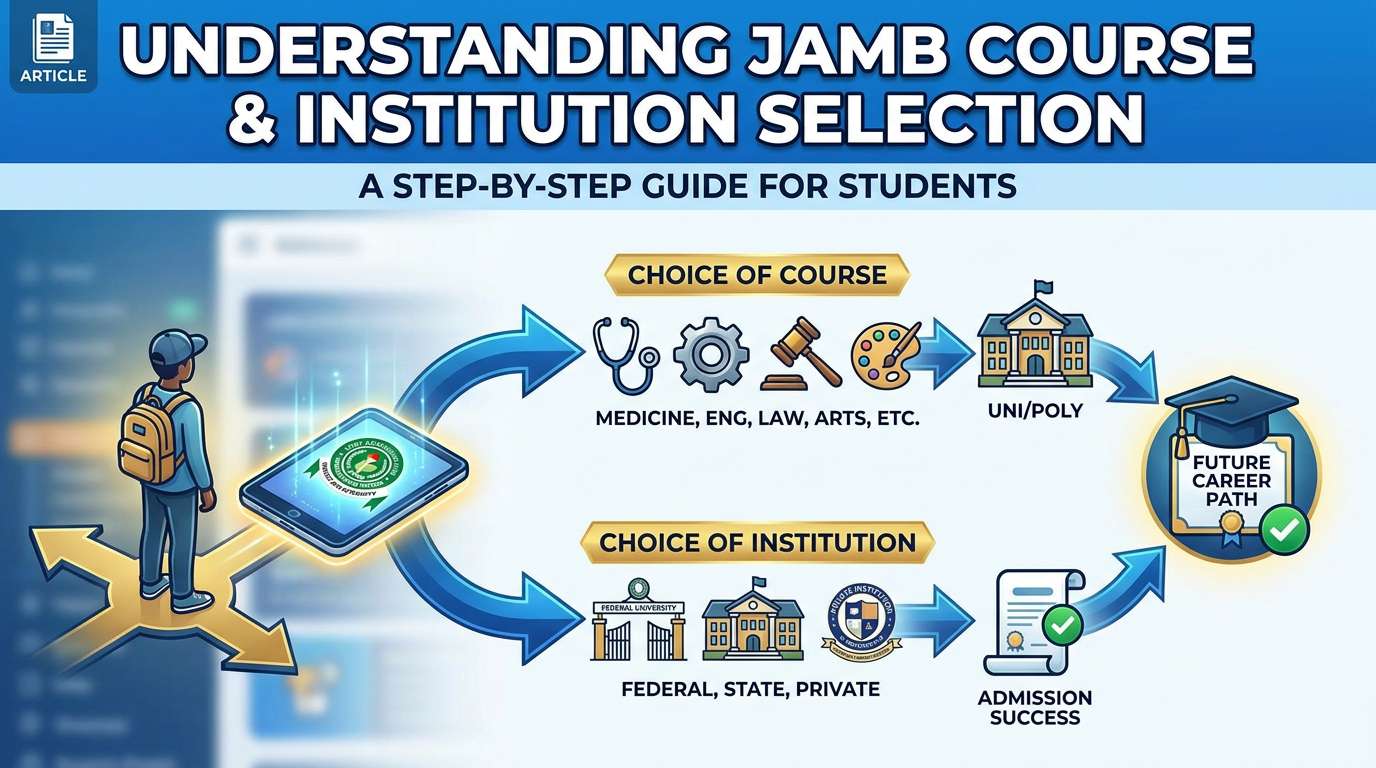
Understanding JAMB Course and Institution Selection
Introduction
For millions of Nigerian students every year, one of the most consequential decisions of their entire academic journey happens quietly, through a series of dropdown menus, during the JAMB (Joint Admissions and Matriculation Board) registration process: selecting a course and institution of choice. Get this selection right, and it opens a clear path toward admission into the course and institution genuinely suited to a student's goals. Get it wrong — through a mismatched subject combination, an unrealistic institutional choice, or a simple technical error — and it can derail admission chances entirely, even for a student who scored well.
This article walks through exactly how JAMB course and institution selection works, the key factors to weigh, and the common mistakes that trip up otherwise well-prepared students every year.
Understanding the UTME Registration Process
The Unified Tertiary Matriculation Examination (UTME), administered by JAMB, is the primary entrance examination required for admission into most Nigerian universities, polytechnics, and colleges of education. During registration, candidates select their intended course of study and up to a limited number of institutions of choice (typically a first and second choice institution), a decision that directly shapes the entire admission process that follows.
Choosing Your Course: Key Considerations
Aligning With Genuine Interest and Strength
As discussed in the companion article on choosing a university course, your JAMB course selection should be grounded in genuine personal interest and academic strength, rather than external pressure or assumptions about prestige alone.
Confirming the Correct Subject Combination
Every course has a specific required UTME subject combination — typically including English Language plus three other specific subjects relevant to that course. Selecting a course without confirming that you are sitting the correct, matching subject combination is one of the most damaging and entirely avoidable errors a candidate can make, since a mismatched combination can result in outright disqualification from that course, regardless of how well a candidate otherwise scored.
For example, a candidate hoping to study Medicine would typically need English Language, Biology, Chemistry, and Physics; a candidate hoping to study Law would typically need English Language, Literature-in-English, and two other relevant subjects, depending on specific institutional requirements. Always confirm the exact required combination directly from official JAMB brochure information or the specific institution's own published requirements, since specific combinations can occasionally vary slightly between institutions for the same general course.
Choosing Your Institution: Key Considerations
Understanding Cut-Off Marks
Each institution, and often each specific course within that institution, sets its own minimum cut-off mark — the minimum UTME score generally required for a candidate to be considered for admission into that specific course. Highly competitive courses at highly competitive institutions, such as Medicine at certain well-established universities, typically carry significantly higher cut-off marks than less competitive courses or institutions.
Being Realistic About Competitiveness
Understanding your own likely UTME performance realistically, based on genuine self-assessment through consistent practice and mock examinations as discussed in the Study Tips section of this resource library, helps inform a realistic institutional choice. Selecting an institution and course combination with cut-off marks significantly above what a candidate is likely to realistically achieve substantially reduces genuine admission chances, regardless of how strongly a candidate might prefer that particular institution.
Considering Institution Type
Nigerian tertiary institutions include federal universities, state universities, private universities, polytechnics, and colleges of education, each with differing admission competitiveness, tuition costs, and specific strengths in particular fields of study. Researching an institution's specific reputation and strength within your intended field of study, rather than relying purely on the institution's overall general reputation, can lead to a more genuinely well-informed choice.
Considering Location and Practical Factors
Practical factors such as an institution's location, accommodation availability, cost of living, and overall campus environment are legitimate and important considerations alongside academic factors, since these practical realities significantly shape a student's actual day-to-day experience throughout their studies.
First Choice vs. Second Choice Institutions
JAMB registration typically allows candidates to select both a first choice and a second choice institution. A common, generally sound strategy involves selecting a slightly more competitive, aspirational first choice institution, alongside a somewhat less competitive, more realistically attainable second choice institution, providing a genuine fallback option if admission to the first choice does not materialize.
The Post-UTME Screening Process
Following the UTME, many Nigerian institutions conduct their own additional post-UTME screening process, which may include a further written examination, an interview, or verification of academic credentials and documents. Performing well on the UTME itself does not automatically guarantee admission — candidates must also generally perform well during any required post-UTME screening process specific to their chosen institution.
Changing Your Course or Institution After Registration
JAMB does provide a formal, officially defined process allowing candidates to request a change of course or change of institution after initial registration, generally available within specific windows announced by JAMB each admission cycle, typically involving an official request submitted directly through JAMB's own platforms. It is important to rely only on JAMB's own official guidance and platforms for this process, rather than unofficial or unverified sources, given the significant number of scams and misinformation that circulate around this particular process each admission cycle.
Understanding O'Level Requirements Alongside UTME
Beyond UTME subject combinations and scores, most institutions also require specific O'Level (WAEC/NECO) credit passes in relevant subjects, typically including a minimum number of credits (commonly five) in subjects relevant to the intended course, including English Language and Mathematics in most cases. Confirming these O'Level requirements alongside UTME subject combination requirements is equally essential, since strong UTME performance alone cannot compensate for missing required O'Level credit passes.
Common Mistakes Candidates Make During Course and Institution Selection
- Selecting a course without confirming the correct, matching UTME subject combination, risking outright disqualification regardless of score.
- Choosing an institution and course combination significantly above realistic cut-off expectations, without a genuinely realistic second choice as a fallback.
- Relying on outdated or unofficial cut-off mark information, rather than confirming current figures directly from JAMB or the specific institution.
- Overlooking O'Level credit requirements while focusing solely on UTME subject combinations and scores.
- Making rushed selections without adequate research, due to registration deadline pressure, rather than planning this decision well in advance.
- Falling for unofficial "change of course" scams, rather than using JAMB's own official, verified channels exclusively for any such request.
Practical Steps for a Well-Informed Selection
- Confirm your intended course's exact UTME subject combination directly from official JAMB information well before registration.
- Research current, official cut-off mark trends for your intended course and institutions of interest.
- Confirm specific O'Level subject and credit requirements for your intended course.
- Select a realistic, well-researched second choice institution alongside your first choice.
- Prepare thoroughly for any anticipated post-UTME screening requirements at your chosen institutions.
- Rely only on JAMB's official platforms and communications for any registration, change of course, or admission-related processes.
JAMB Course and Institution Selection and Career Guidance
Key considerations from this topic include:
- The importance of correct UTME subject combinations for a chosen course.
- Understanding cut-off marks and realistic institutional selection.
- The distinction between UTME and post-UTME screening requirements.
- The formal process for changing course or institution after initial registration.
- The importance of confirming O'Level requirements alongside UTME considerations.
Conclusion
JAMB course and institution selection is a decision that deserves careful, well-informed attention, not rushed, last-minute guessing under registration deadline pressure. Confirming the correct subject combination, researching realistic cut-off marks, understanding post-UTME screening requirements, and relying exclusively on official JAMB information throughout the process together form the foundation of a genuinely well-prepared, strategic approach to this critical stage of a Nigerian student's academic journey.
Getting this process right does not guarantee admission on its own — that still depends significantly on genuine academic preparation and performance — but getting it wrong can undermine even the strongest academic performance through entirely avoidable, technical errors. Approaching this decision with the same careful preparation as the examination itself gives every candidate the strongest possible foundation for a successful admission outcome.