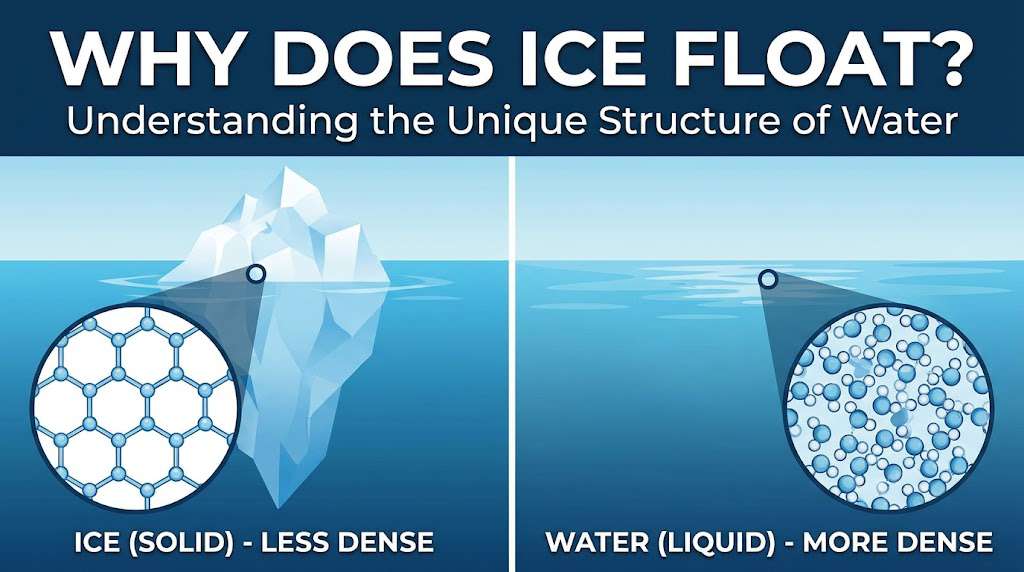
Why Does Ice Float? Understanding the Unique Structure of Water
Introduction
Fill a glass with water, drop in an ice cube, and something quietly strange happens: the solid floats. Nobody questions it — we've all seen it a thousand times. But almost every other substance on Earth behaves the opposite way. Melt a candle, and the solid wax sinks straight to the bottom of the liquid wax. Melt a bar of gold, and solid gold sinks in molten gold. Solids are supposed to be denser than their liquids. Water refuses to follow the rule.
This single exception is not a minor curiosity. It is one of the most consequential facts in all of chemistry — a quirk of molecular geometry that keeps rivers alive through winter, shapes ocean currents, and ultimately makes the planet habitable. To understand it, we need to zoom all the way down to the shape of a single water molecule.
Getting to Know the Water Molecule
Not a Straight Line
A molecule of water — H₂O — is built from one oxygen atom bonded to two hydrogen atoms. If you pictured this as a simple straight line, you would be picturing it wrong. The two hydrogen atoms sit at an angle of roughly 104.5° from each other, giving water molecule a distinct bent, boomerang-like shape. This angle exists because oxygen holds two extra pairs of electrons that aren't involved in bonding — and these lone pairs push the hydrogen atoms together, away from a flat 180° line.
A Molecule With Two Personalities
Oxygen is considerably more electronegative than hydrogen — it has a much stronger pull on shared electrons. Because of this, the electrons in each O–H bond spend more time near the oxygen atom than near the hydrogens. The result is a molecule with slightly mismatched charge: the oxygen end carries a small negative charge (δ⁻), while each hydrogen end carries a small positive charge (δ⁺).
A molecule built this way — with a positive side and a negative side — is called polar. Combine the bent shape with this lopsided charge, and water becomes one of the most strongly polar small molecules in existence. Nearly everything unusual about water traces back to this one fact.
Hydrogen Bonds: Water's Invisible Handshake
Because each water molecule has a positive end and a negative end, neighbouring water molecules are constantly attracted to one another — the positive hydrogen of one molecule reaching toward the negative oxygen of the next. This attraction is called a hydrogen bond.
A single hydrogen bond is weaker than the covalent bonds holding a water molecule together internally, but it's still strong enough to matter enormously. Each water molecule is capable of forming up to four hydrogen bonds simultaneously with its neighbours. Multiply that across trillions of molecules, and you get an enormous, constantly shifting web of connections — one that explains water's high boiling point, its surface tension, and, most dramatically, what happens the moment it freezes.
The Moment Water Turns to Ice
Liquid Water: Close and Constantly Moving
In its liquid state, water molecules have enough thermal energy to slide past one another freely. Hydrogen bonds are forming and breaking many times per second, and because the molecules keep moving, they can pack in fairly close together.
Ice: Locked Into an Open Cage
Cool water down to 0°C, and the molecules lose the energy needed to keep breaking free of their hydrogen bonds. Instead, each molecule settles into a fixed position, hydrogen-bonded to exactly four neighbours in a repeating pattern.
That pattern is a hexagonal lattice — and critically, it is an open structure, full of empty space. Locking water molecules into this rigid honeycomb actually spreads them further apart than they were as a liquid.
Less Mass Packed Into More Space
Density simply means how much mass is squeezed into a given amount of space. Since the hexagonal ice lattice holds its molecules further apart than liquid water does, the same number of water molecules takes up more volume as ice than as liquid. More volume for the same mass means lower density.
Ice ends up roughly 9% less dense than liquid water. That single number explains why about 90% of an iceberg sits silently underwater while only the remaining tenth breaks the surface.
The Strange Case of 4°C
Here's a detail that surprises most people: water is not at its densest right at its freezing point. It's densest at 4°C. As water cools from room temperature down toward 4°C, it behaves the way you'd expect — contracting and growing denser, just like almost any other liquid. But once it dips below 4°C toward 0°C, water starts doing the opposite: it begins to expand slightly, as hydrogen bonds start arranging molecules into the more spread-out clusters that will eventually become the full ice lattice.
So liquid water is actually heaviest — for a given volume — at 4°C, a detail with major consequences for anything that lives in cold water.
Why This One Anomaly Matters So Much
Lakes Freeze From the Surface Down
Because ice is lighter than liquid water, it floats on top of lakes and rivers instead of sinking. As a lake cools through winter, water below 4°C rises toward the surface, and it's this surface layer that eventually freezes solid.
That floating ice sheet then acts like an insulating lid, slowing further heat loss from the water trapped beneath it. Underneath the ice, liquid water hovers around 4°C for the entire winter — cold, but very much alive.
A Refuge for Life Beneath the Ice
Imagine, for a moment, that ice sank instead of floating. Lakes would freeze from the bottom upward, and given enough cold weather, they would eventually freeze solid all the way through, wiping out fish and every other creature living inside. Because ice floats, that never happens — the liquid layer beneath the frozen surface stays open, giving aquatic life a place to survive the coldest months.
Shaping Climate on a Planetary Scale
The same principle scales up dramatically at the poles. Floating polar ice caps insulate the oceans beneath them and bounce sunlight back into space, helping regulate Earth's overall temperature. The very same density differences also help drive deep ocean currents, which move heat around the globe and shape regional climates far from where that heat originated.
Other Everyday Effects of Hydrogen Bonding
- An unusually high boiling point: Water boils at 100°C, far higher than similarly sized molecules — hydrogen sulphide (H₂S) boils at −60°C — simply because so much energy is needed to break apart water's extensive hydrogen bond network.
- Strong surface tension: Hydrogen bonds pull surface molecules inward, creating a thin, elastic "skin" strong enough to support the weight of a pond skater walking across it.
- A powerful solvent: Water's polarity lets it surround and dissolve a huge range of ionic and polar substances, earning it the nickname "the universal solvent" — and making it essential to biology.
- High heat capacity: Breaking hydrogen bonds absorbs a lot of energy before water's temperature rises noticeably, which is why large lakes and oceans moderate the climate of the land around them.
Water Chemistry and WAEC/JAMB Chemistry
- Bonding: Explaining the covalent O–H bonds within a water molecule and the hydrogen bonds that form between separate molecules.
- Shape and polarity: Describing water's bent molecular shape and linking it, along with electronegativity, to its polar nature.
- Anomalous expansion of water: A regularly tested topic — students should be able to explain, in their own words, why water expands rather than contracts as it freezes.
- Density calculations: Applying density = mass ÷ volume to compare ice and liquid water, or to explain floating and sinking more generally.
- Properties of water: Connecting hydrogen bonding to water's high boiling point, high specific heat capacity, and solvent behaviour.
Common Mistakes Students Make
- Mixing up hydrogen bonds and covalent bonds. The O–H bonds inside one water molecule are covalent. Hydrogen bonds form between separate molecules and are considerably weaker.
- Describing ice as "lighter" than water. A large block of ice weighs more than a small glass of water. What's actually true is that ice is less dense — the same mass simply takes up more space.
- Assuming density keeps increasing all the way to 0°C. In reality, water's maximum density occurs at 4°C; between 4°C and 0°C it actually starts expanding again.
- Explaining polarity using electronegativity alone. A complete explanation needs both the electronegativity difference between oxygen and hydrogen and the bent shape of the molecule — a straight-line version of the same atoms would largely cancel out the polarity.
Conclusion
An ice cube floating in a glass looks almost too ordinary to notice — but it's one of chemistry's quietest miracles. A single bent molecule, mildly lopsided in charge, forms a web of hydrogen bonds that locks into an unusually open lattice the moment it freezes, leaving ice lighter than the water it came from.
Without that one anomaly, lakes would freeze solid from the bottom up each winter, wiping out the life inside them, and the layered ocean temperatures that steer global climate would look entirely different. So the next time an ice cube bobs to the surface of your drink, know that you're watching one of the small, essential rules that keeps the natural world running.