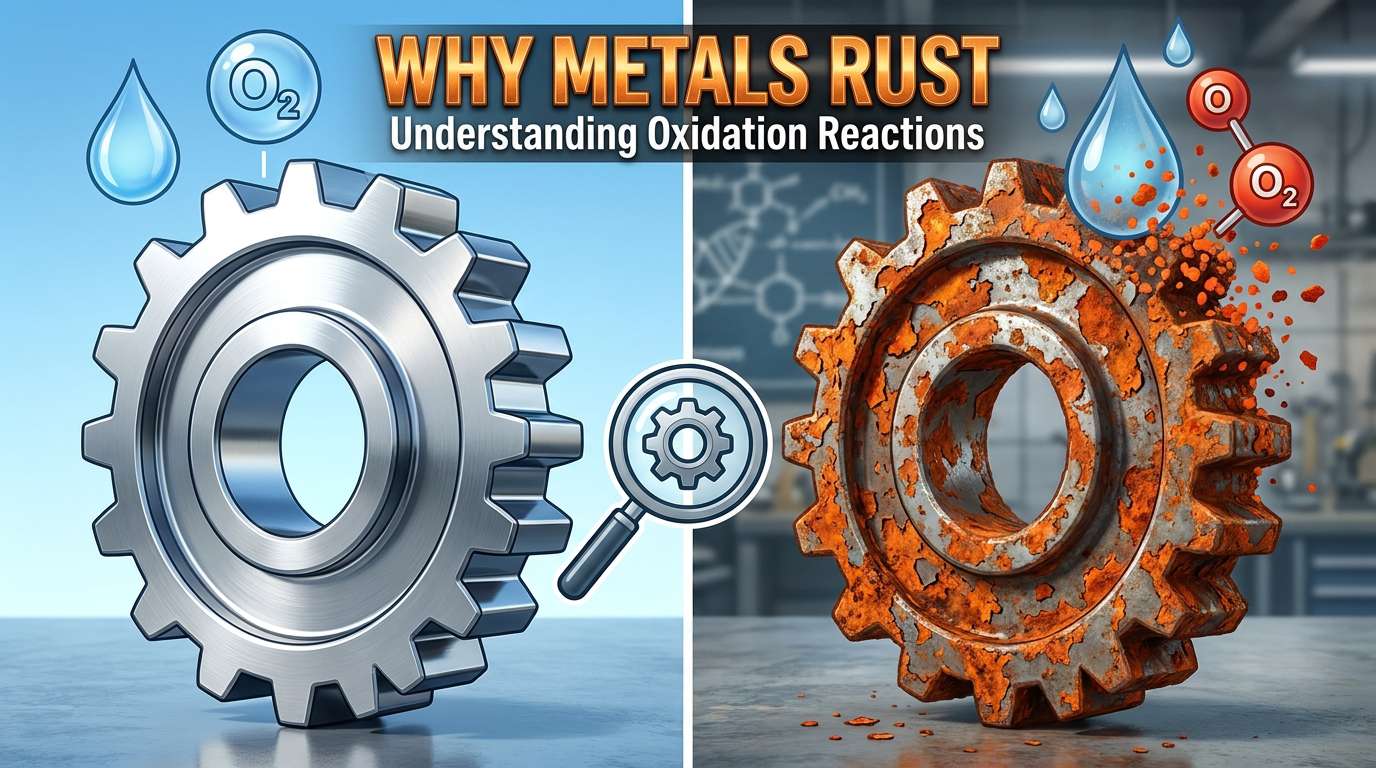
Why Metals Rust: Understanding Oxidation Reactions
Introduction
Leave an iron nail outside for a few weeks and something happens to it that never happens to a piece of plastic or glass left in the same spot. A reddish-brown flaky layer forms on its surface, and if you leave it long enough, the entire nail can crumble away to almost nothing. This is rust — and it is not simple dirt or decay. It is a genuine chemical reaction, quietly rewriting the identity of the metal atom by atom.
Understanding rust means understanding one of the most important classes of reactions in all of chemistry: oxidation. Once you see what is actually happening at the atomic level, rust stops looking like simple wear and tear and starts looking like exactly what it is — electrons changing hands.
What Is Rust, Chemically?
Rust is not pure iron oxide. It is more precisely described as hydrated iron(III) oxide, with the chemical formula Fe₂O₃·nH₂O, where "n" represents a variable number of water molecules bound within its structure.1 The reddish-brown, flaky substance we recognise as rust is a mixture of iron oxides and iron oxide-hydroxides containing water, distinct from pure, dry iron oxide compounds.2
The Two Essential Ingredients: Oxygen and Water
Rusting is not simply "iron reacting with air." It requires two things at once: oxygen and water (or moisture). Rust does not form in fully dry air, even if oxygen is present, and it does not form in water that has had all oxygen removed.3 Both must be present together for the reaction to proceed.
Oxidation and Reduction: The Redox Reaction at the Heart of Rust
Rusting is an example of a redox reaction — a reaction in which one substance loses electrons (oxidation) while another substance gains electrons (reduction), happening simultaneously.4
The Anodic Reaction: Iron Loses Electrons
At certain points on the iron's surface, called anodic sites, iron atoms lose two electrons each, becoming positively charged iron(II) ions:5
Fe(s) → Fe²⁺(aq) + 2e⁻
This loss of electrons is the oxidation step, and it is why oxygen is described as the oxidising agent in this reaction, while iron acts as the reducing agent.6
The Cathodic Reaction: Oxygen Gains Electrons
Meanwhile, at nearby cathodic sites on the same piece of metal, oxygen dissolved in the surrounding water gains those released electrons and combines with water to form hydroxide ions:5
O₂(g) + 2H₂O(l) + 4e⁻ → 4OH⁻
Iron Is Its Own Conductor
Remarkably, the oxidation and reduction steps of rusting occur at separate locations on the same piece of metal. This is possible because iron itself is electrically conductive, allowing electrons released at the anodic site to travel through the metal to the cathodic site where oxygen is waiting to receive them.7 In effect, a rusting nail behaves like a tiny, short-circuited electrochemical cell, with iron acting as both electrode and conducting wire.7
From Iron Ions to Rust: The Full Sequence
Once the iron(II) ions and hydroxide ions are both present in the surrounding water, they combine to form iron(II) hydroxide, a greenish precipitate:4
Fe²⁺ + 2OH⁻ → Fe(OH)₂
This iron(II) hydroxide is then further oxidised by dissolved oxygen, converting it into iron(III) hydroxide.8 Finally, the iron(III) hydroxide undergoes dehydration — losing some of its water content — to form the hydrated iron(III) oxide that we recognise as the familiar reddish-brown flaky rust on the metal's surface.8
The overall simplified equation for rusting is often written as:
4Fe + 3O₂ + 6H₂O → 4Fe(OH)₃
which then dehydrates to form Fe₂O₃·H₂O — rust.4
Why Rust Flakes Off Instead of Protecting the Metal
Some metals, like aluminium, form a thin oxide layer that tightly bonds to the surface and actually protects the metal underneath from further reaction. Iron does not share this advantage. Rust molecules take up considerably more volume than the original iron metal they replaced.2 Because the new rust layer doesn't fit neatly into the same space as the metal it came from, it becomes loose, porous, and flaky, and eventually falls away rather than forming a protective seal.9
This flaking is what makes rusting so destructive over time: each time a layer of rust falls away, it exposes a fresh layer of iron underneath, ready to rust all over again.9 Left unchecked, an iron object can eventually rust away almost entirely, layer by layer, until nothing structurally sound remains.
Factors That Speed Up Rusting
- Salt and other electrolytes: Salty water conducts electricity far better than pure water, which dramatically accelerates the electrochemical process of rusting.10 This is why cars and metal structures near coastal areas typically rust much faster than those inland.
- Acidity: Acidic water similarly improves the movement of ions involved in the reaction, speeding up rust formation.10
- Higher temperatures: Like most chemical reactions, rusting proceeds faster at higher temperatures.1
- Contact between dissimilar metals: When two different metals are in contact in the presence of moisture, a phenomenon called galvanic corrosion can significantly accelerate rusting of the more reactive metal.1
How Chemistry Helps Us Prevent Rust
Because rusting absolutely requires both oxygen and water together, most methods of rust prevention work by blocking one or both of these from reaching the iron surface:
- Painting or coating: A layer of paint, oil, or grease creates a physical barrier that keeps oxygen and moisture away from the metal surface.
- Galvanising: Coating iron with a layer of zinc protects the iron because zinc is more reactive and corrodes preferentially, sacrificially protecting the iron underneath.
- Alloying: Combining iron with other elements, such as chromium in stainless steel, produces a thin, tightly bonded, protective oxide layer that resists further corrosion — unlike ordinary rust.
- Keeping metal dry: Since rust cannot form without both oxygen and water, simply keeping metal objects dry can dramatically slow the rusting process.
Rusting and WAEC/JAMB Chemistry
- Redox reactions: Identifying oxidation as electron loss and reduction as electron gain, using rusting as a real-world example.
- Conditions necessary for rusting: Explaining why both oxygen and water are required, and predicting whether rusting will occur under given conditions.
- Chemical formula of rust: Writing and interpreting the formula Fe₂O₃·xH₂O.
- Methods of rust prevention: Describing painting, galvanising, greasing, and alloying as practical corrosion-prevention methods.
- Electrochemical concepts: Understanding anodic and cathodic reactions as an introduction to electrochemistry more broadly.
Common Mistakes Students Make
- Saying iron rusts in air alone. Dry air, without moisture, does not cause rusting — both oxygen and water are essential.
- Confusing oxidation and reduction. In rusting, iron is oxidised (loses electrons) and oxygen is reduced (gains electrons) — mixing up which substance does which is a very common examination error.
- Believing rust protects the metal underneath. Unlike some other metal oxides, rust is porous and flakes away, continually exposing fresh metal to further corrosion.
- Writing an incomplete or unbalanced equation. The overall equation for rusting must be properly balanced and should reflect that water is incorporated into the final hydrated product, not just iron and oxygen alone.
Conclusion
Rust looks like slow, quiet decay, but underneath it is a fully-fledged electrochemical reaction — iron atoms surrendering electrons to oxygen, in the presence of water, one atom at a time. Understanding oxidation and reduction turns rust from a mundane household nuisance into a vivid, visible demonstration of redox chemistry happening in real time, on railings, car bodies, and old iron gates everywhere.
And once you understand exactly why iron rusts, you also understand exactly how to stop it — by cutting the reaction off from one of the two ingredients, oxygen or water, that it absolutely cannot do without.